Results by title
11 books match the query 'Paraguay'
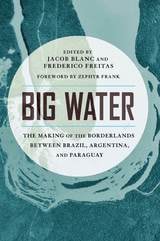
Big Water
The Making of the Borderlands Between Brazil, Argentina, and ParaguayEdited by Jacob Blanc and Frederico Freitas; Foreword by Zephyr Frank
University of Arizona Press, 2018
From the Jesuit reductions in the seventeenth century to the flows of capital and goods accelerated by contemporary trade agreements, the Triple Frontier region has proven fundamental to the development of Brazil, Argentina, and Paraguay, as well as to the Southern Cone and South America itself. Although historians from each of these three countries have tended to construct narratives that stop at their respective borders, the contributors call for a reinterpretation that goes beyond the material and conceptual boundaries of the Triple Frontier. In offering a transnational approach, Big Water helps transcend nation-centered blind spots and approach new understandings of how space and society have developed throughout Latin America.
These essays complicate traditional frontier histories and balance the excessive weight previously given to empires, nations, and territorial expansion. Overcoming stagnant comparisons between national cases, the research explores regional identity beyond border and geopolitical divides. Thus, Big Water focuses on the uniquely overlapping character of the Triple Frontier and emphasizes a perspective usually left at the periphery of national histories.
Contributors
Shawn Michael Austin
Jacob Blanc
Bridget María Chesterton
Christine Folch
Zephyr Frank
Frederico Freitas
Michael Kenneth Huner
Evaldo Mendes da Silva
Eunice Sueli Nodari
Graciela Silvestri
Guillermo Wilde
Daryle Williams
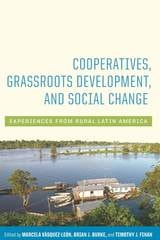
Cooperatives, Grassroots Development, and Social Change
Experiences from Rural Latin AmericaEdited by Marcela Vásquez-León, Brian J. Burke, and Timothy J. Finan
University of Arizona Press, 0
Cooperatives, Grassroots Development, and Social Change presents examples from Paraguay, Brazil, and Colombia, examining what is necessary for smallholder agricultural cooperatives to support holistic community-based development in peasant communities. Reporting on successes and failures of these cooperative efforts, the contributors offer analyses and strategies for supporting collective grassroots interests. Illustrating how poverty and inequality affect rural people, they reveal how cooperative organizations can support grassroots development strategies while negotiating local contexts of inequality amid the broader context of international markets and global competition.
The contributors explain the key desirable goals from cooperative efforts among smallholder producers. They are to provide access to more secure livelihoods, expand control over basic resources and commodity chains, improve quality of life in rural areas, support community infrastructure, and offer social spaces wherein small farmers can engage politically in transforming their own communities.
The stories in Cooperatives, Grassroots Development, and Social Change reveal immense opportunities and challenges. Although cooperatives have often been framed as alternatives to the global capitalist system, they are neither a panacea nor the hegemonic extension of neoliberal capitalism. Through one of the most thorough cross-country comparisons of cooperatives to date, this volume shows the unfiltered reality of cooperative development in highly stratified societies, with case studies selected specifically because they offer important lessons regarding struggles and strategies for adapting to a changing social, economic, and natural environment.
Contributors:
Luis Barros
Brian J. Burke
Charles Cox
Luis Alberto Cuéllar Gómez
Miguel Ricardo Dávila Ladrón de Guevara
Elisa Echagüe
Timothy J. Finan
Andrés González Aguilera
Sonia Carolina López Cerón
Joana Laura Marinho Nogueira
João Nicédio Alves Nogueira
Jessica Piekielek
María Isabel Ramírez Anaya
Rodrigo F. Rentería-Valencia
Lilliana Andrea Ruiz Marín
Marcela Vásquez-León
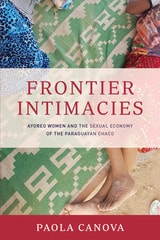
Frontier Intimacies
Ayoreo Women and the Sexual Economy of the Paraguayan ChacoBy Paola Canova
University of Texas Press, 2020
Until the 1960s, the Ayoreo people of Paraguay's Chaco region had remained uncontacted by the world. But as development encroached on their territory, the Ayoreo began to experience rapid cultural change. Paola Canova looks at one aspect of this change in Frontier Intimacies: the sexual practices of Ayoreo women, specifically the curajodie, or single women who exchange sex for money or material goods with non-Ayoreo men, often Mennonite settlers.
Weaving personal anecdotes into her extensive research, Canova shows how the advancement of economic and missionary frontiers has reconfigured gender roles, sexual ethics, and notions of desire in the region. Ayoreo women, she shows, have reappropriated their sexual practices, approaching intimate liaisons on their own terms and seeing the involvement of money not as morally problematic but as constitutive of sexual encounters. By using their sexuality to construct an intimate frontier operating according to their own logics, Canova reveals, Ayoreo women expose the fractured workings of frontier capitalism in spaces of rapid transformation. Inviting broader examination of the ways in which contemporary frontier economies are constructed and experienced, Frontier Intimacies brings a captivating new perspective to the economic development of the Chaco region.

Guerrilla Auditors
The Politics of Transparency in Neoliberal ParaguayKregg Hetherington
Duke University Press, 2011
Paraguay and the Triple Alliance
The Postwar Decade, 1869-1878By Harris Gaylord Warren
University of Texas Press, 1978
In the War of the Triple Alliance—the most terrible conflict in South American history—Paraguay was almost annihilated by the armed forces of Brazil, Argentina, and Uruguay. The chaotic postwar decade began with the Allied occupation of Asunción, which lasted seven years, and was marked by Brazilian-Argentine rivalry and interference in Paraguayan affairs and by the efforts of Paraguay’s governments to revive their stricken land, efforts often thwarted by corruption, factionalism, and revolutions. It ended with the arbitral award eliminating Argentina as a claimant to the Chaco Boreal and with the ascendancy of the Colorado Party, which dominated Paraguayan politics for most of the next century.
This is the first book in any language that examines political, economic, and social developments to provide a well-integrated study of this significant and eventful period. It is based on archival resources, largely unused before, in England, the United States, Brazil, Argentina, and Paraguay, as well as on newspapers, books, pamphlets, and published documents in many libraries. As one historian has said, the study is “a masterpiece of sleuthing and historical synthesis.” It will be of interest not only to students of Paraguay but also to those concerned with Brazilian, Argentine, and Latin American history.
Prophets of Agroforestry
Guaraní Communities and Commercial GatheringBy Richard K. Reed
University of Texas Press, 1995
For almost four centuries, the indigenous Chiripá (Guaraní) people of eastern Paraguay have maintained themselves as a distinct society and culture, despite continual and often intense relations with Paraguayan society and the international economy. In this study, Richard K. Reed explores the economic and social basis for this ethnic autonomy.
Reed finds that Chiripá economic power derives from their practice of commercial agroforestry. Unlike Latin American indigenous societies that have been forced to clear land for commercial agriculture, the Chiripá continue to harvest and sell forest products, such as caffeinated yerba mate, without destroying the forests. Reed also explores the relation of this complex economy to Chiripá social organization and shows how flexible kin ties allowed the Chiripá to adapt to the pressure and opportunities of the commercial economy without adopting the authoritarian nature of rural Paraguayan society.
These findings offer important insights into the relations among indigenous groups, nation-states, and the international economy. They also provide a timely alternative model for sustainable management of subtropical forests that will be of interest in the fields of development and environmental studies.
Storytelling Globalization from the Chaco and Beyond
Mario Blaser
Duke University Press, 2010
The Government of Beans
Regulating Life in the Age of MonocropsKregg Hetherington
Duke University Press, 2020
The Paraguay Reader
History, Culture, PoliticsPeter Lambert and Andrew Nickson, eds.
Duke University Press, 2013
Most of the Reader is arranged chronologically. Weighted toward the twentieth century and early twenty-first, it nevertheless gives due attention to major events in Paraguay's history, such as the Triple Alliance War (1864–70) and the Chaco War (1932–35). The Reader's final section, focused on national identity and culture, addresses matters including ethnicity, language, and gender. Most of the selections are by Paraguayans, and many of the pieces appear in English for the first time. Helpful introductions by the editors precede each of the book's sections and all of the selected texts.
The Rise and Fall of the Paraguayan Republic, 1800–1870
By John Hoyt Williams
University of Texas Press, 1979
Paraguay plays a very small role in the modern world, but for part of the nineteenth century it was a significant regional force. Between 1800 and 1865 it changed from an imperial backwater into a dynamic, dictator-led, financially sound nation. Then came the terrible War of the Triple Alliance, and by 1870 Paraguay had virtually been destroyed.
John Hoyt Williams re-creates the era’s people, places, and events in rich detail and a vigorous style, but this is much more than a mere narrative. His archival research in Paraguay and several other countries enables him to offer new facts and interpretations, correct a number of misapprehensions, and explode a few myths.
He also provides the clearest, most objective portraits available of the three extraordinary men who ruled Paraguay during this time: Dr. José Gaspar de Francia, “El Supremo”; Carlos Antonio López, “the Corpulent Despot”; and López’s flamboyant son Francisco Solano López. Discussions of social, economic, and cultural conditions round out a masterly account of a remarkable historical period.

The Shrinking Jungle
Kevin T. Jones
University of Utah Press, 2012
Anthropologist Kevin Jones takes the reader on a journey into the world of the Aché, hunter-gatherers of the deep jungles of Paraguay. The Aché were among the last tribal peoples to come into peaceful contact with the outside world, with some bands leaving the forest only in the late 1970s. Jones was fortunate to live among them while conducting ethnoarchaeological fieldwork as part of his graduate studies. Their stories were so compelling and the insights into their lives so profound that he wove them into this fictional account, seeking to share the uniqueness of the culture while illustrating the universal nature of the Achés’ concerns.
The Shrinking Jungle tells the story of a fictional Aché band forced to deal with the tribulations of living in a forest gradually diminished by the encroachments of loggers and farmers. It follows the lives of one family and their band as they grapple for existence in a world of waning resources. The unfolding narrative captures the human struggle to live, love, care for family, fend off danger, and dream and hope for a bright future.
A compassionate look at the lives of people affected by the expansion of modern industrial society, The Shrinking Jungle gives a face to the human cost of tropical forest habitat loss. It also provides a realistic glimpse into the lifeways that were common to all human beings for much of our history.