Results by title

7 books match the query 'Paravisini-Gebert, Lizabeth'
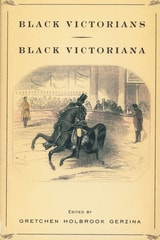
cover of Black Victorians / Black Victoriana

Black Victorians / Black Victoriana

Edited by Gretchen Holbrook Gerzina

Rutgers University Press, 2003

Black Victorians/Black Victoriana is a welcome attempt to correct the historical record. Although scholarship has given us a clear view of nineteenth-century imperialism, colonialism, and later immigration from the colonies, there has for far too long been a gap in our understanding of the lives of blacks in Victorian England. Without that understanding, it remains impossible to assess adequately the state of the black population in Britain today. Using a transatlantic lens, the contributors to this book restore black Victorians to the British national picture. They look not just at the ways blacks were represented in popular culture but also at their lives as they experienced them—as workers, travelers, lecturers, performers, and professionals. Dozens of period photographs bring these stories alive and literally give a face to the individual stories the book tells.

The essays taken as a whole also highlight prevailing Victorian attitudes toward race by focusing on the ways in which empire building spawned a "subculture of blackness" consisting of caricature, exhibition, representation, and scientific racism absorbed by society at large. This misrepresentation made it difficult to be both black and British while at the same time it helped to construct British identity as a whole. Covering many topics that detail the life of blacks during this period, Black Victorians/Black Victoriana will be a landmark contribution to the emergent field of black history in England.
[more]
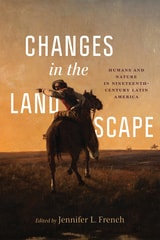
cover of Changes in the Landscape: Humans and Nature in Nineteenth-Century Latin America

Changes in the Landscape

Humans and Nature in Nineteenth-Century Latin America

Edited by Jennifer L. French

Vanderbilt University Press, 2024

Changes in the Landscape is a collection of timely essays that bring the methodologies and commitments of ecocriticism to bear on the study of Latin American literature and cultural production. The book’s eleven chapters, written by some of the leading voices in the field, invite readers to consider how the relationship between humans and nonhuman nature was fundamentally transformed during a period when new modes of capitalist production were emerging in the region and around the world. Jennifer L. French’s introductory essay provides a historical and theoretical framework for the collection.

Ranging from the immediate aftermath of the Spanish‑American Wars of Independence (1810–1826) to the early twentieth century (1925), the volume’s essays cover a wide variety of genres and forms of cultural production, from José Hernández’s epic poem Martín Fierro to prose fiction, painting and photography, and the personal albums compiled by Spanish-American women. Individually and collectively, the essays engage with scientific writing as both a discourse of power and a source of potentially significant, even revelatory information about human and nonhuman nature. Changes in the Landscape enables readers to more fully understand the transition from colonial regimes to the ecocidal extractivism of the export boom (1870–1930) by drawing out and analyzing some of the cognitive resources and rhetorical strategies that were available to imagine, protest, or enact new norms and expectations regarding the relations between human and nonhuman life, be it the life of wildflowers, waterfalls, or Cuba’s Ciénaga de Zapata.
[more]
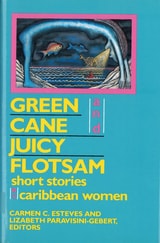
cover of Green Cane and Juicy Flotsam: Short Stories by Caribbean Women

Green Cane and Juicy Flotsam

Short Stories by Caribbean Women

Esteves, Carmen C

Rutgers University Press, 1991

This collection of short stories features moving tales from the rich Caribbean oral tradition, stories that question women's traditional roles, present women's perspectives on the history of Caribbean slavery and colonialism, and convey the beautiful cadences of the language of Caribbean women. It offers the general reader a broad selection of the themes, styles, and techniques characteristic of contemporary women's fiction in the Caribbean. There are twenty-seven enjoyable and vibrant tales in this anthology, some of them originally written in English, others in French, Dutch, and Spanish. There are writers from Guadeloupe, Dominica, Jamaica, Trinidad, Puerto Rico, Martinique, Antigua, Haiti, Cuba, the Dominican Republic, and Surinam. Along with stories by well-known writers such as Jean Rhys, Jamaica Kincaid, Michelle Cliff, Maryse Conde, and Rosario Ferre, the anthology also includes first-rate stories by lesser-known but equally talented writers. The collection also contains a critical introduction, biographical notes, and a bibliography.
[more]
cover of Phyllis Shand Allfrey: A Caribbean Life

Phyllis Shand Allfrey

A Caribbean Life

Paravisini-Gebert, Lizabeth

Rutgers University Press, 1996
Phyllis Shand Allfrey is the first biography of one of the Caribbean's most intriguing writers and politicians. Allfrey (1908-1986) is best known as the author of The Orchid House, a fictionalized account of her early life that was turned into a highly acclaimed film for British television. Born to a prominent family of formerly wealthy sugar planters in Dominica, Allfrey followed an unexpected path: a rising novelist (who is often paired with Jean Rhys in critical discussion) and Fabian socialist in England and the United States, she returned to Dominica to organize the peasantry and estate workers into the island's first political party. Ostracized by the white elite into which she was born, she led the Dominica Labour party to power and became the West Indian Federation's only woman (and only white) minister, only to find herself expelled from the party when the rise of black nationalism made it expedient. The biography recreates Allfrey's life as it unfolds against the background of twentieth-century Caribbean political and literary history, from the decline of the planter class through the rise of party politics and the efforts to join the anglophone West Indies into a federation, to the troubled sixties and seventies, decades marked by racial violence and the emergence of the former British territories from colonial control. This volume includes five autobiographical stories that have long been out of print.
[more]
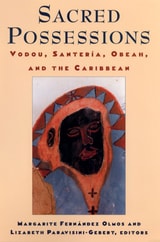
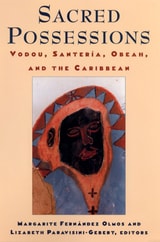
cover of Sacred Possessions: Vodou, Santería, Obeah, and the Caribbean

Sacred Possessions

Vodou, Santería, Obeah, and the Caribbean

Olmos, Margarite Fernândez

Rutgers University Press, 1997

Sacred Possessions is an unprecedented collection of thirteen comparative and interdisciplinary essays exploring the cross-cultural dynamics of African-based religious systems in the Caribbean. The contributors analyze the nature and liturgies of Vodou, Santeria, Obeah, Quimbois, and Gaga as they form one central cultural matrix in the region. They ask how these belief systems were affected by differing colonial histories and landscapes, and how they affected other cultural expressions (from the oral tradition to popular art and literature), and how they have been perceived and (mis)represented by the West.

The book is a unique contribution to the study of the Caribbean as a site of multiculturalism, demonstrating the linkages between anthropology, religion, literature, and popular culture. Also included are a stunning photoessay on Cuban Santeria, a glossary of terms, and an insightful introduction by the editors.
[more]
cover of Sacred Possessions: Vodou, Santería, Obeah, and the Caribbean

Sacred Possessions

Vodou, Santería, Obeah, and the Caribbean

Olmos, Margarite Fernândez

Rutgers University Press, 1997

Sacred Possessions is an unprecedented collection of thirteen comparative and interdisciplinary essays exploring the cross-cultural dynamics of African-based religious systems in the Caribbean. The contributors analyze the nature and liturgies of Vodou, Santeria, Obeah, Quimbois, and Gaga as they form one central cultural matrix in the region. They ask how these belief systems were affected by differing colonial histories and landscapes, and how they affected other cultural expressions (from the oral tradition to popular art and literature), and how they have been perceived and (mis)represented by the West.

The book is a unique contribution to the study of the Caribbean as a site of multiculturalism, demonstrating the linkages between anthropology, religion, literature, and popular culture. Also included are a stunning photoessay on Cuban Santeria, a glossary of terms, and an insightful introduction by the editors.
[more]
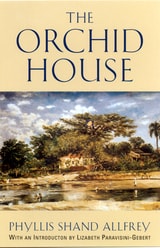
cover of The Orchid House

The Orchid House

Allfrey, Phyllis Shand

Rutgers University Press, 1996

Lally helps to raise three white sisters in the Orchid House on the Island of Dominica and observes as each flees to the cold northern lands of England and America only to return to their magical past and the man they love.
[more]