Results by title
2 books match the query 'Paredez, Deborah'
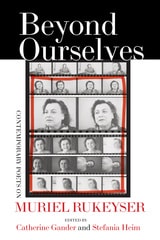
Beyond Ourselves
Contemporary Poets on Muriel RukeyserCatherine Gander
West Virginia University Press, 2026
Muriel Rukeyser has many faces: poet, biographer, theorist, playwright, novelist, story-writer, filmmaker, translator, ethnographer, and innovator of social, documentary poetics; feminist, queer, Jewish, single mother, and social justice activist. Yet above all, she was a poet. Threaded through her work, politics, and life was the conviction that poetry is an animating force that connects people and disciplines. Recent years have seen a surge of renewed interest in Rukeyser’s work, bringing her back into public consciousness as a crucial voice on the relations between poetry and social life in America and beyond.
Beyond Ourselves is the first volume of its kind to comprehensively consider the continued urgency and lasting legacy of Rukeyser’s work as a key source and inspiration for poets working today. Volume editors Catherine Gander and Stefania Heim—both scholars and poets—have gathered critical and creative contributions from some of the most innovative, exciting, and socially engaged poets writing today. In lyric and braided essays, scholarly critique, hybrid investigations, documentary collages, and collaborative poetry, these poets dive deeply into Muriel Rukeyser’s work and life to interrogate, explore, and challenge the models she provides for thinking and writing in our own social, political, and poetic moment. These essays address a range of themes, from the transhistorical politics of motherhood and contemporary relational and feminist poetics of war to communal history via documentary film and the possibilities of coalition-building beyond borders. As in Rukeyser’s own work, the forms of these texts animate their inquiries.
Beyond Ourselves is a volume at the intersections of creative and critical thought, reflecting on how Rukeyser’s expansive body of work offers a vision for, as she writes, “a kind of imagination with which to meet the world.”
Contributors: Daniel Borzutzky, Susan Briante, Catherine Gander, Stacy Hardy, Stefania Heim, Erika Meitner, Philip Metres, Jena Osman, Deborah Paredez, Khadijah Queen, Solmaz Sharif, and Nomi Stone.

Selenidad
Selena, Latinos, and the Performance of MemoryDeborah Paredez
Duke University Press, 2009
Paredez argues that Selena’s death galvanized Latina/o efforts to publicly mourn collective tragedies (such as the murders of young women along the U.S.-Mexico border) and to envision a brighter future. At the same time, reactions to the star’s death catalyzed political jockeying for the Latino vote and corporate attempts to corner the Latino market. Foregrounding the role of performance in the politics of remembering, Paredez unravels the cultural, political, and economic dynamics at work in specific commemorations of Selena. She analyzes Selena’s final concert, the controversy surrounding the memorial erected in the star’s hometown of Corpus Christi, and the political climate that served as the backdrop to the touring musicals Selena Forever and Selena: A Musical Celebration of Life. Paredez considers what “becoming” Selena meant to the young Latinas who auditioned for the biopic Selena, released in 1997, and she surveys a range of Latina/o queer engagements with Selena, including Latina lesbian readings of the star’s death scene and queer Selena drag. Selenidad is a provocative exploration of how commemorations of Selena reflected and changed Latinidad.