Results by title
5 books match the query 'Parody'
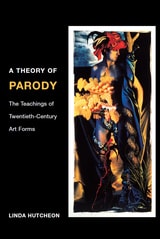
A Theory of Parody
The Teachings of Twentieth-Century Art FormsLinda Hutcheon
University of Illinois Press, 1985
Hutcheon identifies parody as one of the major forms of modern self-reflexivity, one that marks the intersection of invention and critique and offers an important mode of coming to terms with the texts and discourses of the past. Looking at works as diverse as Tom Stoppard's Rosenkrantz and Guildenstern Are Dead, Brian de Palma's Dressed to Kill, Woody Allen's Zelig, Karlheinz Stockhausen's Hymnen, James Joyce's Ulysses, and Magritte's This Is Not a Pipe, Hutcheon discusses the remarkable range of intent in modern parody while distinguishing it from pastiche, burlesque, travesty, and satire. She shows how parody, through ironic playing with multiple conventions, combines creative expression with critical commentary. Its productive-creative approach to tradition results in a modern recoding that establishes difference at the heart of similarity.
In a new introduction, Hutcheon discusses why parody continues to fascinate her and why it is commonly viewed as suspect-–for being either too ideologically shifty or too much of a threat to the ownership of intellectual and creative property.

Kamikaze Biker
Parody and Anomy in Affluent JapanIkuya Sato
University of Chicago Press, 1991
"Ikuya Sato's Kamikaze Biker is an exceptionally fine ethnographic analysis of a recurrent form of Japanese collective youth deviance. . . . Sato has contributed a work of value to a wide range of scholarly audiences."—Jack Katz, Contemporary Sociology
"A must for anyone interested in Japan, juvenile delinquency and/or youth behavior in general, or the impact of affluence on society."—Choice
"The volume provides a sophisticated . . . discussion of changes happening in Japanese society in the early 1980s. As such, it serves as a window on the 1990s and beyond."—Ross Mouer, Asian Studies Review
"Kamikaze Biker is a superlative study, one that might help liberate American social science from the simplistic notion that behavior not directly contributing to economic productivity should be summarily dismissed as 'dangerous' and 'deviant.' "—Los Angeles Times Book Review

Parody and Decadence
Laforgue’s Moralités légendairesMichele Hannoosh
The Ohio State University Press, 1900
Parody in the Middle Ages
The Latin TraditionMartha Bayless
University of Michigan Press, 1996
Bayless' study shows with great clarity that parody was a significant and vibrant literary form in the Middle Ages. In addition, her research sheds new light on clerical culture. The clerics who composed these parodies were far from meddling guardians of somber piety; rather, they appeared to see no contradiction between merriment and devotion. The wide dissemination and long life of these drolleries--some circulated for a thousand years--indicate a taste for clerical amusement that challenges conventional views of medieval solemnity.
Parody in the Middle Ages surveys in detail five of the most common traditions of parody. It provides a complete list of all known medieval Latin parodies, and also provides twenty complete texts in an appendix in the original Latin, with English translations. These texts have been collated from over a hundred manuscripts, many previously unknown. The study brings to light both a form and many texts that have remained obscure and inaccessible until now.
Parody in the Middle Ages appeals to the modern audience not only for its cultural value but also for the same reason the parodies appealed to the medieval audience: they are simply very funny. This welcome new volume will be of particular interest to students of medieval satire and literary culture, to medieval Latinists, and to those who want to explore the breadth of medieval culture.
Martha Bayless is Assistant Professor of English, University of Oregon.
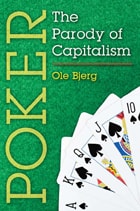
Poker
The Parody of CapitalismOle Bjerg
University of Michigan Press, 2011
Poker is an extraordinary worldwide phenomenon with major social, cultural, and political implications, and Poker: The Parody of Capitalism investigates the game of poker as a cultural expression of significance not unlike art, literature, film, or music. Tracing the history of poker and comparing the evolution of the game to the development of capitalism, Ole Bjerg complicates prevalent notions of “casino capitalism” and correspondingly facile and simplistic comparisons of late capitalism and poker. By employing Slavoj Žižek’s threefold distinction between imaginary-symbolic-real as a philosophical framework to analyze poker and to understand the basic strategies of the game, Bjerg explores the structural characteristics of poker in relation to other games, making a clear distinction between poker and other gambling games of pure chance such as roulette and craps. With its combination of social theory and empirical research, Poker offers an engaging exploration of a cultural trend.
"Poker is a theoretically sophisticated, highly original and innovative treatment of a contemporary social phenomenon, and contributes greatly to our understanding of the nature of contemporary capitalism."
—Charles Livingstone, Monash University Australia