Results by title
3 books match the query 'Parrot'
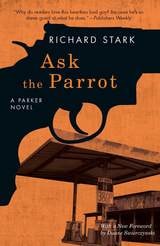
Ask the Parrot
A Parker NovelRichard Stark
University of Chicago Press, 2017
Parker is on the run, on his own, and stripped of suppies and support in this action-packed entry in the classic hard-boiled crime series
Richard Stark's Parker novels are the hardest of hard-boiled, classic crime novels where the heists are huge, the body counts are high, and the bad guys usually win.
The Parker novels have been a huge influence on countless writers and filmmakers, including Quentin Tarantino, George Pelecanos, Colson Whitehead, Lucy Sante, and many more. Their stripped-down language and hard-as-nails amorality create an unforgettable world where the next score could be the big one, but your next mistake could also be your last. There's nothing else like them.
In Ask the Parrot, Parker’s back on the run, dodging dogs, cops, and even a helicopter. His escape brings him to rural Massachusetts, where he meets a small-town recluse who Forced to work with a small-town recluse nursing a grudge against the racetrack that fired him. Even on the run, Parker manages to get up to no good. It'll be a deadly day at the races.
[more]
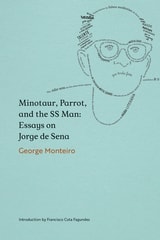
Minotaur, Parrot, and the SS Man
Essays on Jorge de SenaGeorge Monteiro
Tagus Press, 2021
An undisputed giant of twentieth-century Portuguese letters, writer and literary critic Jorge de Sena (1919–1978) spent the most productive decades of his life away from Portugal, teaching at the University of Wisconsin–Madison and the University of California, Santa Barbara. In the essays gathered in this collection, George Monteiro deftly weaves together his readings of Sena's poetry and prose, both literary and critical, with evidence drawn from the deep well of Sena's biographical archive, focusing in particular on his Brazilian and U.S. years. This expansive overview of Sena's unparalleled career, intended to commemorate the centenary of the writer's birth, is also a tribute to Monteiro's own remarkably voluminous and far-reaching body of work on the intersection of Portuguese and Anglo-American literary studies.
[more]
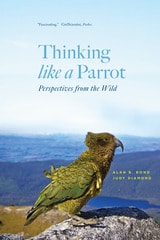
Thinking like a Parrot
Perspectives from the WildAlan B. Bond and Judy Diamond
University of Chicago Press, 2019
From two experts on wild parrot cognition, a close look at the intelligence, social behavior, and conservation of these widely threatened birds.
People form enduring emotional bonds with other animal species, such as dogs, cats, and horses. For the most part, these are domesticated animals, with one notable exception: many people form close and supportive relationships with parrots, even though these amusing and curious birds remain thoroughly wild creatures. What enables this unique group of animals to form social bonds with people, and what does this mean for their survival?
In Thinking like a Parrot, Alan B. Bond and Judy Diamond look beyond much of the standard work on captive parrots to the mischievous, inquisitive, and astonishingly vocal parrots of the wild. Focusing on the psychology and ecology of wild parrots, Bond and Diamond document their distinctive social behavior, sophisticated cognition, and extraordinary vocal abilities. Also included are short vignettes—field notes on the natural history and behavior of both rare and widely distributed species, from the neotropical crimson-fronted parakeet to New Zealand’s flightless, ground-dwelling kākāpō. This composite approach makes clear that the behavior of captive parrots is grounded in the birds’ wild ecology and evolution, revealing that parrots’ ability to bond with people is an evolutionary accident, a by-product of the intense sociality and flexible behavior that characterize their lives.
Despite their adaptability and intelligence, however, nearly all large parrot species are rare, threatened, or endangered. To successfully manage and restore these wild populations, Bond and Diamond argue, we must develop a fuller understanding of their biology and the complex set of ecological and behavioral traits that has led to their vulnerability. Spanning the global distribution of parrot species, Thinking like a Parrot is rich with surprising insights into parrot intelligence, flexibility, and—even in the face of threats—resilience.
[more]