Results by title
17 books match the query 'Part'
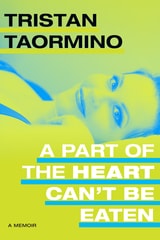
A Part of the Heart Can't Be Eaten
A MemoirTristan Taormino
Duke University Press, 2023
Tristan’s world began to fall apart when her dad was diagnosed with AIDS. After a series of devastating events, she moved to the messy, glorious world of 1990s New York City. In the midst of grief and depression, she helped change queer sexual subculture with her zine Pucker Up, her infamous The Village Voice column, and her editorship of legendary lesbian porn magazine On Our Backs. After the publication of her first book, The Ultimate Guide to Anal Sex for Women, Tristan followed her own path that marked the beginning of her work as a trailblazing feminist pornographer.
After a lifetime of outrageous adventures, Tristan reflects on the bonds, loss, and mental-health struggles that shaped her. She weaves together history from her father’s unpublished memoir, exploring the surprising ways their personal patterns converge and diverge. Bracingly emotional and erotically charged, A Part of the Heart Can’t Be Eaten reveals the transformative power of queer pleasure and defiance.

A Part, Yet Apart
South Asians in Asian AmericaLavina Shankar
Temple University Press, 1998
This construction process parallels the gradual acceptance of the term "Asian American" by peoples primarily of East and Southeast Asian ancestry who found abundant reason to claim a shared identity in dealing with officialdom and an apparently intractable racism in this country. In time, "Asian American" has become a designation of collective pride for a wide range of peoples. In academic institutions and society generally, there are vexed questions about the term's inclusiveness and the dominance of established groups over more recent ones.
A Part, Yet Apart: South Asians in Asian America concerns itself with the extent to which South Asian American are and ought to be included within Asian America -- as that term is applied to academic programs and admission policies; grassroots community organizing and politics more broadly; and critical analyses of cultural products. Taken together these essays form a spirited dialogue on the dilemmas of identity politics, coalition building, and diasporics.
A Point Is That Which Has No Part
Liz Waldner
University of Iowa Press, 2000
The innocence and Keatsian beauty of Euclid's geometry become poignant from a perspective that encompasses all that is non-Euclidean as well as space, time, and the theory of matter. With rare wit and linguistic daring, Waldner opens resonant channels of communication that show there is indeed more than meets the eye—or the mind—in her poems.
Hand to Mouth (Twist and Shout)
Cold comes slow up out
of the darkness among the leaves
that smell so good when bruised
Do you, too, recognize me
god so soon?
Her First Reckoning
Pour wine into vessels the violet of woods,
wine of the reddening stars.
You are god, you can do it.
Your lover calls you St. John the Conqueror.
I have heard her.
This is the name of a root.
Asperge the thousands and thousands of rooms
in which photosynthesis promises sun
to the acolyte cells. Rain yourself on a leaf.
Birch. The bark is malleable as mushroom flesh.
Show that you know me. Scratch out my name
with this tree. My name of trees.
On the day I arrive at the door of my death,
myself now hard to tell
from the trees that had hid it from me,
I will demand that you love me.
You made me like this.
Why did you make me like this?
Transitive, Intransitive: Extemporary Measures
Two crows above the marsh: sew.
Stitch the seventeen sleek shades of blue
to the shadow-patterned greens below.
See fit to make me a suitable view who
having nowhere to else to go
might as well wear this world well.
Llama necks periscope the view:
yonder, across the water, you
testing the air now a crow
chases a redwing blackbird through.
What can I show you who sees
I don't believe? For now,
what the eye of the needle sees:
through through through:
clouds, birds, me, trees;
soon: in, out, with, to;
something moving, something moved:
a stitch in time's an avenue,
future's sutures' revenue—
“the shining hour” improved.
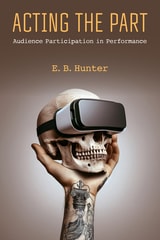
Acting the Part
Audience Participation in PerformanceE. B. Hunter
University of Michigan Press, 2025
Business Cycles
Part IF. A. Hayek
University of Chicago Press, 2012
Contributions to the History of Science
Part I. Robert of Chester's Latin Translation of the Algebra of Al-KhowarizmiWith an introduction, critical notes, and an English version by Louis Charles Karpinski
University of Michigan Press, 1915
Coptic Manuscripts in the Freer Collection
Part I. The Coptic Psalter in the Freer CollectionEdited by William H. Worrell
University of Michigan Press, 1916

Faust
A Tragedy, Part IEugene Stelzig
Bucknell University Press, 2019
Published by Bucknell University Press. Distributed worldwide by Rutgers University Press.
Greek Ostraca in the University of Michigan Collection
Part I - TextsLeiv Amundsen
University of Michigan Press, 1935
Monte Alban's Hinterland, Part I
The Prehispanic Settlement Patterns of the Central and Southern Parts of the Valley of Oaxaca, MexicoRichard E. Blanton, Stephen Kowalewski, Gary Feinman, and Jill Appel
University of Michigan Press, 1982
New Testament Manuscripts in the Freer Collection
Part I. The Washington Manuscript of the Four GospelsHenry A. Sanders
University of Michigan Press, 1912
Papyri from Tebtunis
Part IArthur E.R. Boak
University of Michigan Press, 1944
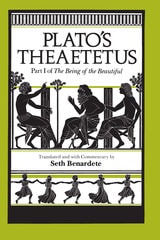
Plato's Theaetetus
Part I of The Being of the BeautifulPlato
University of Chicago Press, 1986
"Seth Benardete is one of the very few contemporary classicists who combine the highest philological competence with a subtlety and taste that approximate that of the ancients. At the same time, he as set himself the entirely modern hermeneutical task of uncovering what the ancients preferred to keep veiled, of making explicit what they indicated, and hence...of showing the naked ugliness of artificial beauty."—Stanley Rose, Graduate Faculty Philosophy Journal
Seth Benardete (1930-2001) was professor of classics at New York University. He was the author or translator of many books, most recently The Argument of the Action, Plato's "Laws," and Plato's "Symposium," all published by the University of Chicago Press.
Reports of the Greenland Expeditions of the University of Michigan (1926-31)
Part I, Aërology Expeditions of 1926 and 1927-29S.P. Fergusson, Editor
University of Michigan Press, 1931
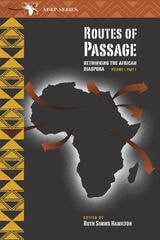
Routes of Passage
Rethinking the African Diaspora: Volume 1, Part 1Ruth Simms Hamilton
Michigan State University Press, 2007
Routes of Passage provides a conceptual, substantive, and empirical orientation to the study of African people worldwide. The book addresses issues of geographical mobility and geosocial displacement; changing culture, political, and economic relationships between Africa and its diaspora; interdiaspora relations; political and economic agency and social mobilization, including cultural production and psychocultural transformation; existence in hostile and oppressive political and territorial space; and confronting interconnected relations of social inequality, especially class, gender, nationality, and race.
Structural Analysis of Unistrut Space-Frame Roofs
Part A: Recommended Method for Computation of Safe Roof LoadsPaul H. Coy
University of Michigan Press, 1959
The Part and the Whole in Early American Literature, Print Culture, and Art
Matthew Pethers
Bucknell University Press, 2024
The essays in this pathbreaking collection consider the significance of varied early American fragmentary genres and practices—from diaries and poetry, to almanacs and commonplace books, to sermons and lists, to Indigenous ruins and other material shards and fragments—often overlooked by critics in a scholarly privileging of the “whole.” Contributors from literary studies, book history, and visual culture discuss a host of canonical and non-canonical figures, from Edward Taylor and Washington Irving to Mary Rowlandson and Sarah Kemble Knight, offering insight into the many intellectual, ideological, and material variations of “form” that populated the early American cultural landscape. As these essays reveal, the casting of the fragmentary as aesthetically eccentric or incomplete was a way of reckoning with concerns about the related fragmentation of nation, society, and self. For a contemporary audience, they offer new ways to think about the inevitable gaps and absences in our cultural and historical archive.