Results by title
10 books match the query 'Part 2'
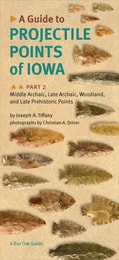
A Guide to Projectile Points of Iowa, Part 2
Middle Archaic, Late Archaic, Woodland, and Late Prehistoric PointsTiffany, Joseph A.
University of Iowa Press, 2009
The two beautifully illustrated parts depict a total of sixty-one full-size stone point types in color by archaeological period. References are provided for those wishing to learn more about each type shown. Archaeologist Joseph Tiffany lists the stone type for each point as well as its estimated range of use based on calibrated radiocarbon age, catalog number, and the county where it was found. By providing actual-size color images of the typed points, each part is very easy to use in the field, lab, or classroom.
From the highly finished Clovis points of the Paleoindian period to the delicate notched and stemmed points of the Woodland period, these tangible remnants of vanished cultures reveal the huge changes in the lifeways of Iowa’s native populations over time. Lay and professional archaeologists, collectors, students, and enthusiasts will appreciate the beauty of the photos and the usefulness of the information in this pocket guide to Iowa projectile points.
Archaeology in the Great Basin and Southwest, Part 2
Papers in Honor of Don D. FowlerNancy J. Parezo
University of Utah Press, 2014
Art Works
Part 2, Volume 12Richard Meyer and David Román, eds.
Duke University Press, 0
Arguing for the primacy of the arts in queer life, the contributors show how art and performance can constitute a form of critical theorizing rather than simply an illustration of it. In different ways, each author demonstrates how art works to invigorate queer critique. The first issue includes a special dossier on AIDS activist film and video, marking the twenty-fifth year of the AIDS pandemic, and essays on late-nineteenth-century male nudes, lesbian surrealism, homoerotic photography in the Deep South, and the transnational, transgender contexts of the Pulitzer Prize–winning play I Am My Own Wife. Essays in the second issue focus on a series of queer case studies, including gay power graphics and psychedelia, female duets on the Broadway stage, Keith Haring and racial politics, British Vogue in the 1920s, and lesbian-feminist magazines of the 1970s. The issue concludes with a dossier of three shorter pieces on queer art and performance: an interview with the Chicano drag street performer Robert Legoretta (“Cyclona”), an essay on blogs and the Five Lesbian Brothers, and a discussion of a rarely exhibited work about cruising and public space by the contemporary artist Glenn Ligon.
Contributors. Deborah Bright, Jill Dolan, Jens Giersdorf, Jason Goldman, Scott Herring, Lucas Hilderbrand, Alexandra Juhasz, Tirza Latimer, Glenn Ligon, Richard Meyer, Rachel Middleman, Ricardo Montez, Erica Rand, Christopher Reed, David Román, Jennifer Flores Sternad, Margo Hobbs Thompson, Stacy Wolf

Bibliography of Geography, Part 2
Regional. Volume 1. The United States of AmericaChauncey D. Harris
University of Chicago Press, 1984
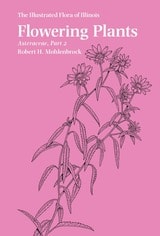
Flowering Plants
Asteraceae, Part 2Robert H. Mohlenbrock
Southern Illinois University Press, 2019
In addition, Mohlenbrock has identified the overall range for each species in Illinois, compiled from various sources, including examinations of herbarium material and Mohlenbrock’s own field studies. The range is given from the northeastern to the northwestern extremities, south to the southwestern limit, and then eastward to the southeastern limit.
As important to amateurs interested in wildflower identification as to botanists and land planners, this second volume of Mohlenbrock’s Asteraceae is an essential addition to the esteemed Illustrated Flora of Illinois series.
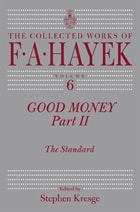
Good Money, Part 2
The StandardF. A. Hayek
University of Chicago Press, 1999
Good Money, Part I: The New World includes seven of Hayek's articles from the 1920s that were written largely in reaction to the work of Irving Fisher and W. C. Mitchell. Hayek encountered Fisher's work on the quantity theory of money and Mitchell's studies on business cycles during a U.S. visit in 1923-24. These articles attack the idea that price stabilization was consistent with the stabilization of foreign exchange and foreshadow Hayek's general critique that the whole of an economy is not simply the sum of its parts.
Good Money, Part II: The Standard offers five more of Hayek's articles that advance his ideas about money. In these essays, Hayek investigates the consequences of the "predicament of composition." This principle works on the premise that the entire society cannot simultaneously increase liquidity by selling property or services for cash. This analysis led Hayek to make what was perhaps his most controversial proposal: that governments should be denied a monopoly on the coining of money.
Taken together, these volumes present a comprehensive chronicle of Hayek's writings on monetary policy and offer readers an invaluable reference to some of his most profound thoughts about money.
"Each new addition to The Collected Works of F. A. Hayek, the University of Chicago's painstaking series of reissues and collections, is a gem."— Liberty on Volume IX of The Collected Works of F. A. Hayek
"Intellectually [Hayek] towers like a giant oak in a forest of saplings."—Chicago Tribune
"One of the great thinkers of our age who . . . revolutionized the world's intellectual and political life."—Former President George Herbert Walker Bush

Hegel’s Phenomenology, Part 2
The Evolution of Ethical and Religious Consciousness to the Absolute StandpointHoward P. Kainz
Ohio University Press, 1983
The publication in 1807 of Georg Wilhelm Frederich Hegel’s Phanomenologie des Geistes (translated alternately as “Phenomenology of Mind” or “Phenomenology of Spirit”) marked the beginning of the modern era in philosophy. Hegel’s remarkable insights formed the basis for what eventually became the Existentialist movement. Yet the Phenomenology remains one of the most difficult and forbidding works in the canon of philosophical literature.

Henry VI, Part 2
William Shakespeare
Arizona Center for Medieval and Renaissance Studies, 2021
In his three Henry VI plays, Shakespeare tackles the infamous Wars of the Roses and the fall of the House of Lancaster. In this translation of Henry VI, Part 2, Douglas Langworthy follows the increasing tensions as the Duke of York foments rebellion against the crown. Langworthy’s translation takes a deep dive into the language of Shakespeare. With a fine-tooth comb, he updates passages that are archaic and difficult to the modern ear, and matches them with the syntax and lyricism of the rest of the play, essentially translating archaic Shakespeare to match contemporary Shakespeare.
This translation of Henry VI, Part 2 was written as part of the Oregon Shakespeare Festival’s Play On! project, which commissioned new translations of thirty-nine Shakespeare plays. These translations present the work of "The Bard" in language accessible to modern audiences while never losing the beauty of Shakespeare’s verse. Enlisting the talents of a diverse group of contemporary playwrights, screenwriters, and dramaturges from diverse backgrounds, this project reenvisions Shakespeare for the twenty-first century. These volumes make these works available for the first time in print—a new First Folio for a new era.

Insider Histories of the Vietnam Era Underground Press, Part 2
Ken Wachsberger
Michigan State University Press, 2011
This enlightening book offers a collection of histories of underground papers from the Vietnam Era as written and told by key staff members of the time. Their stories, building on those presented in Part 1, represent a wide range of publications: countercultural, gay, lesbian, feminist, Puerto Rican, Native American, Black, socialist, Southern consciousness, prisoners’ rights, New Age, rank-and-file, military, and more. Wachsberger notes that the underground press not only produced a few well-known papers but also was truly national and diverse in scope. His goal is to capture the essence of “the countercultural community.” This book will be a fundamental resource for anyone seeking a deeper understanding of a dramatic era in U.S. history, as well as offering a younger readership a glimpse into a generation of idealists who rose up to challenge and improve government and society.
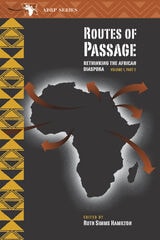
Routes of Passage
Rethinking the African Diaspora: Volume 1, Part 2Ruth Simms Hamilton
Michigan State University Press, 2007
Routes of Passage provides a conceptual, substantive, and empirical orientation to the study of African people worldwide. Routes of Passage addresses issues of geographical mobility and geosocial displacement; changing cultural, political, and economic relationships between Africa and its diaspora; interdiaspora relations; political and economic agency and social mobilization, including cultural production and psychocultural transformation; existence in hostile and oppressive political and territorial space; and confronting interconnected relations of social inequality, especially class, gender, nationality, and race.