Results by title
3 books match the query 'Participation, British'
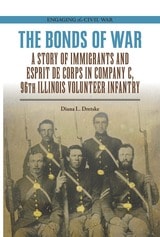
The Bonds of War
A Story of Immigrants and Esprit de Corps in Company C, 96th Illinois Volunteer InfantryDiana L. Dretske
Southern Illinois University Press, 2021
When curator Diana L. Dretske discovered that the five long-gone Union soldiers in a treasured photograph in the Bess Bower Dunn Museum were not fully identified, it compelled her into a project of recovery and reinterpretation. Utilizing an impressive array of local and national archives, as well as private papers, the author’s microhistorical approach records events that often go unnoticed, such as a farmer enlisting in the middle of a crop field, a sister searching her brother’s face for signs of war, and an immigrant dying in an effort to become a good American citizen.
This book, the most intensive examination of the 96th Illinois Volunteer Infantry since the regiment’s history was published in 1887 centers on immigrants from the British Isles who wished to be citizens of a country at war with itself. Far removed from their native homelands, they found new promise in rural Illinois. These men, neighbors along the quiet Stateline Road in Lake County, decide to join the fighting at its most dangerous hour. The bonds of war become then the bonds of their new national identity.
The Bonds of War uncovers the common soldier from the cataclysm that is the American Civil War by offering a collective biography of five soldiers of the 96th in the Western Theater. The human drama of their lives unfolds before the reader on battlefields such as Chickamauga and within the high pine stockades of Andersonville. Their lives argue that those who seem to matter least in military history are the very ones who can tell us the most about the experience of war and the reasons for remembering.
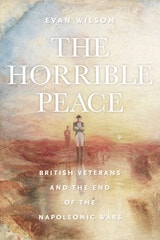
The Horrible Peace
British Veterans and the End of the Napoleonic WarsEvan Wilson
University of Massachusetts Press, 2023
Few battles in world history provide a cleaner dividing line than Waterloo: before, there was Napoleon; after, there was the Pax Britannica. While Waterloo marked France’s defeat and Britain’s ascendance as an imperial power, the war was far from over for many soldiers and sailors, who were forced to contend with the lasting effects of battlefield trauma, the realities of an impossibly tight labor market, and growing social unrest. The Horrible Peace details a story of distress and discontent, of victory complicated by volcanism, and of the challenges facing Britain at the beginning of its victorious century.
Examining the process of demobilization and its consequences for British society, Evan Wilson draws on archival research and veterans’ memoirs to tell the story of this period through the experiences of veterans who struggled to reintegrate and soldiers and sailors who remained in service as Britain attempted to defend and expand the empire. Veterans were indeed central to Britain’s experience of peace, as they took to the streets to protest the government’s indifference to widespread unemployment and misery. The fighting did not stop at Waterloo.
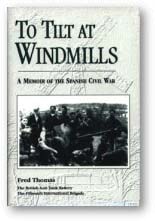
To Tilt at Windmills
A Memoir of the Spanish Civil WarFred A. Thomas
Michigan State University Press, 1996
To Tilt at Windmills is the memoir of Briton Fred Thomas who served with the International Brigades in the Spanish Civil War (July 1936-March 1939).
Inspired by a memorable return to Iberian battlefields forty years later, and based on diaries kept during the many months Thomas spent as a gunner with the British Anti-Tank Battery, the narrative moves eloquently along a journey into the war zone, through the several campaigns in which he fought and where he was twice wounded, and finally to the withdrawal of the Brigades from the conflict. What distinguishes Thomas' account is the remarkable detail provided by the diaries and the measured tone of his reminiscence, There is, as well, the poignant inquiry of the veteran into the shape and meaning of experience as a young soldier. The historian Paul Preston has cited the "warmth, directness and deep humanity" of To Tilt at Windmills, "an important contribution to the collective memory of the war.