Results by title
11 books match the query 'Participation, Indian'
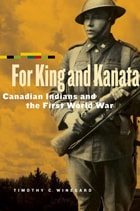
For King and Kanata
Canadian Indians and the First World WarTimothy C. Winegard
University of Manitoba Press, 2012
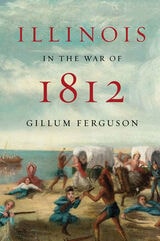
Illinois in the War of 1812
Gillum Ferguson
University of Illinois Press, 2012
Russell P. Strange "Book of the Year" Award from the Illinois State Historical Society, 2012.
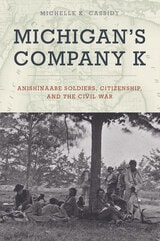
Michigan's Company K
Anishinaabe Soldiers, Citizenship, and the Civil WarMichelle K Cassidy
Michigan State University Press, 2023
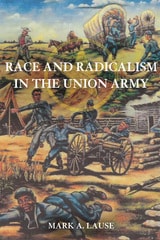
Race and Radicalism in the Union Army
Mark A. Lause
University of Illinois Press, 2013
In this compelling portrait of interracial activism, Mark A. Lause documents the efforts of radical followers of John Brown to construct a triracial portion of the Federal Army of the Frontier. Mobilized and inspired by the idea of a Union that would benefit all, black, Indian, and white soldiers fought side by side, achieving remarkable successes in the field. Against a backdrop of idealism, racism, greed, and the agonies and deprivations of combat, Lause examines links between radicalism and reform, on the one hand, and racialized interactions among blacks, Indians, and whites, on the other.
Lause examines how this multiracial vision of American society developed on the Western frontier. Focusing on the men and women who supported Brown in territorial Kansas, Lause examines the impact of abolitionist sentiment on relations with Indians and the crucial role of nonwhites in the conflict. Through this experience, Indians, blacks, and whites began to see their destinies as interdependent, and Lause discusses the radicalizing impact of this triracial Unionism upon the military course of the war in the upper Trans-Mississippi.
The aftermath of the Civil War destroyed much of the memory of the war in the West, particularly in the Indian Territory (now Oklahoma). The opportunity for an interracial society was quashed by the government's willingness to redefine the lucrative field of Indian exploitation for military and civilian officials and contractors.
Assessing the social interrelations, ramifications, and military impact of nonwhites in the Union forces, Race and Radicalism in the Union Army explores the extent of interracial thought and activity among Americans in this period and greatly expands the historical narrative on the Civil War in the West.
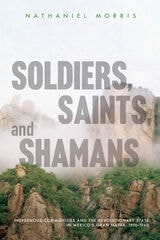
Soldiers, Saints, and Shamans
Indigenous Communities and the Revolutionary State in Mexico's Gran Nayar, 1910–1940Nathaniel Morris
University of Arizona Press, 2020
To make sense of this complex history, Nathaniel Morris offers the first systematic understanding of the participation of the Náayari, Wixárika, O’dam, and Mexicanero peoples in the Mexican Revolution. They are known for being among the least “assimilated” of all Mexico’s Indigenous peoples. It’s often been assumed that they were stuck up in their mountain homeland—“the Gran Nayar”—with no knowledge of the uprisings, civil wars, military coups, and political upheaval that convulsed the rest of Mexico between 1910 and 1940.
Based on extensive archival research and years of fieldwork in the rugged and remote Gran Nayar, Morris shows that the Náayari, Wixárika, O’dam, and Mexicanero peoples were actively involved in the armed phase of the revolution. This participation led to serious clashes between an expansionist, “rationalist” revolutionary state and the highly autonomous communities and heterodox cultural and religious practices of the Gran Nayar’s inhabitants. Morris documents confrontations between practitioners of subsistence agriculture and promoters of capitalist development, between rival Indian generations and political factions, and between opposing visions of the world, of religion, and of daily life. These clashes produced some of the most severe defeats that the government’s state-building programs suffered during the entire revolutionary era, with significant and often counterintuitive consequences both for local people and for the Mexican nation as a whole.
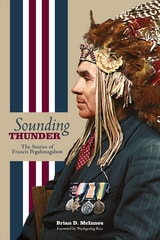
Sounding Thunder
The Stories of Francis PegahmagabowBrian D. McInnes
Michigan State University Press, 2016
Francis Pegahmagabow’s stories describe many parts of his life and are characterized by classic Ojibwe narrative. They reveal aspects of Francis’s Anishinaabe life and worldview. Interceding chapters by Brian McInnes provide valuable cultural, spiritual, linguistic, and historical insights that give a greater context and application for Francis’s words and world. Presented in their original Ojibwe as well as in English translation, the stories also reveal a rich and evocative relationship to the lands and waters of Georgian Bay.
In Sounding Thunder, Brian McInnes provides a new perspective on Pegahmagabow and his experience through a unique synthesis of Ojibwe oral history, historical record, and Pegahmagabow family stories.
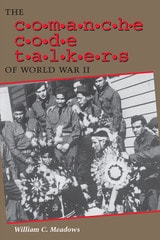
The Comanche Code Talkers of World War II
By William C. Meadows
University of Texas Press, 2003
Among the allied troops that came ashore in Normandy on D-Day, June 6, 1944, were thirteen Comanches in the 4th Infantry Division, 4th Signal Company. Under German fire they laid communications lines and began sending messages in a form never before heard in Europe—coded Comanche. For the rest of World War II, the Comanche Code Talkers played a vital role in transmitting orders and messages in a code that was never broken by the Germans.
This book tells the full story of the Comanche Code Talkers for the first time. Drawing on interviews with all surviving members of the unit, their original training officer, and fellow soldiers, as well as military records and news accounts, William C. Meadows follows the group from their recruitment and training to their active duty in World War II and on through their postwar lives up to the present. He also provides the first comparison of Native American code talking programs, comparing the Comanche Code Talkers with their better-known Navajo counterparts in the Pacific and with other Native Americans who used their languages, coded or not, for secret communication. Meadows sets this history in a larger discussion of the development of Native American code talking in World Wars I and II, identifying two distinct forms of Native American code talking, examining the attitudes of the American military toward Native American code talkers, and assessing the complex cultural factors that led Comanche and other Native Americans to serve their country in this way.
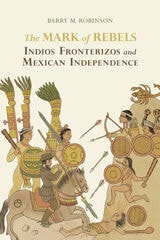
The Mark of Rebels
Indios Fronterizos and Mexican IndependenceBarry M. Robinson
University of Alabama Press, 2016
Explores social and cultural transformations among the indigenous communities of western Mexico, especially the indios fronterizos (Frontier Indians), preceding and during the struggle for independence
In The Mark of Rebels Barry Robinson offers a new look at Mexican Independence from the perspective of an indigenous population caught in the heart of the struggle. During the conquest and settlement of Mexico’s Western Sierra Madre, Spain’s indigenous allies constructed an indio fronterizo identity for their ethnically diverse descendants. These communities used their special status to maintain a measure of autonomy during the colonial era, but the cultural shifts of the late colonial period radically transformed the relationship between these indios fronterizos and their neighbors.
Marshalling an extensive array of archival material from Mexico, the United States, and Spain, Robinson shows that indio fronterizo participation in the Mexican wars of independence grafted into the larger Hidalgo Revolt through alignment with creole commanders. Still, a considerable gulf existed between the aims of indigenous rebels and the creole leadership. Consequently, the privileges that the indios fronterizos sought to preserve continued to diminish, unable to survive either the late colonial reforms of the Spanish regime or creole conceptions of race and property in the formation of the new nation-state.
This story suggests that Mexico’s transition from colony to nation can only be understood by revisiting the origins of the colonial system and by recognizing the role of Spain’s indigenous allies in both its construction and demolition. The study relates events in the region to broader patterns of identity, loyalty, and subversion throughout the Americas, providing insight into the process of mestizaje that is commonly understood to have shaped Latin America. It also foreshadows the popular conservatism of the nineteenth century and identifies the roots of post-colonial social unrest.
This book provides new context for scholars, historians, ethnographers, anthropologists, and anyone interested in the history of Mexico, colonization, Native Americans, and the Age of Revolutions.
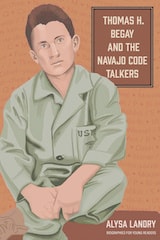
Thomas H. Begay and the Navajo Code Talkers
Alysa Landry
Ohio University Press, 2023
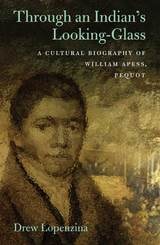
Through an Indian's Looking-Glass
A Cultural Biography of William Apess, PequotDrew Lopenzina
University of Massachusetts Press, 2017
The life of William Apess (1798–1839), a Pequot Indian, Methodist preacher, and widely celebrated writer, provides a lens through which to comprehend the complex dynamics of indigenous survival and resistance in the era of America's early nationhood. Apess's life intersects with multiple aspects of indigenous identity and existence in this period, including indentured servitude, slavery, service in the armed forces, syncretic engagements with Christian spirituality, and Native struggles for political and cultural autonomy. Even more, Apess offers a powerful and provocative voice for the persistence of Native presence in a time and place that was long supposed to have settled its “Indian question” in favor of extinction.
Through meticulous archival research, close readings of Apess's key works, and informed and imaginative speculation about his largely enigmatic life, Drew Lopenzina provides a vivid portrait of this singular Native American figure. This new biography will sit alongside Apess's own writing as vital reading for those interested in early America and indigeneity.
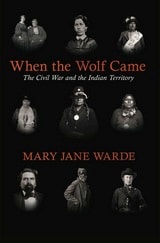
When the Wolf Came
The Civil War and the Indian TerritoryMary Jane Warde
University of Arkansas Press, 2013
Winner of the 2014 Pate Award from the Fort Worth Civil War Round Table.
When the peoples of the Indian Territory found themselves in the midst of the American Civil War, squeezed between Union Kansas and Confederate Texas and Arkansas, they had no way to escape a conflict not of their choosing--and no alternative but to suffer its consequences. When the Wolf Came explores how the war in the Indian Territory involved almost every resident, killed many civilians as well as soldiers, left the country stripped and devastated, and cost Indian nations millions of acres of land. Using a solid foundation of both published and unpublished sources, including the records of Cherokee, Choctaw, and Creek nations, Mary Jane Warde details how the coming of the war set off a wave of migration into neighboring Kansas, the Red River Valley, and Texas. She describes how Indian Territory troops in Unionist regiments or as Confederate allies battled enemies--some from their own nations--in the territory and in neighboring Kansas, Missouri, and Arkansas. And she shows how post-war land cessions forced by the federal government on Indian nations formerly allied with the Confederacy allowed the removal of still more tribes to the Indian Territory, leaving millions of acres open for homesteads, railroads, and development in at least ten states. Enhanced by maps and photographs from the Oklahoma Historical Society's photographic archives, When the Wolf Came will be welcomed by both general readers and scholars interested in the signal public events that marked that tumultuous era and the consequences for the territory's tens of thousands of native peoples.