Results by title

4 books match the query 'Participatory theater'
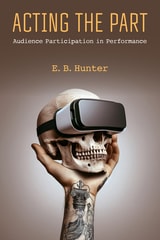
cover of Acting the Part: Audience Participation in Performance

Acting the Part

Audience Participation in Performance

E. B. Hunter

University of Michigan Press, 2025
Acting the Part offers a paradigm for understanding how audiences participate in immersive theater, from physical spaces like the Globe in London to digital spaces like social virtual reality. Reading across twenty-first century productions of ancient Greek tragedies and William Shakespeare’s plays, E. B. Hunter proposes the concept of “enactivity” to describe the positionality audiences inhabit when their participation is critical to the narrative but cannot alter its intended course. This positionality is that of the archetype, the enactment of which is shaped by four production conditions: a historically resonant site, a canonical source, an immersive space, and a production-specific economy that incentivizes some behaviors and discourages others. At the heart of Acting the Part is a framework for identifying how a production’s management of these conditions gives rise to a range of archetypes, such as worshiper, sleuth, cinematographer, and others. Against the backdrop of an ever-increasing push for audience participation, Acting the Part sheds new light on the many ways in which productions shape that participation in real time.
[more]
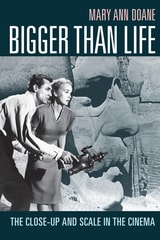
cover of Bigger Than Life: The Close-Up and Scale in the Cinema

Bigger Than Life

The Close-Up and Scale in the Cinema

Mary Ann Doane

Duke University Press, 2021
In Bigger Than Life Mary Ann Doane examines how the scalar operations of cinema, especially those of the close-up, disturb and reconfigure the spectator's sense of place, space, and orientation. Doane traces the history of scalar transformations from early cinema to the contemporary use of digital technology. In the early years of cinema, audiences regarded the monumental close-up, particularly of the face, as grotesque and often horrifying, even as it sought to expose a character's interiority through its magnification of detail and expression. Today, large-scale technologies such as IMAX and surround sound strive to dissolve the cinematic frame and invade the spectator's space, “immersing” them in image and sound. The notion of immersion, Doane contends, is symptomatic of a crisis of location in technologically mediated space and a reconceptualization of position, scale, and distance. In this way, cinematic scale and its modes of spatialization and despatialization have shaped the modern subject, interpolating them into the incessant expansion of commodification.
[more]
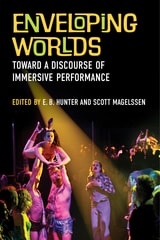
cover of Enveloping Worlds: Toward a Discourse of Immersive Performance

Enveloping Worlds

Toward a Discourse of Immersive Performance

E.B. Hunter and Scott Magelssen, Editors

University of Michigan Press, 2025

2026 Association for Theatre in Higher Education Edited Works Award Winner

Enveloping Worlds is a collection of essays that analyzes the phenomenon of immersive, participatory performance as it has developed in the US. As this collection demonstrates, immersive performance offers three-dimensional multisensory experiences, inviting audience members to be participants in the unfolding of the story, and challenging pre-existing ideas about the function of performance and entertainment. Enveloping Worlds questions audience agency and choice, the space and boundaries of performance, modes of immersion, empathy and engagement, and ethical considerations through fifteen essays. 

Case studies in the volume include the Choctaw Cultural Center in Oklahoma and Choctaw sovereignty; a Black artist’s autoethnographic performance challenging White audiences’ entitlement to full inclusion; Immersive Van Gogh experiences and their scenographers; telephone performance during the COVID-19 lockdowns; Diane Paulus’s The Donkey Show; the Battle of Atlanta panorama; an antebellum-themed department store display from the 1920s; escape rooms; Disney Parks; remotely staged plays about aging and dementia; tiki bars; anachronistic costuming at Renaissance Festivals; the technologies that shape the boundaries of immersive worlds; and tabletop role-playing games. Taken together, these essays contribute a rich discussion of immersive performance across radically different contexts, offering analytical models and terminology with which to clarify and advance this emergent discourse.
[more]
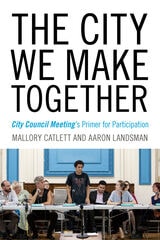
cover of The City We Make Together: City Council Meeting's Primer for Participation

The City We Make Together

City Council Meeting's Primer for Participation

Mallory Catlett

University of Iowa Press, 2022

In 2009, theatre artist Aaron Landsman was dragged by a friend to a city council meeting in Portland, Oregon. At first he was bored, but when a citizen dumped trash in front of the council in order to show how the city needed cleaning up, he was intrigued. He began attending local government meetings across the country, interviewing council members, staffers, activists, and other citizens. Out of this investigation, Landsman and director Mallory Catlett developed a participatory theatre piece called City Council Meeting.

The City We Make Together looks at how we make art with communities, how we perform power and who gets to play which roles, and how we might use creativity and rigorous inquiry to look at our structures of democracy anew.
 
[more]