Results by title
5 books match the query 'Particles (Nuclear physics)'
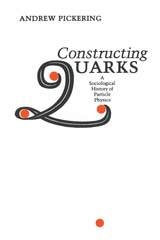
Constructing Quarks
A Sociological History of Particle PhysicsAndrew Pickering
University of Chicago Press, 1984
"A prodigious piece of scholarship that I can heartily recommend."—Michael Riordan, New Scientist
"An admirable history. . . . Detailed and so accurate."—Hugh N. Pendleton, Physics Today
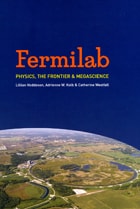
Fermilab
Physics, the Frontier, and MegascienceLillian Hoddeson, Adrienne W. Kolb, and Catherine Westfall
University of Chicago Press, 2008
Fermi National Accelerator Laboratory, located in the western suburbs of Chicago, has stood at the frontier of high-energy physics for forty years. Fermilab is the first history of this laboratory and of its powerful accelerators told from the point of view of the people who built and used them for scientific discovery.
Focusing on the first two decades of research at Fermilab, during the tenure of the laboratory’s charismatic first two directors, Robert R. Wilson and Leon M. Lederman, the book traces the rise of what they call “megascience,” the collaborative struggle to conduct large-scale international experiments in a climate of limited federal funding. In the midst of this new climate, Fermilab illuminates the growth of the modern research laboratory during the Cold War and captures the drama of human exploration at the cutting edge of science.
Foundations of High-Energy Astrophysics
Mario Vietri
University of Chicago Press, 2008
The most thorough and engaging survey of high-energy astrophysics available today, Foundations of High-Energy Astrophysics introduces the main physical processes relevant to the field in a rigorous yet accessible way, while paying careful attention to observational issues. Vietri’s book will quickly become a classic text for students and active researchers in astronomy and astrophysics. Those in adjoining fields will also find it a valuable addition to their personal libraries.
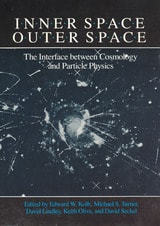
Inner Space/Outer Space
Edited by Edward Kolb, Michael Turner, Keith Olive, David Seckel, and David Lind
University of Chicago Press, 1986
The papers collected here, from scores of scientists, constitute the proceedings of the first major international conference on research at the interface of particle physics and astrophysics, held in May 1984. The editors have written introductions to each major section that draw out the central themes and elaborate on the primary implications of the papers that follow.
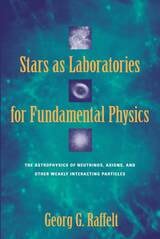
Stars as Laboratories for Fundamental Physics
The Astrophysics of Neutrinos, Axions, and Other Weakly Interacting ParticlesGeorg G. Raffelt
University of Chicago Press, 1996
Raffelt presents the many uses of stellar astrophysics for research in basic particle physics. He focuses primarily on the properties and nongravitational interactions of elementary particles. Numerous graphs and figures complement the text.
Stars as Laboratories for Fundamental Physics is a valuable reference for cosmologists, astrophysicists, and particle physicists.