Results by title
5 books match the query 'Partnerships'
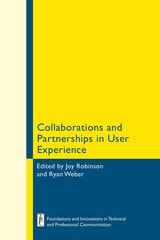
Collaborations and Partnerships in User Experience
Joy Robinson
University Press of Colorado, 2026
Effective UX work is necessarily complex and challenging—and necessarily collaborative. Drawing on their extensive collective experience, the contributors to this edited collection offer valuable insights and practical guidance for UX professionals seeking to navigate the complexities of collaborative work and create effective, user-centered products and services. Collaborations and Partnerships in User Experience focuses on the importance of building and nurturing relationships, fostering open communication, and ensuring that all partners benefit from collaborative efforts. The chapters in the collection offer theoretical frameworks, case studies, and lessons learned from successful (and sometimes unsuccessful) collaborative projects. They also explore the challenges that can arise in UX collaborations, such as differing priorities, vocabularies, and institutional structures, as well as the strategies employed to overcome these hurdles and achieve meaningful outcomes.
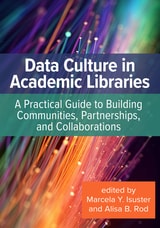
Data Culture in Academic Libraries
A Practical Guide to Building Communities, Partnerships, and CollaborationsMarcela Y. Isuster
Assoc of College & Research Libraries, 2025
In five parts, Data Culture in Academic Libraries: A Practical Guide to Building Communities, Partnerships, and Collaborations can help you foster an institutional culture that favors the curation, creation, and wider use of datasets.
- Data at all Levels
- Data Services and Instruction
- Data Outreach
- Data Communities
- Data Partnerships

Politics and Partnerships
The Role of Voluntary Associations in America's Political Past and PresentEdited by Elisabeth S. Clemens and Doug Guthrie
University of Chicago Press, 2011
But despite the ubiquity of the idea of volunteerism in public policy debates, analysis of its role in American governance has been fragmented. Bringing together a diverse set of disciplinary approaches, Politics and Partnerships is a thorough examination of the place of voluntary associations in political history and an astute investigation into contemporary experiments in reshaping that role. The essays here reveal the key role nonprofits have played in the evolution of both the workplace and welfare and illuminate the way that government’s retreat from welfare has radically altered the relationship between nonprofits and corporations.
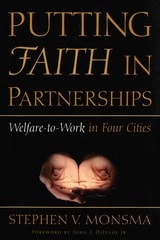
Putting Faith in Partnerships
Welfare-to-Work in Four CitiesStephen V. Monsma
University of Michigan Press, 2004
In this groundbreaking study of a politically controversial topic---the debut offering in Alan Wolfe's Contemporary Political and Social Issues series---author Stephen Monsma avoids overheated rhetoric in favor of a careful, critical analysis of the hard evidence on whether public-private partnerships really work.
The book is based on in-depth studies of social service programs in Los Angeles, Chicago, Philadelphia, and Dallas. By examining public-private partnerships between government offices and nonprofit organizations, Monsma seeks to understand how these partnerships affect the balance between government's efforts to deal with social problems and the rights of individual citizens to control their own lives.
Putting Faith in Partnerships answers many previously unanswered questions in what may be the most controversial public policy debate today: about the feasibility and wisdom of government agencies forming partnerships with private organizations to provide essential public social services.
Stephen V. Monsma is Professor of Political Science at Pepperdine University. He has served as director of the Office of Quality Review in Michigan's Department of Social Services and is a widely recognized expert on the role of faith-based organizations in social service programs.
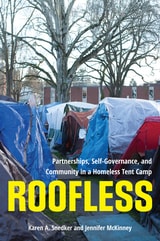
Roofless
Partnerships, Self-Governance, and Community in a Homeless Tent CampKaren A. Snedker
Rutgers University Press, 2027
Roofless critically examines homelessness and responses to it in the United States through the growing practice of forming tent camps. Karen A. Snedker and Jennifer McKinney position Seattle's "Tent City 3," (the US city with the third-largest homeless population), as an organizational model for other local governments to consider implementing in addressing their homelessness crises. Snedker and McKinney document this tent city's development through a census they conducted from 2019 to 2020, though the efforts behind Tent City 3 have a history dating back two decades. Through such an examination, the authors reveal surprising points of view and outcomes, including grassroots partnerships between city agencies, nonprofits, religious organizations, and educational institutions. In the context of rising homelessness in the US, understanding and having insight into the residents' experience of sanctioned unsheltered homelessness, compared to instances of unsanctioned encampments, allows readers to acquire a complete, nuanced picture of tent-based homelessness. As such, Roofless provides valuable insight to audiences ranging from scholars of sociology and social work, policymakers, homelessness advocates, and politicians.