Results by title

4 books match the query 'Pasternak, Boris Leonidovich'
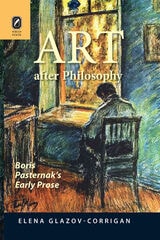
cover of Art after Philosophy: Boris Pasternak's Early Prose

Art after Philosophy

Boris Pasternak's Early Prose

Elena Glazov-Corrigan

The Ohio State University Press, 2013
Art after Philosophy: Boris Pasternak’s Early Prose, by Elena Glazov-Corrigan, redefines an area in Slavic studies which has suffered from neglect for several decades, namely, Pasternak’s early prose narratives. In her bold new study, Glazov-Corrigan analyzes the conceptual networks of thought Pasternak developed when he turned to literature after abandoning the study of Neo-Kantianism in Marburg during the summer of 1912. This book shows conclusively that Pasternak’s knowledge of philosophy is inseparable from his prose works, even though in his early stories and novellas (1913–1918) philosophical ideas operate neither as discrete textual units nor as micro-elements or clusters of possible signification. In the early Pasternak, philosophy becomes a narrative art, a large-scale narrative frame, a manner of seeing rather than of constructing reality.
 
After Roman Jakobson’s famous 1935 essay, which characterized the early Pasternak as a “virtuoso of metonymy,” in contrast to the metaphoric Mayakovsky, no other approach has been able to generate comparable scholarly influence. The present study takes up the implicit challenge of this critical impasse. Entering into a debate with Jakobson’s findings, Art after Philosophy illuminates Pasternak’s boldest artistic experiments and suggests to his readers entirely new ways of approaching not only his early but also his later writing.
[more]
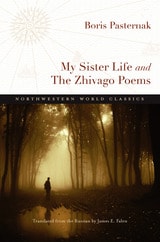
cover of My Sister Life and The Zhivago Poems

My Sister Life and The Zhivago Poems

Boris Pasternak, Translated from the Russian by James E. Falen

Northwestern University Press, 2012

Boris Pasternak is best known in the West for his epic novel Doctor Zhivago, whereas in Russia he is most celebrated as a poet. The two poetry collections offered here in translation are chronological and thematic bookends, and they capture Pasternak’s abiding and powerful vision of life: his sense of its beauty and terror, its precariousness for the individual, and its persistence in time—that vitality of being with which he is on familiar and familial terms.

In the early work My Sister Life, which commemorates the year 1917, Pasternak, then in his late twenties, found his poetic voice. The book would go on to become one of the most influential collections of Rus­sian poetry of the twentieth century. “The Poems of Yury Zhivago” are a part of the poet’s famous novel, Dr. Zhivago, whose title might be rendered in English as “Doctor Life.” These later lyrics are a kind of summing up that reflect, from the perspective of age and approaching death, upon the accumulated experience of a contemplative life amid turbulent and terrifying times.

Falen’s fresh new translations of these poems capture their expres­sion of the beauty and the joy, the terror and the pain, of what it is to be alive . . . and to die.
[more]
cover of Pasternak's "Dr. Zhivago": A Critical Companion

Pasternak's "Dr. Zhivago"

A Critical Companion

Edith W. Clowes

Northwestern University Press, 1995
This book, part of the acclaimed AATSEEL Critical Companions series, is designed to guide readers through Doctor Zhivago, Boris Pasternak's classic story of the Russian Revolution and its aftermath. An introduction places the novel and its author within Russian history and literature, and essays by scholars offer opinion and analysis of Pasternak's method and thought. Finally, there is correspondence relating to the novel and a bibliography chosen by the editor.
[more]
cover of The Author as Hero: Self and Tradition in Bulgakov, Pasternak, and Nabokov

The Author as Hero

Self and Tradition in Bulgakov, Pasternak, and Nabokov

Justin Weir

Northwestern University Press, 2011

Justin Weir develops a persuasive analysis of the complex relationship between authorial self-reflection and literary tradition in three of the most famous Russian novels of the first half of the twentieth century: Bulgakov's The Master and Margarita, Pasternak's Doctor Zhivago, and Nabokov's The Gift. With Weir's innovative interpretation, and its compelling historical, cultural, and theoretical insights, The Author as Hero offers a new view of an important moment in the evolution of Russian literature.
[more]