Results by title
11 books match the query 'Pastoral theology'
A Guide to Formation Advising for Seminarians
Edward J. McCormack
Catholic University of America Press, 2020
The future of the Church depends, in part, on forming future priests and ministers who are ready to accompany, lead, and love the People of God. Formation advising is one important part of that work. A Guide to Formation Advising for Seminarians/Seminary Faculty offers a practical guide to formation advising as a ministry of accompaniment, participation, and evaluation. Deacon Edward McCormack offers a comprehensive introduction to the ministry of formation advising for seminarians studying for priestly ministry. These volumes are for men and women who are new to the ministry of formation advising. The recent Vatican guidelines for seminary formation call for professional accompaniment of seminarians throughout their formation. This book explains in concrete detail how to do this through the entire formation process.
Beginning with an overview of the formation process, A Guide to Formation Advising for Seminarians/Seminary Faculty explains the role of the formation advisor and the skills required for that ministry. It describes the various ways the formation advisor accompanies a person through the formation process. McCormack also provides concrete suggestions for how to promote in seminarians’ active participation in the process. Formators will also find explanation of the evaluation process with a style sheet and examples of written evaluations. The handbook contains an annotated bibliography on all the major topics a formation advisor comes across.
[more]
A Guide to Formation Advising for Seminary Faculty
Accompaniment, Participation, and EvaluationEdward J. McCormack
Catholic University of America Press, 2020
The future of the Church depends, in part, on forming future priests and ministers who are ready to accompany, lead, and love the People of God. Formation advising is one important part of that work. A Guide to Formation Advising for Seminarians/Seminary Faculty offers a practical guide to formation advising as a ministry of accompaniment, participation, and evaluation. Deacon Edward McCormack offers a comprehensive introduction to the ministry of formation advising for seminarians studying for priestly ministry. These volumes are for men and women who are new to the ministry of formation advising. The recent Vatican guidelines for seminary formation call for professional accompaniment of seminarians throughout their formation. This book explains in concrete detail how to do this through the entire formation process.
Beginning with an overview of the formation process, A Guide to Formation Advising for Seminarians/Seminary Faculty explains the role of the formation advisor and the skills required for that ministry. It describes the various ways the formation advisor accompanies a person through the formation process. McCormack also provides concrete suggestions for how to promote in seminarians’ active participation in the process. Formators will also find explanation of the evaluation process with a style sheet and examples of written evaluations. The handbook contains an annotated bibliography on all the major topics a formation advisor comes across.
Beginning with an overview of the formation process, A Guide to Formation Advising for Seminarians/Seminary Faculty explains the role of the formation advisor and the skills required for that ministry. It describes the various ways the formation advisor accompanies a person through the formation process. McCormack also provides concrete suggestions for how to promote in seminarians’ active participation in the process. Formators will also find explanation of the evaluation process with a style sheet and examples of written evaluations. The handbook contains an annotated bibliography on all the major topics a formation advisor comes across.
[more]
Called to Holiness
Pope Emeritus Benedict XVI Pope Emeritus Benedict XVI
Catholic University of America Press, 2017
This edited collection is the first to gather in one volume the most relevant addresses, speeches, and homilies of His Holiness, Pope Emeritus Benedict XVI to seminarians and consecrated men and women into a single volume for the English-speaking world.
[more]
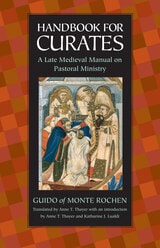
Handbook for Curates
A Late Medieval Manual on Pastoral MinistryCatholic University of America Press, 2011
Guido of Monte Rochen's Handbook for Curates became the most popular pastoral manual at the close of the Middle Ages as thousands of copies were printed in Europe.
[more]
On Living with a Concern for Gospel Ministry
Brian Drayton
QuakerPress, 2006
[more]
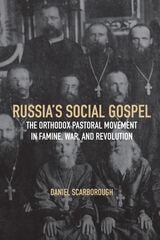
Russia's Social Gospel
The Orthodox Pastoral Movement in Famine, War, and RevolutionDaniel Scarborough
University of Wisconsin Press, 2023
The late Russian Empire experienced rapid economic change, social dislocation, and multiple humanitarian crises, enduring two wars, two famines, and three revolutions. A “pastoral activism” took hold as parish clergymen led and organized the response of Russia’s Orthodox Christians to these traumatic events. In Russia’s Social Gospel, Daniel Scarborough considers the roles played by pastors in the closing decades of the failing tsarist empire and the explosive 1917 revolutions.
This volume draws upon extensive archival research to examine the effects of the pastoral movement on Russian society and the Orthodox Church. Scarborough argues that the social work of parish clergymen shifted the focus of Orthodox practice in Russia toward cooperative social activism as a devotional activity. He furthers our understanding of Russian Orthodoxy by illuminating the difficult position of parish priests, who were charged with both spiritual and secular responsibilities but were supported by neither church nor state. His nuanced look at the pastorate shows how social and historical traumas shifted perceptions of what being religious meant, in turn affecting how the Orthodox Church organized itself, and contributed to Russia’s modernization.
This volume draws upon extensive archival research to examine the effects of the pastoral movement on Russian society and the Orthodox Church. Scarborough argues that the social work of parish clergymen shifted the focus of Orthodox practice in Russia toward cooperative social activism as a devotional activity. He furthers our understanding of Russian Orthodoxy by illuminating the difficult position of parish priests, who were charged with both spiritual and secular responsibilities but were supported by neither church nor state. His nuanced look at the pastorate shows how social and historical traumas shifted perceptions of what being religious meant, in turn affecting how the Orthodox Church organized itself, and contributed to Russia’s modernization.
[more]
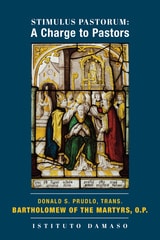
Stimulus Pastorum
A Charge to PastorsBartholomew of the Martyrs, O.P.
St. Augustine's Press, 2022
The work of St. Bartholomew of Braga, O.P. (1514–1590) appears here in English for the first time despite its long and enduring influence in ecclesiastical circles. His meditations on the office of pastor have provided critical insight bishops since their initial circulation and have helped form the most famous among them, including Bartholomew's proteges Charles Borromeo. Pope Paul VI ordered a copy of Bartholomew's work to be distributed among the Catholic bishops at the Second Vatican Council. Donald Prudlo's translation situates St. Bartholomew of the Martyrs in his historical context as a lynchpin of Catholic Reform and affirms him as a figurehead of pastoral administration even in our own times.
[more]
The Pastoral Role of the Roman Catholic Church in Pre-Famine Ireland, 1750–1850
Emmet Larkin
Catholic University of America Press, 2006
[more]
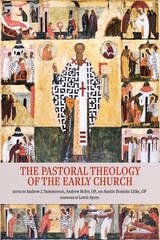
The Pastoral Theology of the Early Church
Andrew J. Summerson
Catholic University of America Press, 2026
The experience of the pastoral leaders of the Early Church is wide and deep. In loving obedience to Christ’s command to make disciples, they expand into geographical locations both urban and rural, across linguistic and social boundaries. Their views are refined by the fires of martyrdom, purified by asceticism, and perfected by the pressures that the care of souls lays upon them. Their preaching, teaching, and witness is hard won by these experiences. To fail to engage with them impoverishes the Christian imagination that aims to answer the “how” and “why” of pastoral care. The Pastoral Theology of the Early Church proposes a selection of these early guides in pastoral theology for Christian leaders, both present and future. The selection of Greek, Latin, and Syriac authors from the first millennium treats themes as broad as Christian Initiation, the Church’s relationship to public officials, and the care owed to the families of infants who have died.
The Pastoral Theology of the Early Church will aid students preparing for ministry and as well as seasoned pastors and pastoral ministers by offering a close look at the early Church’s perennial wisdom in action across differing pastoral contexts. Scholars and interested readers of the early Church will benefit from the surprising, varied situations and themes these leaders tackled head on for the sake of the Gospel.
[more]
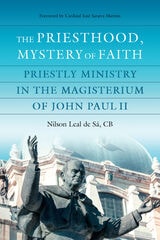
The Priesthood, Mystery of Faith
Priestly Ministry in the Magisterium of John Paul IINilson Leal de Sa, CB
Catholic University of America Press, 2022
After almost twenty-seven years of his pontificate, what was John Paul II’s legacy regarding the ministerial priesthood? What answers did he give to the questions still surrounding this reality today? Nilson Leal de Sá, CB, examines the pontiff’s twenty-seven letters of Holy Thursday addressed annually to the priests. Unlike some papal documents, which are drafted by many hands, these letters to priests were born of a personal initiative, wherein the pope spoke ab imo pectore (from the depths of his heart), giving a little of himself and his thought. Cardinal Georges-Marie Cottier, theologian emeritus of the Pontifical House and a connoisseur of the texts of the Holy Father, has confirmed that “the Letters of Holy Thursday were written by John Paul II himself.”
Leal de Sá has sought in the diversity of the letters of Holy Thursday the major points of the thought of John Paul II on this important topic. The first chapter dwells on the sources of his teaching and emphasizes his use of the Word of God, Tradition, and the conciliar Magisterium. These foundations are the basis of the second chapter, which highlights the priestly identity in the life of the Church. Finally, the third chapter elucidates the specific mission of the priest.
The Priesthood, Mystery of Faith presents itself as a real and stimulating synthesis of John Paul II’s thought about the ministerial priesthood in a systematic way. It renews us in the appreciation of the inestimable gift that God makes to the whole Church through the sacrament of the Holy Orders.
[more]
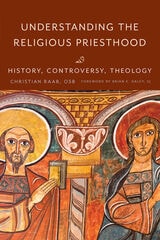
Understanding the Religious Priesthood
History, Controversy, TheologyChristian, OSB Raab
Catholic University of America Press, 2020
Most contemporary theologies of Holy Orders consider priesthood mainly in its diocesan context and most contemporary theologies of religious life do not consider how ordained ministry functions when it is internal rather than external to religious life. Understanding the Religious Priesthood provides a history and theology of religious priesthood that contributes to our understanding of this vocation’s identity and mission. It uncovers what religious priesthood shares with diocesan priesthood and non-ordained religious life and what makes it different from both those other vocations.
Christian Raab begins by tracing the history of religious priesthood from its origins in the early Church to the eve of the Second Vatican Council. He demonstrates that religious priests often faced questions about how to reconcile their two callings, but that they also provided answers in their theologies and spiritualities of priesthood and religious life. Meanwhile, they made key contributions to the Church’s life and mission. Raab then investigates the teachings of the Second Vatican Council on priesthood and religious life. Observing that the Council presented priesthood according to a diocesan typology and presented religious life without sacerdotal associations, he argues that the lack of imagery of religious priesthood contributed to a post-conciliar vocational identity crisis among religious priests. He then seeks to remedy this lacuna by appealing to the biblical images for religious priesthood Hans Urs von Balthasar offered in his theology of vocations. Raab argues that Balthasar’s imagery is a promising way forward for understanding the identity and mission of religious priesthood. In a final part, Raab provides a substantial theological articulation of religious priesthood which illuminates its liturgical signification, ecclesial mediation and mission, and ministerial identity. Here he draws not only from Balthasar but also from Pope John Paul II, Yves Congar, Jean-Marie Tillard, Brian Daley, and Guy Mansini to construct his profile.
[more]