Results by title
5 books match the query 'Patent laws and legislation'
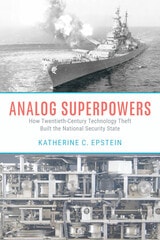
Analog Superpowers
How Twentieth-Century Technology Theft Built the National Security StateKatherine C. Epstein
University of Chicago Press, 2024
At the beginning of the twentieth century, two British inventors, Arthur Pollen and Harold Isherwood, became fascinated by a major military question: how to aim the big guns of battleships. These warships—of enormous geopolitical import before the advent of intercontinental missiles or drones—had to shoot in poor light and choppy seas at distant moving targets, conditions that impeded accurate gunfire. Seeing the need to account for a plethora of variables, Pollen and Isherwood built an integrated system for gathering data, calculating predictions, and transmitting the results to the gunners. At the heart of their invention was the most advanced analog computer of the day, a technological breakthrough that anticipated the famous Norden bombsight of World War II, the inertial guidance systems of nuclear missiles, and the networked “smart” systems that dominate combat today. Recognizing the value of Pollen and Isherwood’s invention, the British Royal Navy and the United States Navy pirated it, one after the other. When the inventors sued, both the British and US governments invoked secrecy, citing national security concerns.
Drawing on a wealth of archival evidence, Analog Superpowers analyzes these and related legal battles over naval technology, exploring how national defense tested the two countries’ commitment to individual rights and the free market. Katherine C. Epstein deftly sets out Pollen’s and Isherwood’s pioneering achievements, the patent questions raised, the geopolitical rivalry between Britain and the United States, and the legal precedents each country developed to control military tools built by private contractors.
Epstein’s account reveals that long before the US national security state sought to restrict information about atomic energy, it was already embroiled in another contest between innovation and secrecy. The America portrayed in this sweeping and accessible history isn’t yet a global hegemon but a rising superpower ready to acquire foreign technology by fair means or foul—much as it accuses China of doing today.

Expanding Intellectual Property
Copyrights and Patents in 20th Century Europe and beyondAugusta Dimou
Central European University Press, 2017

Patent Politics
Life Forms, Markets, and the Public Interest in the United States and EuropeShobita Parthasarathy
University of Chicago Press, 2017
To demonstrate this, Parthasarathy takes readers through a particularly fierce and prolonged set of controversies over patents on life forms linked to important advances in biology and agriculture and potentially life-saving medicines. Comparing battles over patents on animals, human embryonic stem cells, human genes, and plants in the United States and Europe, she shows how political culture, ideology, and history shape patent system politics. Clashes over whose voices and which values matter in the patent system, as well as what counts as knowledge and whose expertise is important, look quite different in these two places. And through these debates, the United States and Europe are developing very different approaches to patent and innovation governance. Not just the first comprehensive look at the controversies swirling around biotechnology patents, Patent Politics is also the first in-depth analysis of the political underpinnings and implications of modern patent systems, and provides a timely analysis of how we can reform these systems around the world to maximize the public interest.

The Patent Crisis and How the Courts Can Solve It
Dan L. Burk and Mark A. Lemley
University of Chicago Press, 2009
Patent law is crucial to encourage technological innovation. But as the patent system currently stands, diverse industries from pharmaceuticals to software to semiconductors are all governed by the same rules even though they innovate very differently. The result is a crisis in the patent system, where patents calibrated to the needs of prescription drugs wreak havoc on information technologies and vice versa. According to Dan L. Burk and Mark A. Lemley in The Patent Crisis and How the Courts Can Solve It, courts should use the tools the patent system already gives them to treat patents in different industries differently. Industry tailoring is the only way to provide an appropriate level of incentive for each industry.
Burk and Lemley illustrate the barriers to innovation created by the catch-all standards in the current system. Legal tools already present in the patent statute, they contend, offer a solution—courts can tailor patent law, through interpretations and applications, to suit the needs of various types of businesses. The Patent Crisis and How the Courts Can Solve It will be essential reading for those seeking to understand the nexus of economics, business, and law in the twenty-first century.

The Supreme Court and Patents and Monopolies
Edited by Philip B. Kurland
University of Chicago Press, 1975