Results by title

3 books match the query 'Patient'

cover of Communicative Biocapitalism: The Voice of the Patient in Digital Health and the Health Humanities

Communicative Biocapitalism

The Voice of the Patient in Digital Health and the Health Humanities

Olivia Banner

University of Michigan Press, 2017

The Precision Medicine Initiative, Apple’s HealthKit, the FitBit—the booming digital health industry asserts that digital networks, tools, and the scientific endeavors they support will usher in a new era of medicine centered around “the voice of the patient.” But whose “voices” do such tools actually solicit? And through what perspective will those voices be heard? Digital health tools are marketed as neutral devices made to help users take responsibility for their health. Yet digital technologies are not neutral; they are developed from an existing set of assumptions about their potential users and contexts for use, and they reflect dominant ideologies of health, dis/ability, gender, and race. Using patient-networking websites, the Quantified Self, and online breast cancer narratives,  Communicative Biocapitalism examines the cultural, technological, economic, and rhetorical logics that shape the “voice of the patient” in digital health to identify how cultural understandings and social locations of race, gender, and disability shape whose voices are elicited and how they are interpreted.
[more]
cover of ICD Connection: Living with an Implantable Cardioverter Defibrillator: A Collection of Patient & Family Stories

ICD Connection

Living with an Implantable Cardioverter Defibrillator: A Collection of Patient & Family Stories

Edited by Helen McFarland, RN

Michigan Publishing Services, 2012
Ten ICD recipients and family members share, in their own words, their unique journey of living with an implantable cardioverter defibrillator (ICD), cardiac arrhythmia, and for some, sudden cardiac arrest. These personal stories represent a diverse collection of experiences from many perspectives such as age, gender, culture, and diagnoses. These ten authors offer advice, encouragement, and hope to others living with similar experiences. The book also includes educational information and resources regarding ICD’s and advice from a clinical psychologist who specializes in helping ICD recipients and family members with emotional and psychological issues related to ICD implantation and cardiac arrhythmia. The book is an educational and support resource for anyone who has been touched by cardiac illness or ICD implantation. It also serves well for healthcare providers as it offers insight and understanding into the patients and families perspective after ICD implantation.
[more]
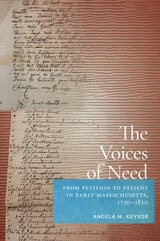
cover of The Voices of Need: From Petition to Patient in Early Massachusetts, 1730–1820

The Voices of Need

From Petition to Patient in Early Massachusetts, 1730–1820

Angela M. Keysor

University of Massachusetts Press, 2027

Revealing how people in need advocated for and negotiated their own care until the development of standardized medicine

The Voices of Need uncovers how men and women in Charlestown, Massachusetts, who turned to municipal authorities for aid, actively shaped how their need was understood and addressed. Through a close examination of Charlestown’s care networks, Angela Keysor shows how town selectmen relied on sufferers themselves to articulate what would relieve their distress, while local women—paid by town authorities—provided hands-on care in homes and neighborhoods. These networks flourished in the early and mid-eighteenth century, but their flexibility and responsiveness were increasingly strained by crisis and change. A devastating smallpox epidemic in 1763, followed by racialized debates over belonging after the legal end of enslavement in Massachusetts in 1783, exposed the limits of community-based care.

After the American Revolution, rising numbers of aid requests prompted town officials to reorganize care through a contract system in which paid caregivers attended to multiple dependents at once. As care became centralized and standardized, the space for individuals to define their own needs—and to influence how those needs were met—steadily narrowed. By 1819, with the founding of Massachusetts General Hospital, sufferers were fully redefined as patients, expected to submit to professional authority rather than participate in decisions about their own care.

Tracing this transition from negotiated assistance to institutional medicine, The Voices of Need illuminates a largely forgotten history of agency among the poor and infirm. In doing so, Keysor challenges conventional narratives of early American health care and shows how the rise of standardized medicine fundamentally reshaped the meaning of need, care, and authority. 

[more]