Results by title

7 books match the query 'Patronage'

cover of Angels in the American Theater: Patrons, Patronage, and Philanthropy

Angels in the American Theater

Patrons, Patronage, and Philanthropy

Edited by Robert A. Schanke

Southern Illinois University Press, 2007

Angels in the American Theater: Patrons, Patronage, and Philanthropy examines the significant roles that theater patrons have played in shaping and developing theater in the United States. Because box office income rarely covers the cost of production, other sources are vital. Angels—financial investors and backers—have a tremendous impact on what happens on stage, often determining with the power and influence of their money what is conceived, produced, and performed. But in spite of their influence, very little has been written about these philanthropists.
Composed of sixteen essays and fifteen illustrations, Angels in the American Theater explores not only how donors became angels but also their backgrounds, motivations, policies, limitations, support, and successes and failures. Subjects range from millionaires Otto Kahn and the Lewisohn sisters to foundation giants Ford, Rockefeller, Disney, and Clear Channel. The first book to focus on theater philanthropy, Angels in the American Theater employs both a historical and a chronological format and focuses on individual patrons, foundations, and corporations.
[more]
cover of Corrupt Illinois: Patronage, Cronyism, and Criminality

Corrupt Illinois

Patronage, Cronyism, and Criminality

Thomas J. Gradel and Dick Simpson

University of Illinois Press, 2015

Public funds spent on jets and horses. Shoeboxes stuffed with embezzled cash. Ghost payrolls and incarcerated ex-governors. Illinois' culture of "Where's mine?" and the public apathy it engenders has made our state and local politics a disgrace.
 
In Corrupt Illinois, veteran political observers Thomas J. Gradel and Dick Simpson take aim at business-as-usual. Naming names, the authors lead readers through a gallery of rogues and rotten apples to illustrate how generations of chicanery have undermined faith in, and hope for, honest government. From there, they lay out how to implement institutional reforms that provide accountability and eradicate the favoritism, sweetheart deals, and conflicts of interest corroding our civic life.
 
Corrupt Illinois lays out a blueprint to transform our politics from a pay-to-play–driven marketplace into what it should be: an instrument of public good.
[more]
cover of Electoral Dynamics in Indonesia: Money Politics, Patronage and Clientelism at the Grassroots

Electoral Dynamics in Indonesia

Money Politics, Patronage and Clientelism at the Grassroots

Edited by Edward Aspinall and Mada Sukmajati

National University of Singapore Press, 2016
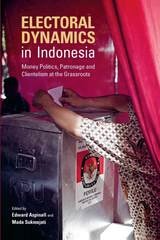
How do politicians win elected office in Indonesia? To find out, research teams fanned out across the country prior to Indonesia’s 2014 legislative election to record campaign events, interview candidates and canvassers, and observe their interactions with voters. They found that at the grassroots political parties are less important than personal campaign teams and vote brokers who reach out to voters through a wide range of networks associated with religion, ethnicity, kinship, micro enterprises, sports clubs and voluntary groups of all sorts. Above all, candidates distribute patronage—cash, goods and other material benefits—to individual voters and to communities. Electoral Dynamics in Indonesia brings to light the scale and complexity of vote buying and the many uncertainties involved in this style of politics, providing an unusually intimate portrait of politics in a patronage-based system.
[more]
cover of Electoral Dynamics in the Philippines: Money Politics, Patronage and Clientelism at the Grassroots

Electoral Dynamics in the Philippines

Money Politics, Patronage and Clientelism at the Grassroots

Edited by Allen Hicken, Edward Aspinall, and Meredith Weiss

National University of Singapore Press, 2019
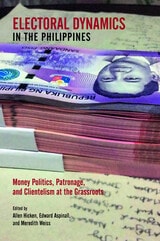
The role of clientism, political machines, and money in grassroots electioneering in the Philippines has been much analyzed by those who study the subject, but never as extensively as Allen Hicken, Edward Aspinall, and Meredith Weiss do in Electoral Dynamics in the Philippines. Combining in-depth ethnographic fieldwork in localities across the Philippines during the 2016 elections with polling data and national comparative data, this study sheds light on the organization of elections and electioneering across the Philippines. How do candidates choose to appeal to voters, and how do they get out the vote? How do voters respond to different kinds of appeals?  How important are patronage and clientism? What are the networks within which patronage is delivered? What do the political machines look like in elections influenced by social media? The book identifies commonalities and differences across the Philippines while speaking to current debates in political science about elections in developing democracies, the structure and organization of clientelism, and the role of money in elections.
[more]
cover of Power, Patronage, and the Local State in Ghana

Power, Patronage, and the Local State in Ghana

Barry Driscoll

Ohio University Press, 2023
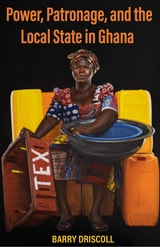
How have the waves of democracy and decentralization that swept the developing world in recent decades affected states—among the most important drivers of poverty and prosperity—at national and local levels in Ghana and beyond? State actors beneath the national level—what Barry Driscoll calls the local state—have considerable responsibility for carrying out state functions, but they are also forced to compete for these local state offices. How does a local state actually work in poor twentieth-century countries? This book offers a descriptive account, as well as a causal explanation, of how political competition affects the local state in Ghana. Driscoll shows how closely fought elections drive local state institutions to provide patronage. The source of these demands for patronage comes not from rent-seeking bureaucrats or landed elites but from the government’s own party volunteers. Driscoll explains how electoral competition affects how local state actors are insulated from such patronage demands. Moreover, these highly competitive, patronage-providing local governments actually have relatively better-qualified senior civil servants at their disposal. Driscoll makes sense of this paradox by introducing the logic of building administrative capacity in order to provide patronage. He then abstracts from the case of Ghana to generalize about how the effect of political competition is shaped by the locally salient variety of clientelism, which in turn is conditioned by the strength of the party system. The book draws on fourteen months of fieldwork in six of Ghana’s districts, far from the nation’s capital city. Ethnographic and interview data come from time spent with market traders, tax collectors, politicians, and other figures in local state offices. Quantitative data come from a survey covering almost all local governments. The result is a detailed account of Ghana’s local state power dynamics that has relevant implications for states across the developing world.
[more]
cover of The Art of the Network: Strategic Interaction and Patronage in Renaissance Florence

The Art of the Network

Strategic Interaction and Patronage in Renaissance Florence

Paul D. McLean

Duke University Press, 2007

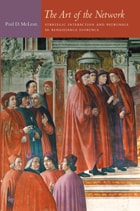
Writing letters to powerful people to win their favor and garner rewards such as political office, tax relief, and recommendations was an institution in Renaissance Florence; the practice was an important tool for those seeking social mobility, security, and recognition by others. In this detailed study of political and social patronage in fifteenth-century Florence, Paul D. McLean shows that patronage was much more than a pursuit of specific rewards. It was also a pursuit of relationships and of a self defined in relation to others. To become independent in Renaissance Florence, one first had to become connected. With The Art of the Network, McLean fills a gap in sociological scholarship by tracing the historical antecedents of networking and examining the concept of self that accompanies it. His analysis of patronage opens into a critique of contemporary theories about social networks and social capital, and an exploration of the sociological meaning of “culture.”

McLean scrutinized thousands of letters to and from Renaissance Florentines. He describes the social protocols the letters reveal, paying particular attention to the means by which Florentines crafted credible presentations of themselves. The letters, McLean contends, testify to the development not only of new forms of self-presentation but also of a new kind of self to be presented: an emergent, “modern” conception of self as an autonomous agent. They also bring to the fore the importance that their writers attached to concepts of honor, and the ways that they perceived themselves in relation to the Florentine state.

[more]
cover of The Politics of Patronage: Lawyers, Philanthropy, and the Mexican American Legal Defense and Educational Fund

The Politics of Patronage

Lawyers, Philanthropy, and the Mexican American Legal Defense and Educational Fund

By Benjamin Márquez

University of Texas Press, 2021

Co-winner, Latino Politics Best Book Award, American Political Science Association

The first book about the Mexican American Legal Defense and Educational Fund, the influential work it has done for the Latina/o community, and the issues stemming from its dependence on large philanthropic organizations.

Founded in 1968, the Mexican American Legal Defense and Educational Fund (MALDEF) is the Latino equivalent to the NAACP: a source of legal defense for the Latina/o community in cases centered on education, state immigration laws, redistricting, employment discrimination, and immigrant rights. Unlike the NAACP, however, MALDEF was founded by Mexican American activists in conjunction with the larger philanthropic structure of the Ford Foundation—a relationship that has opened it up to controversy and criticism.

In the first book to examine this little-known but highly influential organization, Benjamin Márquez explores MALDEF’s history and shows how it has thrived and served as a voice for the Latina/o community throughout its six decades of operation. But he also looks closely at large-scale investments of the Ford Foundation, Rockefeller Foundation, and others, considering how their ties to MALDEF have influenced Mexican American and Latinx politics. Its story crafted from copious research into MALDEF and its benefactors, this book brings to light the influence of outside funding on the articulation of minority identities and the problems that come with creating change through institutional means.

[more]