Results by title
3 books match the query 'Paul, Peter V.'
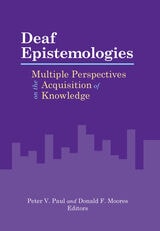
Deaf Epistemologies
Multiple Perspectives on the Acquisition of KnowledgePeter V. Paul
Gallaudet University Press, 2012
Epistemology is the study of how “knowledge” is formed. Standard epistemology isolates the “known” from the “knowers,” thereby defining “knowledge” as objectively constant. Multiple epistemologies suggest that individuals learn in different ways shaped by life factors such as education, family, ethnicity, history, and regional beliefs. In this groundbreaking volume, editors Peter V. Paul and Donald F. Moores call on ten other noted scholars and researchers to join them in examining the many ways that deaf people see and acquire deaf knowledge.
This collection considers three major groups of deaf knowledge perspectives: sociological and anthropological, historical/psychological and literary, and educational and philosophical. The first explores the adoption of a naturalized, critical epistemological stance in evaluating research; the epistemology of a positive deaf identity; how personal epistemologies can help form deaf education policies; and valuing deaf indigenous knowledge in research. The next part considers dueling epistemologies in educating deaf learners; reforms in deaf education; the role of deaf children of hearing parents in creating Deaf epistemologies; and the benefit of reading literature with deaf characters for all students. The final part explores the application of the Qualitative-Similarity Hypothesis to deaf students’ acquisition of knowledge; a metaparadigm for literacy instruction in bilingual-bicultural education; collaborative knowledge-building to access academia; and examination of the benefits and disadvantages of being deaf.
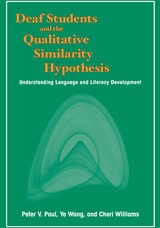
Deaf Students and the Qualitative Similarity Hypothesis
Understanding Language and Literacy DevelopmentPeter V. Paul
Gallaudet University Press, 2013
The difficulty that deaf and hard of hearing students have in attaining language and literacy skills has led to postulations that attribute their struggle to a developmental deficit. Recent research reveals, however, that deaf students acquire language structures, produce errors, and employ strategies in the same fashion as younger hearing students, though at later ages. The ability of all students to learn language and literacy skills in a similar manner at different stages forms the foundation of the Qualitative Similarity Hypothesis (QSH).
This volume describes the theoretical underpinnings and research findings of the QSH. It presents the educational implications for deaf and hard of hearing children and offers reason-based practices for improving their English language and literacy development. This collection also stresses the critical importance of exposing educators to the larger fields of literacy and second-language learning. Providing this background information expands the possibility of differentiating instruction to meet the needs of deaf students. Deaf Students and the Qualitative Similarity Hypothesis includes commentary on the QSH for both first- and second-language English learners and reflects on how the QSH can effect a better future for all language students.
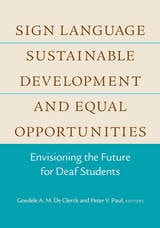
Sign Language, Sustainable Development, and Equal Opportunities
Envisioning the Future for Deaf StudentsGoedele A. M. De Clerck
Gallaudet University Press, 2016
The contributors to this volume offer creative and open-minded explorations of the construct of sustainability that are informed by their work with deaf individuals, deaf communities, families of deaf children, and other stakeholders. Sign Language, Sustainable Development, and Equal Opportunities describes sustainability in relation to:
· identity, resilience, and well-being
· participatory citizenship
· historical perspectives on sign language use in educational contexts
· sign language learning and teaching
· human rights and inclusive education
· literate thought and literacy
· the sign language factor and the development of sign language communities in sub-Saharan Africa
· sign language legislation
These changing communities’ understanding of what is required to become sustainable—in areas such as full participation and citizenship in society, economic well-being, access to quality education, and cultural and linguistic identity—is also taking new forms. This work contributes to the paradigm shifts regarding deaf emancipation and deaf education taking place around the world.