Results by title
7 books match the query 'Pay equity'
Doing Comparable Worth
Gender, Class, and Pay EquityJoan Acker
Temple University Press, 1991
Doing Comparable Worth is the first empirical study of the actual process of attempting to translate into reality the idea of equal pay for work of equal value. This political ethnography documents a large project undertaken by the state of Oregon to evaluate 35,000 jobs of state employees, identify gender-based pay inequities, and remedy these inequities. The book details both the technical and political processes, showing how the technical was always political, how management manipulated and unions resisted wage redistribution, and how initial defeat was turned into partial victory for pay equity by labor union women and women's movement activists.
As a member of the legislative task force that was responsible for implementing the legislation requiring a pay equity study in Oregon, Joan Acker gives an insider's view of how job evaluation, job classification, and the formulation of an equity plan were carried out. She reveals many of the political and technical problems in doing comparable worth that are not evident to outsiders. She also places comparable worth within a feminist theoretical perspective.
In the series Women in the Political Economy, edited by Ronnie J. Steinberg.

Gendered Places
The Landscape of Local Gender Norms across the United StatesWilliam J. Scarborough
Temple University Press, 2023
Every place has its quirky attributes, cultural reputation, and distinctive flair. But when we travel across America, do we also experience distinct gender norms and expectations? In his groundbreaking Gendered Places, William Scarborough examines metropolitan commuting zones to see how each region’s local culture reflects gender roles and gender equity. He uses surveys and social media data to measure multiple dimensions of gender norms, including expectations toward women in leadership, attitudes toward working mothers, as well as the division of household labor.
Gendered Places reveals that different locations, even within the same region of the country, such as Milwaukee and Madison Wisconsin, have distinct gender norms and highly influential cultural environments. Scarboroughshows how these local norms shape the attitudes and behaviors of residents with implications on patterns of inequality such as the gender wage gap. His findings offer valuable insight for community leaders and organizers making efforts to promote equality in their region.
Scarboroughrecognizes local culture as not value-neutral, but highly crucial to the gender structure that perpetuates, or challenges, gender inequality. Gendered Places questions how these gender norms are sustained and their social consequences.
Job Queues, Gender Queues
Explaining Women's Inroads into Male OccupationsBarbara F. Reskin and Patricia A. Roos
Temple University Press, 1990
Since 1970, women have made widely publicized gains in several customarily male occupations. Many commentators have understood this apparent integration as an important step to sexual equality in the workplace. Barbara F. Reskin and Patricia A. Roos read a different lesson in the changing gender composition of occupations that were traditionally reserved for men. With persuasive evidence, Job Queues, Gender Queues offers a controversial interpretation of women's dramatic inroads into several male occupations based on case studies of "feminizing" male occupation.
The authors propose and develop a queuing theory of occupations' sex composition. This theory contends that the labor market comprises a "gender queue" with employers preferring male to female workers for most jobs. Workers also rank jobs into a "job queue." As a result, the highest-ranked workers monopolize the most desirable jobs. Reskin and Roos use this queuing perspective to explain why several male occupations opened their doors to women after 1970. The second part of the book provides evidence for this queuing analysis by presenting case studies of the feminization of specific occupations. These include book editor, pharmacist, public relations specialist, bank manager, systems analyst, insurance adjuster, insurance salesperson, real estate salesperson, bartender, baker, and typesetter/compositor.
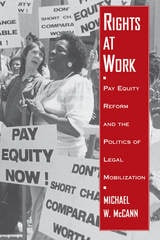
Rights at Work
Pay Equity Reform and the Politics of Legal MobilizationMichael W. McCann
University of Chicago Press, 1994
Rights at Work explores the political strategies in more than a dozen pay equity struggles since the late 1970s, including battles of state employees in Washington and Connecticut, as well as city employees in San Jose and Los Angeles. Relying on interviews with over 140 union and feminist activists, McCann shows that, even when the courts failed to correct wage discrimination, litigation and other forms of legal advocacy provided reformers with the legal discourse—the understanding of legal rights and their constraints—for defining and advancing their cause.
Rights at Work offers new insight into the relation between law and social change—the ways in which grass roots social movements work within legal rights traditions to promote progressive reform.
Squaring Up
Policy Strategies to Raise Women's Incomes in the United StatesMary C. King, Editor
University of Michigan Press, 2001
The Declining Significance of Gender?
Francine D. Blau
Russell Sage Foundation, 2006
Wage Justice
Comparable Worth and the Paradox of Technocratic ReformSara M. Evans and Barbara N. Nelson
University of Chicago Press, 1991
"A perceptive and judicious analysis of comparable worth."—Wendy Kaminer, New York Times Book Review
"Very well-crafted. . . . Wage Justice has admirably launched the scholarly evaluation of pay equity, revealing the unforeseen complexities of this key feminist public policy innovation."—Maurine Weiner Greenwald, Journal of American History
"An insightful glimpse of the policy process."—Marian Lief Palley, American Political Science Review