Results by title
2 books match the query 'Paylore, Patricia G.'
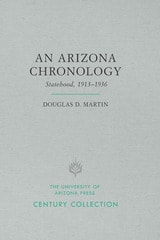
An Arizona Chronology
Statehood, 1913–1936Douglas D. Martin; Edited by Patricia Paylore
University of Arizona Press, 1966
The lively role of the newspaper in “telling history’s story” comes across in An Arizona Chronology, Volume Two, the continued selection by the late veteran journalist, Douglas D. Martin, of reported highlights in Arizona’s first two and a half decades as a state.
Here were the years in which Arizona’s “bad men” virtually dropped out of sight, and the trigger-blast was displaced by the gavel-thumping sound of law and order as a Territory grew up and became a state. The problem of the Apache was no more, and the problem of water began to loom large. Depression and prohibition were the counter-themes. And Arizona’s three C's—Copper, Cattle, and Cotton—were about to strike for their place in the national limelight.
It was a time of conversion. The vital currents of frontier energy were turned into the channels of modern agriculture, finance, and urban growth. As this volume’s editor, Patricia Paylore, points out, the transformation reaffirms Douglas Martin’s view of Arizona history as the “persistence of the pioneer spirit of the nineteenth century” in terms of “the strength and optimism of a young people determined to take its place in the Union.”
[more]
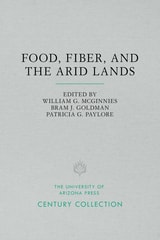
Food, Fiber, and the Arid Lands
Edited by William G. McGinnies, Bram J. Goldman, and Patricia G. Paylore
University of Arizona Press, 1971
From the Foreword:
The world’s dramatic awakening to the impact of ecology on the quality of human life, and a new awareness of the potential for exploitation of the desert environment—in which our particular interest lies—give rise to more thoughtful, even sober, attention to the problems faced by those aspiring only to bigger yields from crops and more protein from animals. To these very basic needs of food and fiber, we are, therefore, addressing ourselves further to a consideration of housing, educational programs, and nonagrarian resource evolution, to the end that the planners and the decision makers may have the benefit of the most intelligent and contemporary understanding possible of the cultural and social aspects of arid lands as well as the latest technological advances on a wide-ranging spectrum of scientific developments.
The world’s dramatic awakening to the impact of ecology on the quality of human life, and a new awareness of the potential for exploitation of the desert environment—in which our particular interest lies—give rise to more thoughtful, even sober, attention to the problems faced by those aspiring only to bigger yields from crops and more protein from animals. To these very basic needs of food and fiber, we are, therefore, addressing ourselves further to a consideration of housing, educational programs, and nonagrarian resource evolution, to the end that the planners and the decision makers may have the benefit of the most intelligent and contemporary understanding possible of the cultural and social aspects of arid lands as well as the latest technological advances on a wide-ranging spectrum of scientific developments.
[more]