Results by title
4 books match the query 'Payne, Darwin Reid'

Computer Scenographics
Darwin Reid Payne
Southern Illinois University Press, 1994
Darwin Reid Payne’s approach to theatrical design is that of a computer advocate and pioneer. With Computer Scenographics, he ushers in a new generation of scenery design by applying state-of-the-art technology to the traditional methods of scenography. Though not a how-to book, Computer Scenographics is a general introduction to, and an affirmation of, the value of computer graphics for both student and working scenographers.
Payne acknowledges that many scenographers would not want to use computers exclusively in the preparation of their designs. Today’s scenographers continue to value the manual skills of drawing and painting, learned and perfected over time, and would not consider abandoning these skills entirely. And it is unlikely that the most powerful computer or most sophisticated software could ever supplant that intimate interaction of hand and mind provided by traditional tools and materials. Nevertheless, Payne’s utilization of the Virtus Walk-Through computer program to facilitate set design expands the tools of the artist to new dimensions.
Aided by 129 illustrations, Payne addresses four major topics: (1) how computer studios are set up; (2) how computers serve as storage for visual ideas and as conceptual tools; (3) how technical information needed for producing a scenographer’s ideas onstage is created with computers; (4) and how modelmaking has been changed by computer-generated three-dimensional possibilities, especially by the introduction of "virtual reality" onto the computer platform.
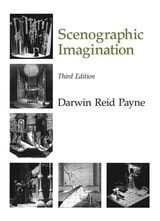
The Scenographic Imagination, Third Edition
Darwin Reid Payne
Southern Illinois University Press, 1993
In this enlarged and thoroughly revised third edition of his widely used text, Darwin Reid Payne explores the principles and philosophies that shape the visual elements of theatre.
Payne sets out to discover who scenographers are and to define their responsibilities. He sees scenographers as not merely craftspersons but artists with "a special vision that spans all the arts." Such artists are in a position to "extend and amplify underlying meanings of the production." The proper goal of beginning scenographers, according to Payne, is one day to be able to approach the job as artists in full command of their craft.
Payne seeks to instill in beginning scenographers a basic core of knowledge: an understanding of theatre history and the development of drama; a knowledge of art history and an understanding of periods and styles of architecture, painting, sculpture, furnishings, and costume; and a familiarity with the principles, techniques, and materials of pictorial and three-dimensional design. This new edition contains 248 illustrations, 38 more than the second edition. Payne’s goal, certainly, is to teach students what to do and how to do it; equally important, however, is Payne’s view that scenographers must know why.
To Payne, "Scenography is an art whose scope is nothing less than the whole world outside the theatre." Scenographers must read not only in their own field but in others as well. Payne has incorporated into his text many suggestions for outside readings, quoting passages and even entire chapters from important works. Stressing research, Payne argues that without knowledge of the literature of their own and related arts, scenographers cannot grow. And that is the emphasis of this book: to present aspiring scenographers with an approach and a set of concepts that will enable them to grow. Toward that end, Payne establishes five priorities, the first of which is to develop in students what he calls "time vision," or the ability to "see" the historical past as a living place with living inhabitants. The second priority is to bring about an awareness that allows students to "see" beneath the surface of objects and events. Third, students must be helped to recognize and appreciate the difference between the "concept of space as it exists outside the theatre and the concept of space as it is used within the theatre." The fourth priority is to ingrain in students an understanding of the importance of imagery to the scenographer, and the final priority is to teach those technical skills necessary to carry out the concepts of the scenographer.
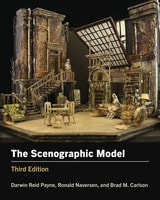
The Scenographic Model
Third EditionDarwin Reid Payne, Ronald Naversen, and Brad M. Carlson
Southern Illinois University Press, 2025
An authoritative guide to modelmaking for theater
This third edition of noted scenographer Darwin Reid Payne’s landmark text builds upon Payne’s theories and exercises to provide a modern exploration of the practice of theatrical modelmaking. With chapters on traditional and contemporary materials, tools, and techniques, the book serves as a foundational guide to understanding the historical, theoretical, and practical aspects of scenographic modelmaking, making it essential for the beginner, generalist, and professional design practitioner.
The volume begins with a brief history of the scenographic model and explores how modelmaking has adapted to changes in materials, technology, and commercial influences over time. It details setting up a safe, productive model-building studio before introducing the types and purposes of various scenographic models. It then instructs the reader in constructing common model elements and accessories. Later chapters explore how the models reveal stage space and create mood and atmosphere through tonal shading and lighting; discuss the use of found objects, collage techniques, and projection models in scenic design; and delve into 3D printing and computer routering. The final chapter provides information on various aspects of photography and image sharing related to design and production communication.
This comprehensive text provides information not just from theater but also from other modeling disciplines and sources, including architecture, film, dioramas, dollhouse modeling, and model railroading. A useful resource for high school, community college, university, and community theater enthusiasts, it is an excellent reference book for theater designers throughout the country.
Theory and Craft of the Scenographic Model, Revised Edition
Darwin Reid Payne
Southern Illinois University Press, 1985
Through diagrams, sketches, and models, along with explications of the essential tools and materials required, Payne defines and delineates the precise step-by-step procedures of scenographic modelmaking: the basic preparations of construction, the process of making the model, and the experimental aspects of modelmaking. This new edition with 50 additional illustrations and other new information offers teachers, students, and beginning professionals alike a complete and comprehensive approach to creating and constructing the scenographic model.