Results by title
2 books match the query 'Payne, John W.'

Emotional Decisions
Trade off Difficulty and Coping in Consumer ChoiceMary Frances Luce, James R. Bettman, and John W. Payne
University of Chicago Press, 2001
Decision-making can be difficult and often results in necessary trade-offs, e.g., safety versus price in the purchasing of an automobile. This work provides a model of trade-off difficulty, focusing on its antecedents and consequences. The authors advance a new framework for the integration of the emotional and cognitive aspects of decision-making and argue that consumers perceive and appraise their choices in light of their goals and potential coping strategies.
[more]
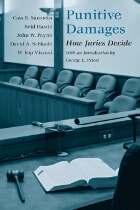
Punitive Damages
How Juries DecideCass R. Sunstein, Reid Hastie, John W. Payne, David A. Schkade, and W. Kip Viscu
University of Chicago Press, 2002
Over the past two decades, the United States has seen a dramatic increase in the number and magnitude of punitive damages verdicts rendered by juries in civil trials. Probably the most extraordinary example is the July 2000 award of $144.8 billion in the Florida class action lawsuit brought against cigarette manufacturers. Or consider two recent verdicts against the auto manufacturer BMW in Alabama. In identical cases, argued in the same court before the same judge, one jury awarded $4 million in punitive damages, while the other awarded no punitive damages at all. In cases involving accidents, civil rights, and the environment, multimillion-dollar punitive awards have been a subject of intense controversy.
But how do juries actually make decisions about punitive damages? To find out, the authors-experts in psychology, economics, and the law-present the results of controlled experiments with more than 600 mock juries involving the responses of more than 8,000 jury-eligible citizens. Although juries tended to agree in their moral judgments about the defendant's conduct, they rendered erratic and unpredictable dollar awards. The experiments also showed that instead of moderating juror verdicts, the process of jury deliberation produced a striking "severity shift" toward ever-higher awards. Jurors also tended to ignore instructions from the judges; were influenced by whatever amount the plaintiff happened to request; showed "hindsight bias," believing that what happened should have been foreseen; and penalized corporations that had based their decisions on careful cost-benefit analyses. While judges made many of the same errors, they performed better in some areas, suggesting that judges (or other specialists) may be better equipped than juries to decide punitive damages.
Using a wealth of new experimental data, and offering a host of provocative findings, this book documents a wide range of systematic biases in jury behavior. It will be indispensable for anyone interested not only in punitive damages, but also jury behavior, psychology, and how people think about punishment.
[more]