Results by title
7 books match the query 'Paz, Octavio'
Octavio Paz
A MeditationIlan Stavans
University of Arizona Press, 2001
Reality in Movement
Octavio Paz as Essayist and Public IntellectualMaarten van Delden
Vanderbilt University Press, 2021
Reality in Movement looks at a wide range of topics of interest in Paz's career, including his engagement with the subversive, adversary strain in Western culture; his meditations on questions of cultural identity and intercultural contact; his dialogue with both leftist and conservative ideological traditions; his interest in feminism and psychoanalysis, and his theory of poetry. It concludes with a chapter on Octavio Paz as a literary character—a kind of reception study.
Offering a complex and nuanced portrait of Paz as a writer and thinker—as well as an understanding of the era in which he lived—Reality in Movement will appeal to students of Octavio Paz and of Mexican literature more generally, and to readers with an interest in the many significant literary, cultural, political, and historical topics Paz wrote about over the course of his long career.
The Bow and the Lyre
The Poem, The Poetic Revelation, Poetry and HistoryBy Octavio Paz
University of Texas Press, 1973
In The Bow and the Lyre Octavio Paz, one of the most important poets writing in Spanish, presents his sustained reflections on the poetic phenomenon and on the place of poetry in history and in our personal lives. It is written in the same prose style that distinguishes The Labyrinth of Solitude. The Bow and the Lyre will serve as an important complement to Paz's poetry.
Paz's discussions of the different aspects of the poetic phenomenon are not limited to Spanish and Spanish American literature. He is almost as apt to choose an example from Homer, Vergil, Blake, Whitman, Rimbaud as he is from Lope de Vega, Jiménez, Darío, Neruda. In writing these essays, he draws on his vast storehouse of knowledge, revealing a world outlook of ample proportions. In reading these essays, we share the observations of a searching, original, highly cultivated mind.
The Latin American Ecocultural Reader
Edited by Jennifer French and Gisela Heffes
Northwestern University Press, 2021
The Latin American Ecocultural Reader is a comprehensive anthology of literary and cultural texts about the natural world. The selections, drawn from throughout the Spanish-speaking countries and Brazil, span from the early colonial period to the present. Editors Jennifer French and Gisela Heffes present work by canonical figures, including José Martí, Bartolomé de las Casas, Rubén Darío, and Alfonsina Storni, in the context of our current state of environmental crisis, prompting new interpretations of their celebrated writings. They also present contemporary work that illuminates the marginalized environmental cultures of women, indigenous, and Afro-Latin American populations. Each selection is introduced with a short essay on the author and the salience of their work; the selections are arranged into eight parts, each of which begins with an introductory essay that speaks to the political, economic, and environmental history of the time and provides interpretative cues for the selections that follow.
The editors also include a general introduction with a concise overview of the field of ecocriticism as it has developed since the 1990s. They argue that various strands of environmental thought—recognizable today as extractivism, eco-feminism, Amerindian ontologies, and so forth—can be traced back through the centuries to the earliest colonial period, when Europeans first described the Americas as an edenic “New World” and appropriated the bodies of enslaved Indians and Africans to exploit its natural bounty.
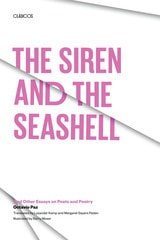
The Siren and the Seashell
And Other Essays on Poets and PoetryBy Octavio Paz
University of Texas Press, 1976
Octavio Paz has long been known for his brilliant essays as well as for his poetry. Through the essays, he has sought to confront the tensions inherent in the conflict between art and society and to achieve a unity of their polarities. The Siren and the Seashell is a collection of Paz’s essays, focusing on individual poets and on poetry in general. The first five poets he treats are Latin American: Sor Juana Inés de la Cruz, Rubén Darío, José Juan Tablada, Ramón López Velarde, and Alfonso Reyes. Then there are essays on Robert Frost, e. e. cummings, Saint-John Perse, Antonio Machado, and Jorge Guillén. Finally, there are Paz’s reflections on the poetry of solitude and communion and the literature of Latin America. Each essay is more than Paz’s impressions of one person or issue; each is the occasion for a wider discussion of cultural, historical, psychological, and philosophical themes. The essays were selected from Paz’s writing between 1942 and 1965 and provide an overview of the development of his thinking and an exploration of the ideas central in his works.
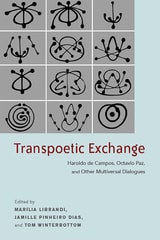
Transpoetic Exchange
Haroldo de Campos, Octavio Paz, and Other Multiversal DialoguesMarília Librandi
Bucknell University Press, 2020
The volume is divided into three parts. “Essays” unites seven texts by renowned scholars who focus on the relationship between the two authors, their impact and influence, and their cultural resonance by exploring explore the historical background and the different stylistic and cultural influences on the authors, ranging from Latin America and Europe to India and the U.S. The second section, “Remembrances,” collects four experiences of interaction with Haroldo de Campos in the process of transcreating Paz’s poem and working on Transblanco and Galáxias. In the last section, “Poems,” five poets of international standing--Jerome Rothenberg, Antonio Cicero, Keijiro Suga, André Vallias, and Charles Bernstein.
Paz and Campos, one from Mexico and the other from Brazil, were central figures in the literary history of the second half of the 20th century, in Latin America and beyond. Both poets signal the direction of poetry as that of translation, understood as the embodiment of otherness and of a poetic tradition that every new poem brings back as a Babel re-enacted.
This volume is a print corollary to and expansion of an international colloquium and poetic performance held at Stanford University in January 2010 and it offers a discussion of the role of poetry and translation from a global perspective. The collection holds great value for those interested in all aspects of literary translation and it enriches the ongoing debates on language, modernity, translation and the nature of the poetic object.
Published by Bucknell University Press. Distributed worldwide by Rutgers University Press.
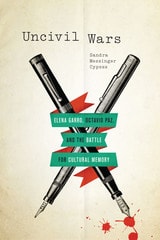
Uncivil Wars
Elena Garro, Octavio Paz, and the Battle for Cultural MemoryBy Sandra Messinger Cypess
University of Texas Press, 2012
The first English-language book to place the works of Elena Garro (1916–1998) and Octavio Paz (1914–1998) in dialogue with each other, Uncivil Wars evokes the lives of two celebrated literary figures who wrote about many of the same experiences and contributed to the formation of Mexican national identity but were judged quite differently, primarily because of gender.
While Paz’s privileged, prize-winning legacy has endured worldwide, Garro’s literary gifts garnered no international prizes and received less attention in Latin American literary circles. Restoring a dual perspective on these two dynamic writers and their world, Uncivil Wars chronicles a collective memory of wars that shaped Mexico, and in turn shaped Garro and Paz, from the Conquest period to the Mexican Revolution; the Spanish Civil War, which the couple witnessed while traveling abroad; and the student massacre at Tlatelolco Plaza in 1968, which brought about social and political changes and further tensions in the battle of the sexes. The cultural contexts of machismo and ethnicity provide an equally rich ground for Sandra Cypess’s exploration of the tandem between the writers’ personal lives and their literary production. Uncivil Wars illuminates the complexities of Mexican society as seen through a tense marriage of two talented, often oppositional writers. The result is an alternative interpretation of the myths and realities that have shaped Mexican identity, and its literary soul, well into the twenty-first century.