Results by title
3 books match the query 'Peace movements in literature'
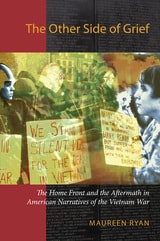
The Other Side of Grief
The Home Front and the Aftermath in American Narratives of the Vietnam WarMaureen Ryan
University of Massachusetts Press, 2008
The lingering aftereffects of the Vietnam War resonate to this day throughout American society: in foreign policy, in attitudes about the military and war generally, and in the contemporary lives of members of the so-called baby boom generation who came of age during the 1960s and early 1970s. While the best-known personal accounts of the war tend to center on the experience of combat, Maureen Ryan's The Other Side of Grief examines the often overlooked narratives—novels, short stories, memoirs, and films—that document the war's impact on the home front.
In analyzing the accounts of Vietnam veterans, women as well as men, Ryan focuses on the process of readjustment, on how the war continued to insinuate itself into their lives, their families, and their communities long after they returned home. She looks at the writings of women whose husbands, lovers, brothers, and sons served in Vietnam and whose own lives were transformed as a result. She also appraises the experiences of the POWs who came to be embraced as the war's only heroes; the ordeal of Vietnamese refugees who fled their “American War” to new lives in the United States; and the influential movement created by those who committed themselves to protesting the war.
The end result of Ryan's investigations is a cogent synthesis of the vast narrative literature generated by the Vietnam War and its aftermath. Together those stories powerfully demonstrate how deeply the legacies of the war penetrated American culture and continue to reverberate still.
Waging War on War
Peacefighting in American LiteratureGiorgio Mariana
University of Illinois Press, 2015
Giorgio Mariani rigorously engages with the essential question of what makes a text explicitly anti-war. Ranging from Emerson and Joel Barlow to Maxine Hong Kingston and Tim O'Brien, Waging War on War explores why sustained attempts at identifying the anti-war text's formal and philosophical features seem to always end at an impasse. Mariani moves a step beyond to construct a theoretical model that invites new inquiries into America's nonviolent, nonconformist tradition even as it challenges the ways we study U.S. warmaking and the cultural reactions to it. In the process, he shows how the ideal of nonviolence and a dislike of war have been significant, if nonhegemonic, features of American culture since the nation's early days.
Ambitious and nuanced, Waging War on War at last defines anti-war literature while exploring the genre's role in an assertive peacefighting project that offered--and still offers--alternatives to violence.
Writing against War
Literature, Activism, and the British Peace MovementCharles Andrews
Northwestern University Press, 2017
The cataclysm of the First World War gave rise to the British Peace Movement, a spectrum of pacifist, internationalist, and antiwar organizations and individuals. Antiwar sentiments found expression not only in editorials, criticism, and journalism but also in novels and other works of literature. Writing against War examines the work of Aldous Huxley, Storm Jameson, Siegfried Sassoon, Rose Macaulay, and Virginia Woolf to analyze the effects of their attempts to employ fiction in the service of peace activism. It further traces how Huxley, Woolf, and others sought to reconcile their antiwar beliefs with implacable military violence.
The British Peace Movement's failure to halt the rise of fascism and the Second World War continues to cast a shadow over contemporary pacifist movements. Writing about War will fascinate scholars of peace studies and literature and offers valuable insights for current-day peace activists and artists who seek to integrate creativity with activism.