Results by title
3 books match the query 'Peacekeeping forces'
Civil Wars and Foreign Powers
Outside Intervention in Intrastate ConflictPatrick M. Regan
University of Michigan Press, 2002
We have seen recent massive intervention by the United States and its allies in Europe in internal conflict in Bosnia and Kosovo. In Civil Wars and Foreign Powers: Outside Intervention in Intrastate Conflict, Patrick Regan systematically answers the question about the conditions under which third parties intervene in civil conflicts to stop the fighting. It uses data on all civil conflicts since 1945 to identify those conflicts that are amenable to outside interventions and the types of interventions that are more likely to be successful. Civil Wars and Foreign Powers is a book about how governments can help facilitate the end of civil conflicts. In a time when internal conflicts appear to be increasing in number, and increasingly destabilizing, governments need to know what policies work and when. Interventions are generally of two sorts -- unilateral, or when one state takes action, and multilateral, such as UN or NATO action. This book examines the conditions under which each form of intervention is most likely and most effective. The analysis suggests that three conditions associated with multi-lateral interventions will increase the likelihood of success: mutual consent of the parties involved; impartiality on the part of the intervenors; and the existence of a coherent intervention strategy. The questions are posed from the perspective of the decision maker and the answers offered are framed in a language familiar to the decision-making community. The book mixes descriptive case material with systematic statistical analysis of a unique data set of all civil conflicts since World War II, providing contemporary examples to illustrate overall trends in the data. Beyond the policy implications this work is also rich in theoretical development about issues of conflict and conflict management. This book will appeal to students of international conflict, civil war, ethnic conflict, and those who are concerned with developing policy in the post-cold war world to deal with intrastate conflict.
[more]
Claiming Impartiality
Peacebuilding Organizations as Actors in Multiple Fields of Global GovernanceAndrea Warnecke
University of Michigan Press, 2026
Why has multilateral peacebuilding in conflict-ridden states emerged as a depoliticized practice that rarely engages with local actors and agendas? And why has depoliticization persisted despite continued criticisms? Claiming Impartiality offers an innovative answer to the puzzling persistence of depoliticization in post-war peacebuilding that focuses on the institutional mandates, interests, and practices of those international and bilateral organizations that design and implement most peacebuilding interventions.
Drawing on and expanding a Bourdieusian field perspective, the book examines international organizations as actors in multiple fields of global governance. Using the case studies of Bosnia and Herzegovina and Timor-Leste, it traces the emergence and transformation of peacebuilding practices by leading international and bilateral organizations during the first two decades of the field’s existence. The organizational lens highlights the tensions that exist between the objectives of simultaneously acting as a peacebuilding organization and as a peacekeeping, humanitarian, or development organization whose practices are to varying degrees committed to observing the twin principles of impartiality and neutrality. By thinking through these sometimes contradictory roles, the book offers new insights into how these organizations sideline questions of political agency in favor of expanding their influence into related fields of global governance. Claiming Impartiality discusses the future of peacebuilding and explores avenues for addressing political challenges to peace itself.
Drawing on and expanding a Bourdieusian field perspective, the book examines international organizations as actors in multiple fields of global governance. Using the case studies of Bosnia and Herzegovina and Timor-Leste, it traces the emergence and transformation of peacebuilding practices by leading international and bilateral organizations during the first two decades of the field’s existence. The organizational lens highlights the tensions that exist between the objectives of simultaneously acting as a peacebuilding organization and as a peacekeeping, humanitarian, or development organization whose practices are to varying degrees committed to observing the twin principles of impartiality and neutrality. By thinking through these sometimes contradictory roles, the book offers new insights into how these organizations sideline questions of political agency in favor of expanding their influence into related fields of global governance. Claiming Impartiality discusses the future of peacebuilding and explores avenues for addressing political challenges to peace itself.
[more]
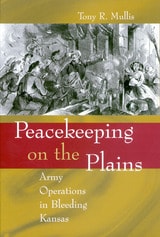
Peacekeeping on the Plains
Army Operations in Bleeding KansasTony R. Mullis
University of Missouri Press, 2004
Historians have written on “Bleeding Kansas” and on the frontier army as a constabulary force, but little scholarship exists on how the army performed its peacekeeping operations in the 1850s. In Peacekeeping on the Plains, Tony R. Mullis is one of the first scholars to detail the military concerns associated with peace enforcement in Kansas and the trans-Missouri West.
Between 1854 and 1856, the Franklin Pierce administration called upon the U.S. Army to conduct a series of peace operations in the newly formed Kansas and Nebraska territories. The army responded to the president’s call by successfully completing a mission against the Lakota Sioux in 1855 and by aiding civil authorities in the imposition of peace among competing factions in Kansas during 1856.
Although these police duties were not always popular with the soldiers that conducted them, the purpose behind them remained constant—the maintenance of peace, order, and security. Given Americans’ misgivings about a standing army and their limited expectations for it as a domestic peacekeeper, its use in this fashion during the 1850s was a delicate proposition.
By drawing on diverse sources, including official army correspondence, personal papers of key military and political leaders, and local accounts of army activities, Mullis shows how peace operations were conducted by the U.S. Army long before the second half of the twentieth century. He alsopresents a thorough analysis of the professional dilemmas confronted by army officers, as well as the delicate command and control issues associated with the different types of peace operations.
Mullis’s assessment of the army’s peacekeeping efforts in the mid-1850s offers a full understanding of the constraints and frustrations involved. Many of the dilemmas faced by the army in Kansas parallel those encountered in various spots around the globe today. Peacekeeping on the Plains will provide any reader with a better insight into the nuances of peace operations in the 1850s and assist military historians in their understanding of these activities as they relate to the twenty-first century.
[more]