Results by title
10 books match the query 'Pedagogies'
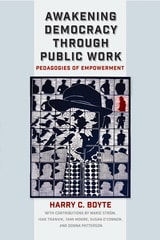
Awakening Democracy through Public Work
Pedagogies of EmpowermentHarry C. Boyte
Vanderbilt University Press, 2018
Awakening Democracy through Public Work begins with the story of Public Achievement, a youth civic education and empowerment initiative with roots in the civil rights movement. It describes Public Achievement's first home in St. Bernard's, a low-income Catholic elementary school in St. Paul, Minnesota, and how the program spread across the country and then abroad, giving birth to the larger concept of public work.
In Public Achievement, young people practice "citizen politics" as they tackle issues ranging from bullying, racism, and sexual harassment to playground improvements, curriculum changes, and better school lunches. They develop everyday political skills for working across differences and making constructive change. Such citizen politics, more like jazz than a set piece of music, involves the interplay and negotiation of diverse interests and views, sometimes contentious, sometimes harmonious. Public Achievement highlights young people's roles as co-creators—builders of schools, communities, and democratic society. They are not citizens in waiting, but active citizens who do public work.
Awakening Democracy through Public Work also describes how public work can find expression in many kinds of work, from education and health to business and government. It is relevant across the sweep of society. People have experimented with the idea of public work in hundreds of settings in thirty countries, from Northern Ireland and Poland to Ghana and Japan. In Burundi it birthed a national initiative to rework relations between villagers and police. In South Africa it helped people in poor communities to see themselves as problem solvers rather than simply consumers of government services.
In the US, at Denison University, public work is being integrated into dorm life. At Maxfield School in St. Paul, it is transforming special education. In rural Missouri, it led to the "emPowerU" initiative of the Heartland Foundation, encouraging thousands of young people to stay in the region. In Eau Claire, Wisconsin, it generated "Clear Vision," a program providing government support for citizen-led community improvements. Public work has expanded into the idea of "citizen professionals" working with other citizens, not on them or for them. It has also generated the idea of "civic science," in which scientists see themselves as citizens and science as a resource for civic empowerment.
Awakening Democracy through Public Work shows that we can free the productive powers of people to work across lines and differences to build a better society and create grounded hope for the future.
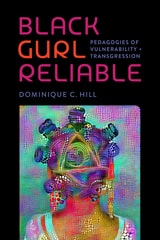
Black Gurl Reliable
Pedagogies of Vulnerability and TransgressionDominique C. Hill
Vanderbilt University Press, 2025
As a means of mitigating the deleterious effects of schooling on Black girls’ and women’s bodies and making legible the insights and knowledge produced from schooling experiences, Hill introduces the concept of Transgressngroove. This living feminist practice explores the relationships between Black girlhood, education, and the body, as researched for over a decade through workshops, consulting, classrooms, personal development, and other teaching/learning spaces.
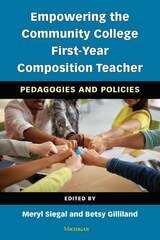
Empowering the Community College First-Year Composition Teacher
Pedagogies and PoliciesMeryl Siegal and Betsy Gilliland
University of Michigan Press, 2021
This volume is an inquiry into community college first-year pedagogy and policy at a time when change has not only been called for but also mandated by state lawmakers who financially control public education. It also acknowledges new policies that are eliminating developmental and remedial writing courses while keeping mind that, for most community college students, first-year composition serves as the last course they will take in the English department toward their associate’s degree.
Chapters focusing on pedagogy and policy are integrated within cohesively themed parts: (1) refining pedagogy; (2) teaching toward acceleration; (3) considering programmatic change; and (4) exploring curriculum through research and policy. The volume concludes with the editors’ reflections regarding future work; a glossary and reflection questions are included.
This volume also serves as a call to action to change the way community colleges attend to faculty concerns. Only by listening to teachers can the concerns discussed in the volume be addressed; it is the teachers who see how societal changes intersect with campus policies and students’ lives on a daily basis.
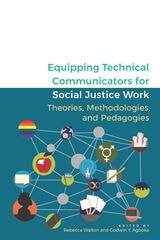
Equipping Technical Communicators for Social Justice Work
Theories, Methodologies, and PedagogiesRebecca Walton
Utah State University Press, 2021
For the field of technical and professional communication to maintain its commitment to this work, how social justice intersects with inclusivity through UX, technological, civic, and legal literacies, as well as through community engagement, must be acknowledged. Equipping Technical Communicators for Social Justice Work will be of significance to established scholar-teachers and graduate students, as well as to newcomers to the field.
Contributors: Kehinde Alonge, Alison Cardinal, Erin Brock Carlson, Oriana Gilson, Laura Gonzales, Keith Grant-Davie, Angela Haas, Mark Hannah, Kimberly Harper, Sarah Beth Hopton, Natasha Jones, Isidore Kafui Dorpenyo, Liz Lane, Emily Legg, Nicole Lowman, Kristen Moore, Emma Rose, Fernando Sanchez, Jennifer Sano-Franchini, Adam Strantz, Cana Uluak Itchuaqiyaq, Josephine Walwema, Miriam Williams, Han Yu
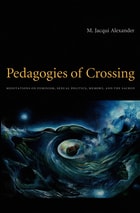
Pedagogies of Crossing
Meditations on Feminism, Sexual Politics, Memory, and the SacredM. Jacqui Alexander
Duke University Press, 2005
In these meditations, Alexander deftly unites large, often contradictory, historical processes across time and space. She focuses on the criminalization of queer communities in both the United States and the Caribbean in ways that prompt us to rethink how modernity invents its own traditions; she juxtaposes the political organizing and consciousness of women workers in global factories in Mexico, the Caribbean, and Canada with the pressing need for those in the academic factory to teach for social justice; she reflects on the limits and failures of liberal pluralism; and she presents original and compelling arguments that show how and why transgenerational memory is an indispensable spiritual practice within differently constituted women-of-color communities as it operates as a powerful antidote to oppression. In this multifaceted, visionary book, Alexander maps the terrain of alternative histories and offers new forms of knowledge with which to mold alternative futures.
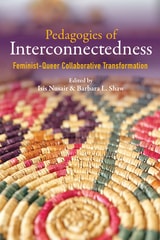
Pedagogies of Interconnectedness
Feminist-Queer Collaborative TransformationEdited by Isis Nusair and Barbara Shaw
University of Illinois Press, 2025
The contributors describe ways of building communities within and beyond academic programs and examine what it means to engage in community-building work and action across institutional boundaries. In Part One, the essayists focus on the centrality of community building and reinterpreting bodies of knowledge with students, staff, faculty, and community members. Part Two looks at bringing transnational approaches to feminist collaborations in ways that challenge the classroom’s central place in knowledge production. Part Three explores organic collaborations in and beyond the classroom.
A practical and much-needed resource, Pedagogies of Interconnectedness offers cutting-edge ideas for collaboration in pedagogy, education justice, community-based activities, and liberatory worldmaking.
Contributors: Jordyn Alderman, Leen Al-Fatafta, Meryl Altman, María Claudia André, Andrea N. Baldwin, Carolyn Beer, Luisa Bieri, Rebecca Dawson, Misty De Berry, Danielle M. DeMuth, Emily Fairchild, Sara Youngblood Gregory, Letizia Guglielmo, Jeremy Hall, K. Melchor Hall, Linh U. Hua, Christine Keating, Charlotte Meehan, Brayden Milam, Isis Nusair, Montserrat Pérez-Toribio, Andrea Putala, Ariella Rotramel, Ann Russo, Kimberly Sanchez, Barbara L. Shaw, M. Gabriela Torres, Ayana K. Weekley, and Sharon R. Wesoky

Pedagogies of Woundedness
Illness, Memoir, and the Ends of the Model MinorityJames Kyung-Jin Lee
Temple University Press, 2022
The pressures Asian Americans feel to be socially and economically exceptional include an unspoken mandate to always be healthy. Nowhere is this more evident than in the expectation for Asian Americans to enter the field of medicine, principally as providers of care rather than those who require care. Pedagogies of Woundedness explores what happens when those considered model minorities critically engage with illness and medicine whether as patients or physicians.
James Kyung-Jin Lee considers how popular culture often positions Asian Americans as medical authorities and what that racial characterization means. Addressing the recent trend of writing about sickness, disability, and death, Lee shows how this investment in Asian American health via the model minority is itself a response to older racial forms that characterize Asian American bodies as diseased. Moreover, he pays attention to what happens when academics get sick and how illness becomes both methodology and an archive for scholars.
Pedagogies of Woundedness also explores the limits of biomedical “care,” the rise of physician chaplaincy, and the impact of COVID. Throughout his book and these case studies, Lee shows the social, ethical, and political consequences of these common (mis)conceptions that often define Asian Americans in regard to health and illness.
Social Writing/Social Media
Publics, Presentations, and PedagogiesDouglas M. Walls
University Press of Colorado, 2018
Social media have been (for quite some time now) part of the fabric of our lives. But as with many new technologies, it often takes a while for us to be able to step back, assess the tool's impact, and consider what's next. This collection offers one of the first sets of scholarly work in our field that responds to social media's influence on both popular and extra-curricular writing as well as on scholarly communication. Too frequently, social media is dismissed as non-academic, unworthy of sustained attention by researchers. The authors featured here present compelling reasons why this oft-neglected form of writing deserves—and demands—continued academic response.
Social Writing/Social Media: Publics, Presentations, and Pedagogies makes this contribution by examining the impact of social media on three writing-related themes: publics and audiences, presentation of self and groups, and pedagogy at various levels of higher education. The contributors to this collection urge readers to pay attention to an undertheorized aspect of writing online—the acts of composing that occur specifically in social-media spaces. Organized in three sections—social media and public audiences; social media and presentation; and social media and pedagogy—it builds on previous explorations of the role of multimodality in composition studies by extending ongoing conversations that have asked readers to expand notions of literacy in the twenty-first century. By addressing the wide range of composing activities that take place in social media and the rich variety of genres, audiences, stylistic choices, and pedagogical possibilities, this collection offers an important contribution to our understanding of pedagogy and practice in social media spaces.
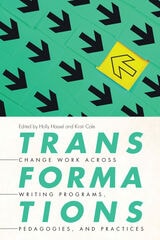
Transformations
Change Work across Writing Programs, Pedagogies, and PracticesHolly Hassel
Utah State University Press, 2021
The collection includes chapters from multiple award-winning writing programs, including the recipients of the Two-Year College Association’s Outstanding Programs in English Award and the Conference on College Composition and Communication’s Writing Program Certificate of Excellence. These authors offer perspectives that demonstrate the deep work of transformation in writing programs and practices writ large, confirm the ways in which writing programs are connected to and situated within larger institutional and disciplinary contexts, and outline successful methods for navigating these contexts in order to transform the work.
In using the prism of transformation as the organizing principle for the collection, Transformations offers a range of strategies for adapting writing programs so that they meet the needs of students and teachers in service of creating equitable, ethical literacy instruction in a range of postsecondary contexts.
Contributors: Leah Anderst, Cynthia Baer, Ruth Benander, Mwangi Alex Chege, Jaclyn Fiscus-Cannaday, Joanne Giordano, Rachel Hall Buck, Sarah Henderson Lee, Allison Hutchinson, Lynee Lewis Gaillet, Jennifer Maloy, Neil Meyer, Susan Miller-Cochran, Ruth Osorio, Lori Ostergaard, Shyam Pandey, Cassie Phillips, Brenda Refaei, Heather Robinson, Shelley Rodrigo, Julia Romberger, Tiffany Rousculp, Megan Schoen, Paulette Stevenson
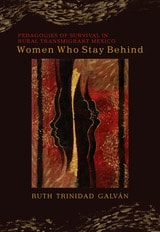
Women Who Stay Behind
Pedagogies of Survival in Rural Transmigrant MexicoRuth Trinidad Galván
University of Arizona Press, 2015
The book studies women’s and families’ use of cultural knowledge, community activism, and teaching and learning spaces. Throughout, Trinidad Galván provides answers to these questions: How does the migration of loved ones alter community, familial, and gender dynamics? And what social relations (convivencia), cultural knowledge, and women-centered pedagogies sustain women’s survival (supervivencia)?
Researchers, educators, and students interested in migration studies, gender studies, education, Latin American studies, and Mexican American studies will benefit from the ethnographic approach and theoretical insight of this groundbreaking work.