Results by title
8 books match the query 'Peden, Margaret Sayers'
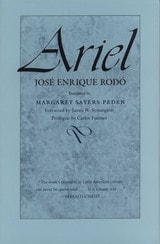
Ariel
By José Enrique Rodó
University of Texas Press, 1988
"Irritating, insufferable, admirable, stimulating, disappointing Rodó: . . . you are part of our family quarrels, and must bear with your disrespectful, equally disappointed, intuitive, incomplete nephews, living in a world that you helped define for us, and offered unto our revolt." —from the Prologue by Carlos Fuentes
First published in 1900 Uruguay, Ariel is Latin America's most famous essay on esthetic and philosophical sensibility, as well as its most discussed treatise on hemispheric relations. Though Rodó protested the interpretation, his allegorical conflict between Ariel, the lover of beauty and truth, and Caliban, the evil spirit of materialism and positivism, has come to be regarded as a metaphor for the conflicts and cultural differences between Latin America and the United States. Generations of statesmen, intellectuals, and literary figures have been formed by this book, either in championing its teachings or in reacting against them. This edition of Ariel, prepared especially with teachers and students in mind, contains a reader's guide to names, places, and important movements, as well as notes and a comprehensive annotated English/Spanish bibliography.
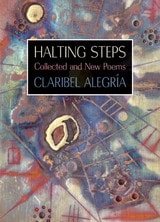
Halting Steps
Collected and New PoemsClaribel Alegria
Northwestern University Press, 2013
Halting Steps represents the most complete single-volume retrospective in English of Claribel Alegría’s seven-decade career. The volume collects all of Alegría’s poems from her fourteen previously published books and debuts several new poems under the title “Otherness.”
Her poetry is not only lyrical and introspective but also politically engaged. Her verse speaks forcefully, specifically, and fearlessly to matters of social justice in her region. She strikes a universal theme, however, in giving a voice to individuals of all classes in their struggle against oppression, but especially women who must contend with a system in which men hold the power and women are excluded. Alegría demonstrates her remarkable range with deeply personal poems, perhaps most notably in the poem cycle “Sorrow,” as she moves steadily through the waves of grief she experiences after her husband’s death.
In Halting Steps, both longtime admirers and those new to her work can appreciate the sustained creative power of Claribel Alegría’s poems.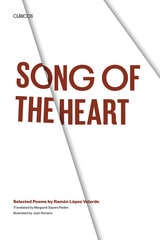
Song of the Heart
Selected Poems by Ramón López VelardeBy Ramón López Velarde
University of Texas Press, 1995
Ramón López Velarde (1888-1921) was one of the most Mexican of Mexican poets, whose sense of history found expression in many poems, including his best-known "La suave Patria" ("Sweet Land"). This bilingual collection, drawn primarily from Poesías completas y el minutero, offers English-language readers our first book-length introduction to his poetry.
Often called a "poet of the provinces," López Velarde gives us a glimpse into a slower and more gentle way of life. His poems present the contrast between city and hometown and between urban and pastoral landscapes. Through these contrasts runs the thread of religious faith, while urgency of language informs the entire body of his poetic production.
Original, specially commissioned drawings by noted contemporary Mexican artist Juan Soriano complement the poems. This combination of poetry and art speaks to universal emotions; indeed the poetry of López Velarde belongs to everyone who sings the Song of the Heart.
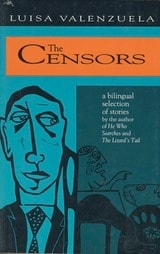
The Censors
A Bilingual Selection of StoriesLuisa Valenzuela
Northwestern University Press, 1995
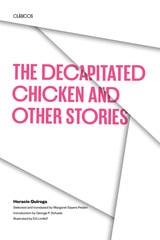
The Decapitated Chicken and Other Stories
By Horacio Quiroga
University of Texas Press, 1976
Tales of horror, madness, and death, tales of fantasy and morality: these are the works of South American master storyteller Horacio Quiroga. Author of some 200 pieces of fiction that have been compared to the works of Poe, Kipling, and Jack London, Quiroga experienced a life that surpassed in morbidity and horror many of the inventions of his fevered mind. As a young man, he suffered his father's accidental death and the suicide of his beloved stepfather. As a teenager, he shot and accidentally killed one of his closest friends. Seemingly cursed in love, he lost his first wife to suicide by poison. In the end, Quiroga himself downed cyanide to end his own life when he learned he was suffering from an incurable cancer.
In life Quiroga was obsessed with death, a legacy of the violence he had experienced. His stories are infused with death, too, but they span a wide range of short fiction genres: jungle tale, Gothic horror story, morality tale, psychological study. Many of his stories are set in the steaming jungle of the Misiones district of northern Argentina, where he spent much of his life, but his tales possess a universality that elevates them far above the work of a regional writer.
The first representative collection of his work in English, The Decapitated Chicken and Other Stories provides a valuable overview of the scope of Quiroga's fiction and the versatility and skill that have made him a classic Latin American writer.
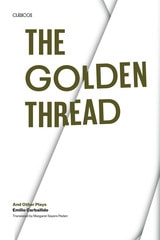
The Golden Thread and other Plays
By Emilio Carballido
University of Texas Press, 1970
Emilio Carballido was one of the most innovative and accomplished of Mexico's playwrights and one of the outstanding creators in the new Latin American theater. By his mid-forties he had already produced an impressive body of works in two very different veins. On the one hand, he mastered the techniques of the "well-made play." On the other, he developed a richly rewarding vein of fantasy, sometimes poetic, sometimes comic, sometimes macabre—and sometimes all three.
The plays in this volume are in the latter vein, ranging from surrealist farce in "The Intermediate Zone" to the grotesqueries of "The Time and the Place," from tragicomedy in "Theseus" to the dreamlike permutations of "The Golden Thread." But even at his most fantastic, Carballido never loses his remarkable gift for characterization: his peevish Minotaur, his raffish Nahual (were-jaguar) are wholly believable monsters.
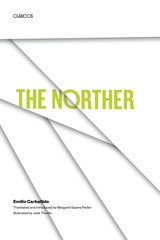
The Norther
By Emilio Carballido
University of Texas Press, 1968
Recognized in Mexico as one of the country's most important contemporary dramatists, Emilio Carballido has only recently become known in other countries through his plays and short stories. This translation introduces Carballido as a novelist. In The Norther what makes and breaks human relationships is his central interest as he traces the course of a relationship between a widow and a young man. The characters are created as their emotional and psychological outlines are drawn, and it is in the characterization that the hand of the dramatist is revealed. But it is Carballido's novelistic talent that has made The Norther the object of widely divergent interpretations. The critical conflict aroused by this novel is discussed in an Introduction by the translator, Margaret Sayers Peden.
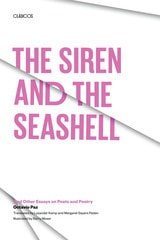
The Siren and the Seashell
And Other Essays on Poets and PoetryBy Octavio Paz
University of Texas Press, 1976
Octavio Paz has long been known for his brilliant essays as well as for his poetry. Through the essays, he has sought to confront the tensions inherent in the conflict between art and society and to achieve a unity of their polarities. The Siren and the Seashell is a collection of Paz’s essays, focusing on individual poets and on poetry in general. The first five poets he treats are Latin American: Sor Juana Inés de la Cruz, Rubén Darío, José Juan Tablada, Ramón López Velarde, and Alfonso Reyes. Then there are essays on Robert Frost, e. e. cummings, Saint-John Perse, Antonio Machado, and Jorge Guillén. Finally, there are Paz’s reflections on the poetry of solitude and communion and the literature of Latin America. Each essay is more than Paz’s impressions of one person or issue; each is the occasion for a wider discussion of cultural, historical, psychological, and philosophical themes. The essays were selected from Paz’s writing between 1942 and 1965 and provide an overview of the development of his thinking and an exploration of the ideas central in his works.