Results by title
3 books match the query 'Penang'
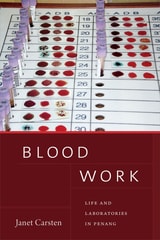
Blood Work
Life and Laboratories in PenangJanet Carsten
Duke University Press, 2019
What is blood? How can we account for its enormous range of meanings and its extraordinary symbolic power? In Blood Work Janet Carsten traces the multiple meanings of blood as it moves from donors to labs, hospitals, and patients in Penang, Malaysia. She tells the stories of blood donors, their varied motivations, and the paperwork, payment, and other bureaucratic processes involved in blood donation, tracking the interpersonal relations between lab staff and revealing how their work with blood reflects the social, cultural, and political dynamics of modern Malaysia. Carsten follows hospital workers into factories and community halls on blood drives and brings readers into the operating theater as a machine circulates a bypass patient's blood. Throughout, she foregrounds blood's symbolic power, uncovering the processes that make the hospital, the blood bank, the lab, and science itself work. In this way, blood becomes a privileged lens for understanding the entanglements of modern life.
[more]
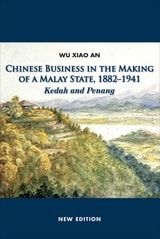
Chinese Business in the Making of a Malay State, 1882-1941
Kedah and PenangWu Xiao An
National University of Singapore Press, 2010
The Chinese in colonial Malaya were noted for their involvement in revenue farming, the rice trade, mining and estates, and pawnbroking. However, the Chinese presence was also significant in broader economic and social spheres, and the wealth and power of the Chinese community helped fuel the emerging colonial state and the modern transformation of Southeast Asia. In Chinese Business in the Making of a Malay State, Wu Xiao An argues persuasively that Chinese ventures owed much of their success to the flexibility and dynamism of Chinese family and economic networks, and the moral imperatives that governed relationships within the Chinese community.
Using Penang and Kedah as a case study, Wu draws on archival sources, family histories and an examination of legal arrangements and the press to show that personal business and business networks were not bound by the territorial borders of traditional or modern states, but extended across much of Southeast Asia and into China. His demonstration of the complexity of interactions involving new migrants, sojourners and settlers, both Chinese and non-Chinese, challenges understandings of state formation and economic growth in colonial Malaya based on ethnic stereotypes and accounts of events limited by fixed political boundaries.
Using Penang and Kedah as a case study, Wu draws on archival sources, family histories and an examination of legal arrangements and the press to show that personal business and business networks were not bound by the territorial borders of traditional or modern states, but extended across much of Southeast Asia and into China. His demonstration of the complexity of interactions involving new migrants, sojourners and settlers, both Chinese and non-Chinese, challenges understandings of state formation and economic growth in colonial Malaya based on ethnic stereotypes and accounts of events limited by fixed political boundaries.
[more]
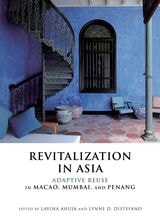
Revitalization in Asia
Adaptive Reuse in Macao, Mumbai, and PenangEdited by Lavina Ahuja and Lynne D. DiStefano
Hong Kong University Press, 2025
Useful case studies on sustainability and revitalization in Asia.
Revitalization in Asia offers a clear understanding of the value of sustainable adaptive reuse within an Asian context. Three highly urbanized places—Macao, Mumbai, and Penang —are considered in detail through essays and timelines that examine both conservation and planning perspectives. Six essays look at the connection between adaptive reuse and the three dimensions of sustainability regarding the United Nations' Sustainable Development Goals. Additionally, for each location, five case studies offer a comparative framework for understanding similarities and differences between adaptive reuse projects.
Revitalization in Asia offers a clear understanding of the value of sustainable adaptive reuse within an Asian context. Three highly urbanized places—Macao, Mumbai, and Penang —are considered in detail through essays and timelines that examine both conservation and planning perspectives. Six essays look at the connection between adaptive reuse and the three dimensions of sustainability regarding the United Nations' Sustainable Development Goals. Additionally, for each location, five case studies offer a comparative framework for understanding similarities and differences between adaptive reuse projects.
[more]