Results by title
4 books match the query 'Peoples'
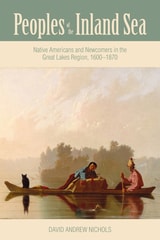
Peoples of the Inland Sea
Native Americans and Newcomers in the Great Lakes Region, 1600–1870David Andrew Nichols
Ohio University Press, 2018
Diverse in their languages and customs, the Native American peoples of the Great Lakes region—the Miamis, Ho-Chunks, Potawatomis, Ojibwas, and many others—shared a tumultuous history. In the colonial era their rich homeland became a target of imperial ambition and an invasion zone for European diseases, technologies, beliefs, and colonists. Yet in the face of these challenges, their nations’ strong bonds of trade, intermarriage, and association grew and extended throughout their watery domain, and strategic relationships and choices allowed them to survive in an era of war, epidemic, and invasion.
In Peoples of the Inland Sea, David Andrew Nichols offers a fresh and boundary-crossing history of the Lakes peoples over nearly three centuries of rapid change, from pre-Columbian times through the era of Andrew Jackson’s Removal program. As the people themselves persisted, so did their customs, religions, and control over their destinies, even in the Removal era. In Nichols’s hands, Native, French, American, and English sources combine to tell this important story in a way as imaginative as it is bold. Accessible and creative, Peoples of the Inland Sea is destined to become a classroom staple and a classic in Native American history.
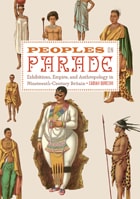
Peoples on Parade
Exhibitions, Empire, and Anthropology in Nineteenth-Century BritainSadiah Qureshi
University of Chicago Press, 2011

The Atlantic Slave Trade
Effects on Economies, Societies and Peoples in Africa, the Americas, and EuropeJoseph E. Inikori and Stanley L. Engerman
Duke University Press, 1992
Among the questions these essays address are: the social cost to Africa of this forced migration; the role of slavery in the economic development of Europe and the United States; the short-term and long-term effects of the slave trade on black mortality, health, and life in the New World; and the racial and cultural consequences of the abolition of slavery. Some of these essays originally appeared in recent issues of Social Science History; the editors have added new material, along with an introduction placing each essay in the context of current debates.
Based on extensive archival research and detailed historical examination, this collection constitutes an important contribution to the study of an issue of enduring significance. It is sure to become a standard reference on the Atlantic slave trade for years to come.
Contributors. Ralph A. Austen, Ronald Bailey, William Darity, Jr., Seymour Drescher, Stanley L. Engerman, David Barry Gaspar, Clarence Grim, Brian Higgins, Jan S. Hogendorn, Joseph E. Inikori, Kenneth Kiple, Martin A. Klein, Paul E. Lovejoy, Patrick Manning, Joseph C. Miller, Johannes Postma, Woodruff Smith, Thomas Wilson
The Peoples Of Las Vegas
One City, Many FacesJerry L Simich
University of Nevada Press, 2005
Beneath the glitzy surface of the resorts and the seemingly cookie-cutter suburban sprawl of Las Vegas lies a vibrant and diverse ethnic life. People of varied origins make up the population of nearly two million and yet, until now, little mention of the city has been made in studies and discussion of ethnicity or immigration. The Peoples of Las Vegas: One City, Many Faces fills this void by presenting the work of seventeen scholars of history, political science, sociology, anthropology, law, urban studies, cultural studies, literature, social work, and ethnic studies to provide profiles of thirteen of the city’s many ethnic groups. The book’s introduction and opening chapters explore the historical and demographic context of these groups, as well as analyze the economic and social conditions that make Las Vegas so attractive to recent immigrants. Each group is the subject of the subsequent chapters, outlining migration motivations and processes, economic pursuits, cultural institutions and means of transmitting culture, involvement in the broader community, ties to homelands, and recent demographic trends.