Results by title

3 books match the query 'Percussion ensembles'
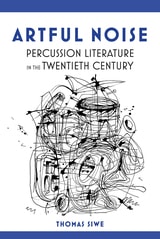
cover of Artful Noise: Percussion Literature in the Twentieth Century

Artful Noise

Percussion Literature in the Twentieth Century

Thomas Siwe

University of Illinois Press, 2020

Twentieth-century composers created thousands of original works for solo percussion and percussion ensemble. Concise and ideal for the classroom, Artful Noise offers an essential and much-needed survey of this unique literature.

Percussionist Thomas Siwe organizes and analyzes the groundbreaking musical literature that arose during the twentieth century. Focusing on innovations in style and the evolution of the percussion ensemble, Siwe offers a historical overview that connects the music to scoring techniques, new instrumentation and evolving technologies as well as world events. Discussions of representative pieces by seminal composers examines the resources a work requires, its construction, and how it relates to other styles that developed during the same period. In addition, Siwe details the form and purpose of many of the compositions while providing background information on noteworthy artists. Each chapter is supported with musical examples and concludes with a short list of related works specifically designed to steer musicians and instructors alike toward profitable explorations of composers, styles, and eras.
[more]
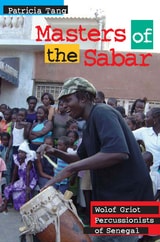
cover of Masters of the Sabar: Wolof Griot Percussionists of Senegal

Masters of the Sabar

Wolof Griot Percussionists of Senegal

Patricia Tang

Temple University Press, 2006
Masters of the Sabar is the first book to examine the music and culture of Wolof griot percussionists, masters of the vibrant sabar drumming tradition. Based on extensive field research in Senegal, this book is a biographical study of several generations of percussionists in a Wolof griot (géwël) family, exploring and documenting their learning processes, repertories, and performance contexts—from life-cycle ceremonies to sporting events and political meetings. Patricia Tang examines the rich history and changing repertories of sabar drumming, including dance rhythms and bàkks, musical phrases derived from spoken words. She notes the recent shift towards creating new bàkks which are rhythmically more complex and highlight the virtuosity and musical skill of the percussionist. She also considers the burgeoning popular music genre called mbalax. The compact disc that accompanies the book includes examples of the standard sabar repertory, as well as bàkks composed and performed by Lamine Touré and his family drum troupe.
[more]
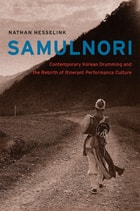
cover of SamulNori: Contemporary Korean Drumming and the Rebirth of Itinerant Performance Culture

SamulNori

Contemporary Korean Drumming and the Rebirth of Itinerant Performance Culture

Nathan Hesselink

University of Chicago Press, 2012

In 1978, four musicians crowded into a cramped basement theater in downtown Seoul, where they, for the first time, brought the rural percussive art of p’ungmul to a burgeoning urban audience. In doing so, they began a decades-long reinvention of tradition, one that would eventually create an entirely new genre of music and a national symbol for Korean culture.
                Nathan Hesselink’s SamulNori traces this reinvention through the rise of the Korean supergroup of the same name, analyzing the strategies the group employed to transform a museum-worthy musical form into something that was both contemporary and historically authentic, unveiling an intersection of traditional and modern cultures and the inevitable challenges such a mix entails. Providing everything from musical notation to a history of urban culture in South Korea to an analysis of SamulNori’s teaching materials and collaborations with Euro-American jazz quartet Red Sun, Hesselink offers a deeply researched study that highlights the need for traditions—if they are to survive—to embrace both preservation and innovation. 
[more]