Results by title
6 books match the query 'Performativity'

Anime's Identity
Performativity and Form beyond JapanStevie Suan
University of Minnesota Press, 2021
A formal approach to anime rethinks globalization and transnationality under neoliberalism
Anime has become synonymous with Japanese culture, but its global reach raises a perplexing question—what happens when anime is produced outside of Japan? Who actually makes anime, and how can this help us rethink notions of cultural production? In Anime’s Identity, Stevie Suan examines how anime’s recognizable media-form—no matter where it is produced—reflects the problematics of globalization. The result is an incisive look at not only anime but also the tensions of transnationality.
Far from valorizing the individualistic “originality” so often touted in national creative industries, anime reveals an alternate type of creativity based in repetition and variation. In exploring this alternative creativity and its accompanying aesthetics, Suan examines anime from fresh angles, including considerations of how anime operates like a brand of media, the intricacies of anime production occurring across national borders, inquiries into the selfhood involved in anime’s character acting, and analyses of various anime works that present differing modes of transnationality.
Anime’s Identity deftly merges theories from media studies and performance studies, introducing innovative formal concepts that connect anime to questions of dislocation on a global scale, creating a transformative new lens for analyzing popular media.
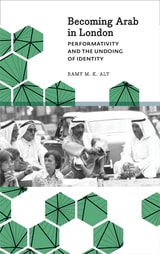
Becoming Arab in London
Performativity and the Undoing of IdentityRamy M. K. Aly
Pluto Press, 2015
Drawing on the work of Judith Butler, Aly emphasizes the need to move away from the concept of identity and toward the idea of race, gender, and class as performance. Based on seven years of fieldwork, during which time the author immersed himself in London’s Arab community, Becoming Arab in London is an innovative and necessary contribution to the study of diaspora and difference in contemporary Britain.

On Teacher Neutrality
Politics, Praxis, and PerformativityDaniel P. Richards
Utah State University Press, 2020
Higher education itself and its stakeholders are continually exploring the role of teachers in the classroom and the extent to which it is possible or ethical to engage in neutrality. Amplifying voices from teachers in underrepresented positions and institutions in discussions of teacher ideology, On Teacher Neutrality shapes the discourse around these topics both within the writing classroom and throughout higher education. The book offers a rich array of practices, pedagogies, and theories that will help ground instructors and posits a way forward toward better dialogue and connections with the various stakeholders of higher education in the United States.
Contributors:
Tristan Abbott, Kelly Blewett, Meaghan Brewer, Christopher Michael Brown, Chad Chisholm, Jessica Clements, Jason C. Evans, Heather Fester, Romeo García, Yndalecio Isaac Hinojosa, Mara Holt, Erika Johnson, Tawny LeBouef Tullia, Lauren F. Lichty, Adam Pacton, Daniel P. Richards, Patricia Roberts-Miller, Karen Rosenberg, Allison L. Rowland, Robert Samuels, David P. Stubblefield, Jennifer Thomas, John Trimbur

Performance Generating Systems in Dance
Dramaturgy, Psychology, and PerformativityPil Hansen
Intellect Books, 2022
Performance-generating systems are systematic and task-based dramaturgy that generate performance for or with an audience. In dance, such systems differ in ways that matter from more closed choreographed scores and more open forms of structured improvisation. Dancers performing within these systems draw on predefined and limited sources while working on specific tasks within constraining rules. The generating components of the systems provide boundaries that enable the performance to self-organize into iteratively shifting patterns instead of becoming repetitive or chaotic.
This book identifies the generating components and dynamics of these works and the kinds of dramaturgical agency they enable. It explains how the systems of these creations affect the perception, cognition, and learning of dancers and why that is a central part of how they work. It also examines how the combined dramaturgical and psychological effects of the systems performatively address individual and social conditions of trauma that otherwise tend to remain unchangeable and negatively impact the human capacity to learn, relate, and adapt. The book provides analytical frameworks and practical insights for those who wish to study or apply performance-generating systems in dance within the fields of choreography and dance dramaturgy, dance education, community dance, or dance psychology.

The Irish in Us
Irishness, Performativity, and Popular CultureDiane Negra, ed.
Duke University Press, 2006
Examining how Irishness is performed and commodified in the contemporary transnational environment, the contributors explore topics including Van Morrison’s music, Frank McCourt’s writing, the explosion of Irish-themed merchandising, the practices of heritage seekers, the movie The Crying Game, and the significance of red hair. Whether considering the implications of Garth Brooks’s claim of Irishness and his enormous popularity in Ireland, representations of Irish masculinity in the TV series Buffy the Vampire Slayer and Angel, or Americans’ recourse to a consoling Irishness amid the racial and nationalist tensions triggered by the events of September 11, the contributors delve into complex questions of ethnicity, consumerism, and globalization. Ultimately, they call for an increased awareness of the exclusionary effects of claims of Irishness and for the cultivation of flexible, inclusive ways of affiliating with Ireland and the Irish.
Contributors. Natasha Casey, Maeve Connolly, Catherine M. Eagan, Sean Griffin, Michael Malouf, Mary McGlynn, Gerardine Meaney, Diane Negra, Lauren Onkey, Maria Pramaggiore, Stephanie Rains, Amanda Third

Where Is Ana Mendieta?
Identity, Performativity, and ExileJane Blocker
Duke University Press, 1999
Taken from banners carried in a 1992 protest outside the Guggenheim Museum in New York, the title phrase “Where is Ana Mendieta?” evokes not only the suspicious and tragic circumstances surrounding her death but also the conspicuous absence of women artists from high-profile exhibitions. Drawing on the work of such theorists as Judith Butler, Joseph Roach, Edward Said, and Homi Bhabha, Blocker discusses the power of Mendieta’s earth-and-body art to alter, unsettle, and broaden the terms of identity itself. She shows how Mendieta used exile as a discursive position from which to disrupt dominant categories, analyzing as well Mendieta’s use of mythology and anthropology, the ephemeral nature of her media, and the debates over her ethnic, gender, and national identities.
As the first major critical examination of this enigmatic artist’s work, Where Is Ana Mendieta? will interest a broad audience, particularly those involved with the production, criticism, theory, and history of contemporary art.