Results by title
19 books match the query 'Performing'
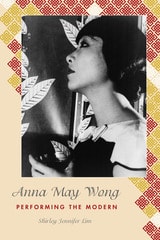
Anna May Wong
Performing the ModernShirley Jennifer Lim
Temple University Press, 2019
Finalist for the 2020 Organization of American Historians Mary Nickliss Prize
Pioneering Chinese American actress Anna May Wong made more than sixty films, headlined theater and vaudeville productions, and even starred in her own television show. Her work helped shape racial modernity as she embodied the dominant image of Chinese and, more generally, “Oriental” women between 1925 and 1940.
In Anna May Wong, Shirley Jennifer Lim re-evaluates Wong’s life and work as a consummate artist by mining an historical archive of her efforts outside of Hollywood cinema. From her pan-European films and her self-made My China Film to her encounters with artists such as Josephine Baker, Carl Van Vechten, and Walter Benjamin, Lim scrutinizes Wong’s cultural production and self-fashioning. Byconsidering the salient moments of Wong’s career and cultural output, Lim’s analysis explores the deeper meanings, and positions the actress as an historical and cultural entrepreneur who rewrote categories of representation.
Anna May Wong provides a new understanding of the actress’s career as an ingenious creative artist.
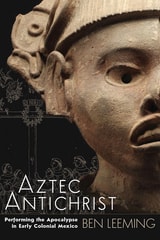
Aztec Antichrist
Performing the Apocalypse in Early Colonial MexicoBen Leeming
University Press of Colorado, 2022
Discovered in the archives of the Hispanic Society of America in New York inside a notebook of miscellaneous Nahuatl-Christian texts written almost entirely by an Indigenous writer named Fabían de Aquino, the plays are filled with references to human sacrifice, bloodletting, ritual divination, and other religious practices declared “idolatrous” at a time when ecclesiastical authorities actively sought to suppress writing about Indigenous religion. These are Indigenous plays for an Indigenous audience that reveal how Nahuas made sense of Christianity and helped form its colonial image—the title figure is a powerful Indigenous being, an “Aztec Antichrist,” who violently opposes the evangelizing efforts of the church and seeks to draw converted Nahuas back to the religious practices of their ancestors. These practices include devotion to Nahua deities such as Tlaloc, Quetzalcoatl, and Tezcatlipoca who, in one of the most striking moves made by Aquino, are cast as characters in the plays.
Along with the translations, Leeming provides context and analysis highlighting these rare and fascinating examples of early Indigenous American literature that offer a window into the complexity of Nahua interactions with Christianity in the early colonial period. The work is extremely valuable to all students and scholars of Latin American religion, colonialism, Indigenous history, and early modern history and theater.

Blood Brothers and Peace Pipes
Performing the Wild West in German FestivalsA. Dana Weber
University of Wisconsin Press, 2019
This book, based on years of fieldwork observing and studying the festivals, plays, events, and groups that comprise this subculture, addresses a larger, timely issue: cultural transfer and appropriations. Are Germans dressing up in American Indian costumes paying tribute or offending the cultures they are representing? Avoiding simplistic answers, A. Dana Weber considers the complexity of cultural enactments as they relate both to the distinctly German phenomenon as well as to larger questions of cultural representations in American and European live performance traditions."

Claiming Space
Performing the Personal through Decorated MortarboardsSheila Bock
Utah State University Press, 2023
Claiming the space of these graduation caps is a popular and widespread way that individuals make their voices heard, or rather seen, in the visual landscape of commencement ceremonies. The forms and meanings of these material displays take shape in relation to broader, ongoing conversations about higher education in the United States, conversations grounded in discourses of belonging, citizenship, and the promises of the American Dream. Integrating observational fieldwork with extensive interviews and surveys, author Sheila Bock highlights the interpretations of individuals participating in this tradition. She also attends to the public framings of this tradition, including how images of mortarboards have grounded online enactments of community through hashtags such as #LatinxGradCaps and #LetTheFeathersFly, as well as what rhetorical framings are employed in news coverage and legal documents in cases where the value of the practice is both called into question and justified.
As university administrators and cultural commentators seek to make sense of the current state of higher education, these forms of material expression offer insight into how students themselves are grappling with higher ed's promises and shortcomings. Claiming Space is a meaningful contribution to folklore, cultural studies, media studies, and education.
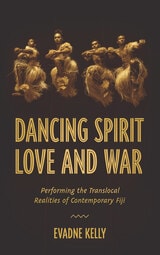
Dancing Spirit, Love, and War
Performing the Translocal Realities of Contemporary FijiEvadne Kelly
University of Wisconsin Press, 2022
Through extensive archival and ethnographic fieldwork in both Fiji and Canada, Kelly offers key insights into an underrepresented dance form, region, and culture. Her perceptive analysis of meke will be of interest in dance studies, postcolonial and Indigenous studies, anthropology and performance ethnography, and Pacific Island studies.
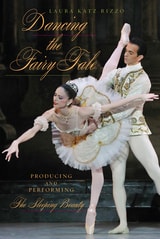
Dancing the Fairy Tale
Producing and Performing The Sleeping BeautyLaura Katz Rizzo
Temple University Press, 2015
Using extensive archival research, dance analysis, and American feminist theory, Dancing the Fairy Tale places women at the center of a historical narrative to reveal how the production and performance of The Sleeping Beauty in the years between 1937 and 2002 made significant contributions to the development and establishment of an American classical ballet. Katz Rizzo highlights not only what women have done not only behind the scenes, as administrators, producers, or directors of ballet companies and schools, but also as active interpreters embodying the ballet's title role.
In the process, Katz Rizzo also emphasizes the importance of regional sites outside of locations traditionally understood as central to the development of ballet in the United States.
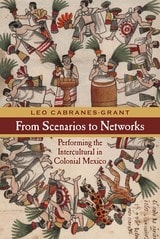
From Scenarios to Networks
Performing the Intercultural in Colonial MexicoLeo Cabranes-Grant
Northwestern University Press, 2016
In this innovative study, Leo Cabranes-Grant analyzes four intercultural events in the Viceroyalty of New Spain that took place between 1566 and 1690. Rather than relying on racial labels to describe alterations of identity, Cabranes-Grant focuses on experimentation, rehearsal, and the interaction between bodies and objects. His analysis shows how scenarios are invested with affective qualities, which in turn enable cultural and semiotic change. Central to his argument is Bruno Latour’s Actor-Network Theory, which figures society as a constantly evolving web of relationships among objects, people, and spaces. In examining these scenarios, Cabranes-Grant attempts to discern the reasons why the conditions of an intensified moment within this ceaseless flow take on a particular value and inspire their re-creation. Cabranes-Grant offers a fresh perspective on Latour’s theory and reorients debates concerning history and historiography in the field of performance studies.
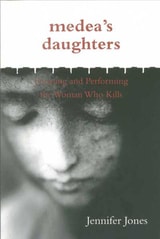
Medea’s Daughters
Forming and Performing the Woman Who KillsJennifer Jones
The Ohio State University Press, 2003
In Medea's Daughters, Jennifer Jones explores the legal, cultural, and dramatic representations of six accused murderesses to look at how English-speaking society responded to and controlled anxiety over female transgressions. The woman who kills—in particular, the woman who kills a member of her own family—has not only broken the law, she has also violated gender expectations. Jones argues that dramatic representations of criminal women, especially women who kill, proliferate during times of heightened feminist activity and that theatrical narratives, as evidenced in plays, television, and film, serve to contain women and deflect attention away from issues of women’s systematic repression.
Medea’s Daughters focuses on six women (of whom Lizzie Borden, Susan Smith, and Louise Woodward are the best known) whose murder trials caught the attention of their respective cultures. This broad spectrum allows an examination of how women’s legal status has evolved over five centuries.
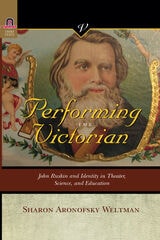
PERFORMING THE VICTORIAN
JOHN RUSKIN AND IDENTITY IN THEATER, SCIENCE, AND EDUCATIONSHARON ARONOFSKY WELTMAN
The Ohio State University Press, 2007
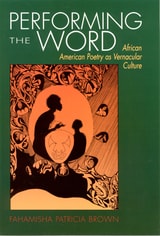
Performing The Word
African American Poetry As Vernacular CultureBrown, Fahamisha Patricia
Rutgers University Press, 1999
Fahamista Patricia Brown examines elements of African American expressive culture- its language practices, both fold and popular. Her book is an excellent introduction to a diverse group of poets and the common basis of their work in language practices and performativity, in the expressive culture of a people. Performing the Word is an important contribution to the understanding of African American culture and American poetry as a whole.
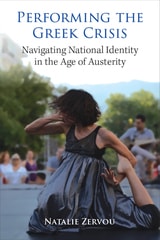
Performing the Greek Crisis
Navigating National Identity in the Age of AusterityNatalie Zervou
University of Michigan Press, 2024
Winner of the 2025 Dance Studies Association de la Torre Bueno Book Prize
Performing the Greek Crisis explores the impact of the Greek financial crisis (2009–19) on the performing arts sector in Greece, and especially on contemporary concert dance. When Greece became the first European Union member to be threatened with default, the resulting budget cuts pushed dance to develop in unprecedented directions. The book examines the repercussions that the crisis had on artists’ daily lives and experiences, weaving the personal with the political to humanize a phenomenon that, to date, had been examined chiefly through economic and statistical lenses. Informed by the author’s experience of growing up in Greece and including interviews and rich descriptions of performances, the book offers a glimpse into a pivotal moment in Greek history.
In Greece, dance (and, by extension, the body) has historically held a central role in the process of national identity construction. When the crisis broke out, artists had to navigate through a precariously fluctuating landscape, with their bodies as their only stable referent. By centering the analysis of the Greek crisis on the dancing bodies, Performing the Greek Crisis is able to examine the various ways that artists reconceptualized their history and reframed ideas of national belonging, race, citizenship, and immigration.
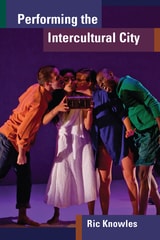
Performing the Intercultural City
Ric Knowles
University of Michigan Press, 2017
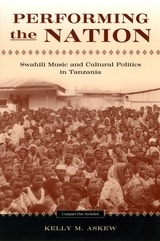
Performing the Nation
Swahili Music and Cultural Politics in TanzaniaKelly Askew
University of Chicago Press, 2002
As Askew shows, the genres of ngoma (traditional dance), dansi (urban jazz), and taarab (sung Swahili poetry) have played prominent parts in official articulations of "Tanzanian National Culture" over the years. Drawing on over a decade of research, including extensive experience as a taarab and dansi performer, Askew explores the intimate relations among musical practice, political ideology, and economic change. She reveals the processes and agents involved in the creation of Tanzania's national culture, from government elites to local musicians, poets, wedding participants, and traffic police. Throughout, Askew focuses on performance itself—musical and otherwise—as key to understanding both nation-building and interpersonal power dynamics.
Performing the News
Identity, Authority, and the Myth of NeutralityElia Powers
Rutgers University Press, 2024
Performing the News: Identity, Authority, and the Myth of Neutrality explores how journalists from historically marginalized groups have long felt pressure to conform when performing for audiences. Many speak with a flat, “neutral” accent, modify their delivery to hide distinctive vocal attributes, dress conventionally to appeal to the “average” viewer, and maintain a consistent appearance to avoid unwanted attention. Their aim is what author Elia Powers refers to as performance neutrality—presentation that is deemed unobjectionable, reveals little about journalists’ social identity, and supposedly does not detract from their message. Increasingly, journalists are challenging restrictive, purportedly neutral forms of self-presentation. This book argues that performance neutrality is a myth that reinforces the status quo, limits on-air diversity, and hinders efforts to make newsrooms more inclusive. Through in-depth interviews with journalists in broadcasting and podcasting, and those who shape their performance, the author suggests ways to make journalism more inclusive and representative of diverse audiences.
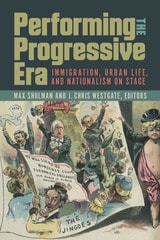
Performing the Progressive Era
Immigration, Urban Life, and Nationalism on StageMax Shulman and J. Chris Westgate
University of Iowa Press, 2019

Performing with the Dead
Trances and TracesChristopher "Kit" Danowski
Intellect Books, 2024
In this book, Kit Danowski constructs a methodology called kanga (from the Bantu for tying and untying), using three methods based on aspects of the Afrolatinx ritual and modified for performance contexts: spell, charm, and trance. This methodology enacts and complicates distinctions between performance and ritual, serving as a contribution to respectful and responsible intercultural performance practices. The methodology is bricoleur, drawing from ethnography, psychoanalytic theory, and phenomenology. Kanga in practice leads to a state of consciousness that Danowski calls hauntological. This borrows from Derrida but is redefined to refer to the study of haunted states of consciousness, where reality is coconstituted by the living and the dead and ancestral spirits are invoked to do the work once reserved for characters.
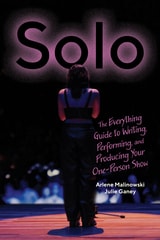
Solo
The Everything Guide to Writing, Performing, and Producing Your One-Person ShowArlene Malinowski and Julie Ganey
Northwestern University Press, 2026
The art of solo performance has exploded in the last twenty years as an immediate and accessible art form. The number of solo festivals grows every year, and artists are hungry for the opportunity to center their own voices and experiences. Solo is designed to feed that hunger.
Seasoned theater educators and performers Arlene Malinowski and Julie Ganey have compiled an invaluable guide for students and practitioners alike. Topics include high-stakes narratives, compelling characters, and the role of narrators, as well as practical exercises, interviews with performers at every stage of their careers, and examples from real one-person shows. Performers will also find advice on collaborating with directors, incorporating technical elements, and producing and marketing strategies.
Whether you’re just starting out or are a seasoned professional looking to refine your show-in-progress, Solo is an essential volume for anyone ready to bring their story to life onstage.

The Choral Turn
Performing the Chorus in the Ruins of DemocracyAmy Holzapfel
University of Michigan Press, 2027
The Choral Turn: Performing the Chorus in the Ruins of Democracy examines the recent resurgence of the chorus—a hallmark of ancient Greek tragedy—across contemporary Western theatre, performance, and activism, arguing that this “choral turn” is inseparable from anxieties about the decline of liberal democracy. Drawing on classical studies, theatre and performance studies, and political philosophy, Holzapfel coins the term “choraperformativity” to describe performances that mobilize the formal and collective conventions of the chorus to contest or reshape dominant political narratives. The Choral Turn uses case studies—plays about war and catastrophe featuring Greek-like choruses, refugee performers theatrically reenacting their own displacement, environmental protesters staging collective mourning for a dying planet—to show how groups use choral performance to demand recognition and assert the need for change. Rather than treating the chorus as inherently progressive, the study asks hard questions about who gets included in these choral communities and who gets left out, offering a nuanced, timely look at collective action on stage and in the streets.
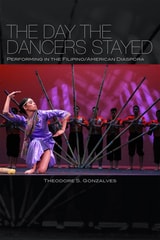
The Day the Dancers Stayed
Performing in the Filipino/American DiasporaTheodore S. Gonzalves
Temple University Press, 2009
Pilipino Cultural Nights at American campuses have been a rite of passage for youth culture and a source of local community pride since the 1980s. Through performances—and parodies of them—these celebrations of national identity through music, dance, and theatrical narratives reemphasize what it means to be Filipino American. In The Day the Dancers Stayed, scholar and performer Theodore Gonzalves uses interviews and participant observer techniques to consider the relationship between the invention of performance repertoire and the development of diasporic identification.
Gonzalves traces a genealogy of performance repertoire from the 1930s to the present. Culture nights serve several functions: as exercises in nostalgia, celebrations of rigid community entertainment, and occasionally forums for political intervention. Taking up more recent parodies of Pilipino Cultural Nights, Gonzalves discusses how the rebellious spirit that enlivened the original seditious performances has been stifled.