Results by title

4 books match the query 'Periodical editors'

cover of Austin Harrison and the English Review

Austin Harrison and the English Review

Martha S. Vogeler

University of Missouri Press, 2008
Political and literary journalist Austin Harrison became editor of the English Review in 1910. While holding that chair, he expanded the publication’s literary scope by publishing articles on such issues as women’s suffrage, parliamentary reform, the German threat, and Irish home rule. But although he edited the Review far longer than did its celebrated founder, Ford Madox Ford, history has long confined him to the shadows of not only his predecessor but also his father, the English Positivist Frederic Harrison.
 
 
            This first scholarly assessment of Harrison’s tenure at the English Review from 1910 to 1923 shows him courting controversy, establishing reputations, winning and losing authors, and pushing the limits of the publishable as he made his “Great Adult Review” the most consistently intelligent and challenging monthly of its day. Martha Vogeler offers a compelling personal and family narrative and a new perspective on British literary culture and political journalism in the years just before, during, and after the First World War.
 
 
            Vogeler provides a revealing account of Harrison the editor—his writings and opinions, his public life and relations—as she also traces the complex relationship between a son and his famous father. Balancing a scholar’s attention to detail and a fine writer’s eye for style, she relates Harrison’s improbable friendships with the notorious Frank Harris and the outrageous Aleister Crowley. And she has mined Harrison’s correspondence to lend insight into the careers of such writers as Ford Madox Ford, D. H. Lawrence, H. G. Wells, Joseph Conrad, John Masefield, Bernard Shaw, Arnold Bennett, and Marie Stopes. Other figures such as George Gissing, Bertrand Russell, Lord Northcliffe, and important Irish revolutionaries appear in new contexts.
 
 
            Ranging widely across literature, foreign relations, national politics, the women’s movement, censorship, and sexuality, Vogeler captures the themes of Harrison’s era. She describes his transformation from Germanophobe before and during World War I to an outspoken critic of the punitive measures against Germany in the Treaty of Versailles. She explores the ambiguities in his engagement with modernist aesthetics and in his attempt to escape the shadow of his father while benefiting from his family’s wealth and connections. Vogeler’s assessment of Harrison’s books further sharpens our understanding of his ideas about Germany, women, education, and Victorian family life—notably his underappreciated tribute/rebuke to his father, Frederic Harrison: Thoughts and Memories.
 
 
            This account of Austin Harrison’s career allows us to observe a journalist making his way in a highly competitive world and opens up a new window on Britain in the era of the Great War.
[more]
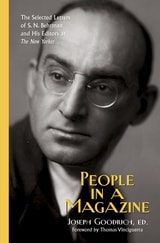
cover of People in a Magazine: The Selected Letters of S. N. Behrman and His Editors at "The New Yorker"

People in a Magazine

The Selected Letters of S. N. Behrman and His Editors at "The New Yorker"

Joseph Goodrich

University of Massachusetts Press, 2018

Playwright, biographer, screenwriter, and critic S. N. Behrman (1893–1973) characterized the years he spent writing for The New Yorker as a time defined by “feverish contact with great theatre stars, rich people and social people at posh hotels, at parties, in mansions and great estates.” While he hobnobbed with the likes of Mary McCarthy, Elia Kazan, and Greta Garbo and was one of Broadway's leading luminaries, Behrman would later admit that the friendships he built with the magazine's legendary editors Harold Ross, William Shawn, and Katharine S. White were the “one unalloyed felicity” of his life.

People in a Magazine collects Behrman's correspondence with his editors along with telegrams, interoffice memos, and editorial notes drawn from the magazine's archives—offering an unparalleled view of mid-twentieth-century literary life and the formative years of The New Yorker, from the time of Behrman's first contributions to the magazine in 1929 until his death.

[more]
cover of Secretaries of the Moon: The Letters of Wallace Stevens and José Rodriguez Feo

Secretaries of the Moon

The Letters of Wallace Stevens and José Rodriguez Feo

Beverly Coyle and Alan Filreis, eds.

Duke University Press, 1986

The letter from Jose Rodriguez Feo that prompted Stevens's poem was the third in a ten-year correspondence (1944-54) between the poet and the young Cuban, who quickly became Stevens's "most exciting correspondent." The two shared a Harvard education, both were anxious to see Stevens translated for a Cuban audience, and each had an enduring admiration for Santayana, whose awareness of the cultural tensions between the Northern and Southern hemispheres formed a basis for the protracted argument between Stevens as the practical, Protestant father and the passionate Rodriguez Feo. The Cuban's descriptions of his life at the Villa Olga, of his black-and-white cow Lucera and his mule Pompilio, delighted Stevens, as did his wide-ranging questions and pronouncements of literary matters. Unaware of the well-known Stevens reticence, Rodriguz Feo elicited a more informal, playful response than Stevens's other correspondents. Formal salutations soon gave way to "Dear Antillean," "Dear Wallachio."

Coyle and Filreis present the entire extant correspondence between the two men. The fifty-one Rodriguez Feo letters and ten of the numerous Stevens letters are printed here for the first time, and the exchange between the two is unusually complete. The work includes a critical introduction and complete annotation of the letters.
[more]
cover of The Little Magazine in Contemporary America

The Little Magazine in Contemporary America

Edited by Ian Morris and Joanne Diaz

University of Chicago Press, 2015

Little magazines have often showcased the best new writing in America. Historically, these idiosyncratic, small-circulation outlets have served the dual functions of representing the avant-garde of literary expression while also helping many emerging writers become established authors. Although changing technology and the increasingly harsh financial realities of publishing over the past three decades would seem to have pushed little magazines to the brink of extinction, their story is far more complicated.

In this collection, Ian Morris and Joanne Diaz gather the reflections of twenty-three prominent editors whose little magazines have flourished over the past thirty-five years. Highlighting the creativity and innovation driving this diverse and still vital medium, contributors offer insights into how their publications sometimes succeeded, sometimes reluctantly folded, but mostly how they evolved and persevered. Other topics discussed include the role of little magazines in promoting the work and concerns of minority and women writers, the place of universities in supporting and shaping little magazines, and the online and offline future of these publications.

Selected contributors
Betsy Sussler, BOMB; Lee Gutkind, Creative Nonfiction; Bruce Andrews, L=A=N=G=U=A=G=E; Dave Eggers, McSweeney’s; Keith Gessen, n+1; Don Share, Poetry; Jane Friedman, VQR; Amy Hoffman, Women’s Review of Books; and more.
 
[more]