Results by title

5 books match the query 'Peronism'
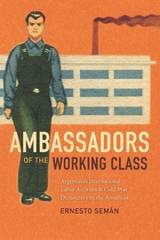
cover of Ambassadors of the Working Class: Argentina's International Labor Activists and Cold War Democracy in the Americas

Ambassadors of the Working Class

Argentina's International Labor Activists and Cold War Democracy in the Americas

Ernesto Semán

Duke University Press, 2017
In 1946 Juan Perón launched a populist challenge to the United States, recruiting an army of labor activists to serve as worker attachés at every Argentine embassy. By 1955, over five hundred would serve, representing the largest presence of blue-collar workers in the foreign service of any country in history. A meatpacking union leader taught striking workers in Chicago about rising salaries under Perón. A railroad motorist joined the revolution in Bolivia. A baker showed Soviet workers the daily caloric intake of their Argentine counterparts. As Ambassadors of the Working Class shows, the attachés' struggle against US diplomats in Latin America turned the region into a Cold War battlefield for the hearts of the working classes. In this context, Ernesto Semán reveals, for example, how the attachés' brand of transnational populism offered Fidel Castro and Che Guevara their last chance at mass politics before their embrace of revolutionary violence. Fiercely opposed by Washington, the attachés’ project foundered, but not before US policymakers used their opposition to Peronism to rehearse arguments against the New Deal's legacies.
[more]
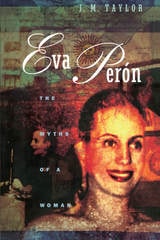
cover of Eva Perón: The Myths of a Woman

Eva Perón

The Myths of a Woman

Julie Taylor

University of Chicago Press, 1981

Eva Perón, one of the most powerful women in the world at the time of her death in 1952, rose from humble origins to international renown as First Lady of Argentina and the force behind the throne of her husband Juan Perón. Despite her immense popularity, she was inaccessible to the people of Argentina, and so images were constructed around her to fill that void. According to Julie M. Taylor, these "myths" around Eva Perón reflect Argentine culture and political history at the time of her seven-year reign. With a brief biography of Eva Perón serving as a backdrop, Taylor offers a detailed analysis of the principle myths that grew around this enigmatic woman.

"Taylor shows that she is remembered by different classes and political factions as saint, a revolutionary, or a whore, depending on whether she was interpreted as an embodiment or as a violation of the Argentine feminine ideal."—Booklist

"Highly commendable . . . it deliberately eschews the sensationalism that characterizes earlier [biographies]. . . . Taylor instead concentrates on the myths that have lingered since her death. . . . [This book] transcends biography."—Gentlemen's Quarterly

"[A] concise and brilliant examination of the legends that arose in Argentina during the lifetime . . . of a woman who broke with Argentine tradition and became a political figure in her own right."—New Yorker
[more]
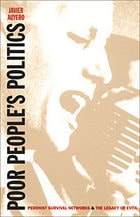
cover of Poor People's Politics: Peronist Survival Networks and the Legacy of Evita

Poor People's Politics

Peronist Survival Networks and the Legacy of Evita

Javier Auyero

Duke University Press, 2000

“Political clientelism” is a term used to characterize the contemporary relationships between political elites and the poor in Latin America in which goods and services are traded for political favors. Javier Auyero critically deploys the notion in Poor People’s Politics to analyze the political practices of the Peronist Party among shantytown dwellers in contemporary Argentina.
Looking closely at the slum-dwellers’ informal problem-solving networks, which are necessary for material survival, and the different meanings of Peronism within these networks, Auyero presents the first ethnography of urban clientelism ever carried out in Argentina. Revealing a deep familiarity with the lives of the urban poor in Villa Paraíso, a stigmatized and destitute shantytown of Buenos Aires, Auyero demonstrates the ways in which local politicians present their vital favors to the poor and how the poor perceive and evaluate these favors. Having penetrated the networks, he describes how they are structured, what is traded, and the particular way in which women facilitate these transactions. Moreover, Auyero proposes that the act of granting favors or giving food in return for votes gives the politicians’ acts a performative and symbolic meaning that flavors the relation between problem-solver and problem-holder, while also creating quite different versions of contemporary Peronism. Along the way, Auyero is careful to situate the emergence and consolidation of clientelism in historic, cultural, and economic contexts.
Poor People’s Politics reexamines the relationship between politics and the destitute in Latin America, showing how deeply embedded politics are in the lives of those who do not mobilize in the usual sense of the word but who are far from passive. It will appeal to a wide range of students and scholars of Latin American studies, sociology, anthropology, political science, history, and cultural studies.
[more]
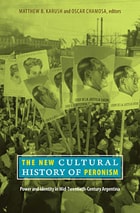
cover of The New Cultural History of Peronism: Power and Identity in Mid-Twentieth-Century Argentina

The New Cultural History of Peronism

Power and Identity in Mid-Twentieth-Century Argentina

Matthew B. Karush and Oscar Chamosa, eds.

Duke University Press, 2010

In nearly every account of modern Argentine history, the first Peronist regime (1946–55) emerges as the critical juncture. Appealing to growing masses of industrial workers, Juan Perón built a powerful populist movement that transformed economic and political structures, promulgated new conceptions and representations of the nation, and deeply polarized the Argentine populace. Yet until now, most scholarship on Peronism has been constrained by a narrow, top-down perspective. Inspired by the pioneering work of the historian Daniel James and new approaches to Latin American cultural history, scholars have recently begun to rewrite the history of mid-twentieth-century Argentina. The New Cultural History of Peronism brings together the best of this important new scholarship.

Situating Peronism within the broad arc of twentieth-century Argentine cultural change, the contributors focus on the interplay of cultural traditions, official policies, commercial imperatives, and popular perceptions. They describe how the Perón regime’s rhetoric and representations helped to produce new ideas of national and collective identity. At the same time, they show how Argentines pursued their interests through their engagement with the Peronist project, and, in so doing, pushed the regime in new directions. While the volume’s emphasis is on the first Perón presidency, one contributor explores the origins of the regime and two others consider Peronism’s transformations in subsequent years. The essays address topics including mass culture and melodrama, folk music, pageants, social respectability, architecture, and the intense emotional investment inspired by Peronism. They examine the experiences of women, indigenous groups, middle-class anti-Peronists, internal migrants, academics, and workers. By illuminating the connections between the state and popular consciousness, The New Cultural History of Peronism exposes the contradictions and ambivalences that have characterized Argentine populism.

Contributors: Anahi Ballent, Oscar Chamosa, María Damilakou, Eduardo Elena, Matthew B. Karush, Diana Lenton, Mirta Zaida Lobato, Natalia Milanesio, Mariano Ben Plotkin, César Seveso, Lizel Tornay
[more]
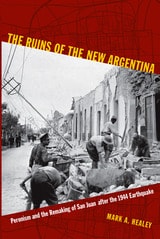
cover of The Ruins of the New Argentina: Peronism and the Remaking of San Juan after the 1944 Earthquake

The Ruins of the New Argentina

Peronism and the Remaking of San Juan after the 1944 Earthquake

Mark A. Healey

Duke University Press, 2011

In January 1944, an earthquake reduced the province of San Juan, Argentina, to rubble, leaving perhaps ten thousand dead and one hundred thousand homeless. In The Ruins of the New Argentina, Mark A. Healey argues that the disaster and the massive rebuilding project that followed transformed not only the province but also the nation. The earthquake was a shattering and galvanizing experience, an indictment of the old social order and an invitation to transform it. From the nation’s capital, an obscure colonel in a recently installed military regime launched a relief campaign and rapidly commissioned plans to rebuild the province, especially its capital city. The campaign was a rousing success, launching the public career of its director, Juan Domingo Perón, who would soon found a movement, reach the presidency, and transform the politics and social structure of the country. Dreaming and building the new city became the landmark project for a generation of modernist architects and planners, as well as an enduring challenge and controversy for local residents and the Peronist state. By exploring the struggle to rebuild, Healey shows how this destroyed province played a crucial role in forging, testing, and ultimately limiting the Peronist project of transforming the nation.
[more]