Results by title
30 books match the query 'Persistence'
After King Philip’s War
Presence and Persistence in Indian New EnglandEdited by Colin G. Calloway
Dartmouth College Press, 1997
Change and the Persistence of Tradition in India
Five LecturesRichard L. Park, Editor
University of Michigan Press, 1971
Communication Ethics and Tenacious Hope
Contemporary Implications of the Scottish EnlightenmentRonald C. Arnett with Foreword by Thomas M. Lessl
Southern Illinois University Press, 2022
Tenacious hope, the heart of a just and free society
During the Enlightenment, Scottish intellectuals and administrators met the demands of profit and progress while shepherding concerns for self and other, individual and community, and family and work. Communication Ethics and Tenacious Hope captures the “unity of contraries,” offering the Scottish Enlightenment as an exemplar of tenacious hope countering the excesses of individualism. Ronald C. Arnett reveals two stories: the struggle between optimism and tenacious hope, and optimism’s ultimate triumph in the exclusion of difference and the reification of progress as an ultimate good.
In chapters that detail the legacies of Lord Provost George Drummond, Adam Smith, David Hume, Thomas Reid, George Campbell, Adam Ferguson, and Sir Walter Scott, Arnett highlights the problematic nature of optimism and the ethical agency of tenacious hope. Arnett illustrates the creative union of education and administration, the ability to accept doubt within systems of knowledge and imagination, and an abiding connection to local soil. As principles of progress, free will, and capitalism swept Europe, proponents of optimism envisioned a world of consumerism and absolutes. In contrast, practitioners of tenacious hope embraced uncertainty and compassion as pragmatic necessities.
This work continues Arnett’s scholarship, articulating the vital importance of communication ethics. Those seeking to discern and support a temporal sense of the good in this historical moment will find in this timely work the means to pursue, hold, and nourish tenacious hope. This insightful theorization of the Scottish Enlightenment distills the substance of a just and free society for meeting dangerous and uncertain times.
De-Stalinisation Reconsidered
Persistence and Change in the Soviet UnionEdited by Thomas M. Bohn, Rayk Einax, and Michel Abeßer
Campus Verlag, 2014
Feminist Generations
The Persistence of the Radical Women's MovementNancy Whittier
Temple University Press, 1995
The radical feminist movement has undergone significant transformation over the past four decades—from the direct action of the 1960s and 1970s to the backlash against feminism in the 1980s and 1990s. Drawing on organizational documents and interviews with both veterans of the women's movement and younger feminists in Columbus, Ohio, Nancy Whittier traces the changing definitions of feminism as the movement has evolved. She documents subtle variations in feminist identity and analyzes the striking differences, conflicts, and cooperation between longtime and recent activists.
The collective stories of the women—many of them lesbians and lesbian feminists whom the author shows to be central to the women's movement and radical feminism—illustrate that contemporary radical feminism is very much alive. It is sustained through protests, direct action, feminist bookstores, rape crisis centers, and cultural activities like music festivals and writers workshops, which Whittier argues are integral—and political—aspects of the movement's survival.
Her analysis includes discussions of a variety of both liberal and radical organizations, including the Women's Action Collective, Women Against Rape, Fan the Flames Bookstore, the Ohio ERA Task Force, and NOW. Unlike many studies of feminist organizing, her study also considers the difference between Columbus, a Midwest, medium-sized city, and feminist activities in major cities like New York, San Francisco, and Chicago, as well as the roles of radical feminists in the development of women's studies departments and other social movements like AIDS education and self-help.
In the series Women in the Political Economy, edited by Ronnie J. Steinberg.
Haiti and the Revolution Unseen
The Persistence of the Decolonial ImaginationNatalie Marie Léger
Vanderbilt University Press, 2025
Léger writes against a Haiti- and Haitians-less idea of the Revolution. She asks scholars and artists of the Revolution to know Haitians as Ginens (African Haitians) and Haiti as Ayiti Ginen (Africa Haiti). This form of knowing demands a decolonial understanding of the Haitian Revolution and a reevaluation of its stories as told by influential twentieth-century Caribbean writers. The story she tells showcases the immense political impact of the African Haitian revolutionist’s philosophies of freedom in Saint Domingue and Haiti thereafter; and she argues that the absence of these philosophies in Caribbean classics of the Revolution demands consideration of why these classics continue to shape how the Revolution and Haiti are discussed in Caribbean Studies, Black Studies, Postcolonial Studies and Haitian Studies. More pressingly, Léger calls on artists and scholars of the Revolution to be mindful of how Haiti and Haitians are figured in narratives of the Revolution. The immense space Haiti holds in Caribbean imaginings of freedom and revolution makes mediating it, its Revolution, and peoples through a prejudiced gaze that serves the West hugely problematic, since a denigrated Haiti yields stunted visions of the Caribbean’s future. These conditions require attention to the pervasive presence of colonial paradigms for being in classic literatures of the Revolution and the way they undermine the generative manner Caribbean writers have used Haiti to think through their past, present, and future.

I've Had to Think Up a Way to Survive
On Trauma, Persistence, and Dolly PartonLynn Melnick
University of Texas Press, 2022
A moving and essential exploration of what it takes to find your voice as a woman, a survivor, an artist, and an icon.
The first time Lynn Melnick listened to a Dolly Parton song in full, she was 14 years old, in the triage room of a Los Angeles hospital, waiting to be admitted to a drug rehab program. Already in her young life as a Jewish teen in the 1980s, she had been the victim of rape, abuse, and trauma, and her path to healing would be long. But in Parton’s words and music, she recognized a fellow survivor.
In this powerful, incisive work of social and self-exploration, Melnick blends personal essay with cultural criticism to explore Parton’s dual identities as feminist icon and objectified sex symbol, identities that reflect the author’s own fraught history with rape culture and the arduous work of reclaiming her voice. Each chapter engages with the artistry and impact of one of Parton’s songs, as Melnick reckons with violence, misogyny, creativity, parenting, friendship, sex, love, and the consolations and cruelties of religion. Bold and inventive, I’ve Had to Think Up a Way to Survive gives us an accessible and memorable framework for understanding our times and a revelatory account of survival, persistence, and self-discovery.

Late Theory
Fredric Jameson, or The Persistence of ReadingPhillip E. Wegner
University of Minnesota Press, 2026
A bold, dialectic engagement with Fredric Jameson’s thought
Fredric Jameson (1934–2024) is widely regarded as the most influential literary and cultural theorist of the past fifty years. The culmination of more than three decades of sustained engagement with Jameson’s work, Late Theory offers a critical response to his late writings, namely the final volumes of his “Poetics of Social Forms,” to develop an original and dialectical reading practice in conversation with his evolving thought.
Jameson’s final works bring renewed clarity to three foundational concerns that structure his intellectual legacy. These are the problem of periodization and the challenge of grasping the present as a historical category, the dangers posed by the rise of moralizing modes of critique in literary and cultural studies, and the radical interpretive potential unlocked by allegory and the semiotic method. Phillip E. Wegner shows how these late interventions mark not a conclusion but an extension of Jameson’s long-standing project: envisioning the dialectic as a living, collective form of reasoning—a “thought mode of the future” capable of transforming our lives.
At its core, Late Theory is a passionate argument for cultural and aesthetic education as a practice of solidarity and imagination. Foregrounding Jameson’s enduring effort to build heterogeneous communities of readers committed to shared inquiry, Wegner affirms the urgency of reading, teaching, and thinking together in a moment of crisis for the university and global culture.
Retail e-book files for this title are screen-reader friendly with images accompanied by short alt text and/or extended descriptions.

Life After Welfare
Reform and the Persistence of PovertyBy Laura Lein and Deanna T. Schexnayder; with Karen Manges Douglas and Daniel G. Schroeder
University of Texas Press, 2007
A Choice Outstanding Academic Book
In the decade since President Clinton signed the Personal Responsibility and Work Opportunity Reconciliation Act of 1996 into law—amidst promises that it would "end welfare as we know it"—did the reforms ending entitlements and moving toward time limits and work requirements lift Texas families once living on welfare out of poverty, or merely strike their names from the administrative rolls?
Under welfare reform, Texas continued with low monthly payments and demanding eligibility criteria. Many families who could receive welfare in other states do not qualify in Texas, and virtually any part-time job makes a family ineligible. In Texas, most families who leave welfare remain in or near poverty, and many are likely to return to the welfare rolls in the future.
This compelling work, which follows 179 families after leaving welfare, is set against a backdrop of multiple types of data and econometric modeling. The authors' multi-method approach draws on administrative data from nine programs serving low-income families and a statewide survey of families who have left welfare. Survey data on health problems, transportation needs, and child-care issues shed light on the patterns of employment and welfare use seen in the administrative data. In their lives after welfare, the families chronicled here experience poverty even when employed; a multiplicity of barriers to employment that work to exacerbate one another; and a failing safety net of basic human services as they attempt to sustain low-wage employment.
Narratives of Persistence
Indigenous Negotiations of Colonialism in Alta and Baja CaliforniaLee M. Panich
University of Arizona Press, 2020
The Ohlone of the San Francisco Bay area and the Paipai of northern Baja California occupy opposite ends of the spectrum of Native Californian identities. Or so it would appear. While the Ohlone lack popular recognition and official acknowledgement from the United States government, the Paipai occupy a large reserve and celebrate their ongoing cultural traditions throughout Baja California and southern California. Yet the two groups share a similar colonial history: entanglements with early European explorers, labor and enculturation at Spanish missions, and sustained interactions with American and Mexican settler colonialism.
Based on fifteen years of archaeological and historical research in the two regions, Narratives of Persistence charts the remarkable persistence of the Ohlone and Paipai alongside a synthesis of Native Californian endurance over the past five centuries. As the case studies demonstrate, Ohlone and Paipai people made intelligent and culturally appropriate choices to cope with the impact of colonialism on their communities, even as they took different pathways to the present day.
Lee M. Panich illustrates how changes in Native identity and practice within these colonial contexts were made to best conduct the groups’ lives within shifting sets of colonial constraints. He draws connections between the events and processes of the deeper past and the way the Ohlone and Paipai today understand their own histories and identities, offering a model for how scholars of Indigenous histories may think about the connections between the past and the present.
On Persistence
Rebecca Comay
Seagull Books, 2026
On Persistence is an exploration into the elusive, unruly force of endurance—not as moral virtue or capitalist work ethic, but as a temporal and affective structure that resists assimilation. In these wide-ranging philosophical and literary essays, Rebecca Comay interrogates what it means to persist when progress stalls and resolution fails to arrive. Engaging figures from Freud to Beckett, Proust to Benjamin, Hamlet to Niobe, Comay tracks the strange temporality of suspended life: interminable mourning, unfinished projects, the persistence of the past, the undead stirrings of the death drive. What emerges is a radically different model of time—neither static nor teleological, but a form of interruption that opens space for rethinking agency, grief, resistance, and repair.
On Persistence offers a profound meditation on what it means to endure—and to endure differently—in a time that demands something else of us.

Patterns of Persistence
Utah Women Legislators, 1993–2026Tiffany Greene and Marie Cornwall
University of Utah Press, 2027
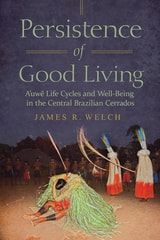
Persistence of Good Living
A’uwe Life Cycles and Well-Being in the Central Brazilian CerradosJames R. Welch
University of Arizona Press, 2023
Anthropologist James R. Welch transparently presents ethnographic insights from his long-term fieldwork in two A’uwẽ communities. He addresses how distinctive constructions of age organization contribute to social well-being in an era of major ecological, economic, and sociocultural change. Welch shows how A’uwẽ perspectives on the human life cycle help define ethnic identity, promote cultural resilience, and encourage the betterment of youth. They provide frameworks that people may creatively mobilize to responsibly and respectfully engage with others at different stages of life. They also motivate people to access and manage landscape resources essential to the social construction of good living. Through careful analysis, Welch shows how contemporary traditional peoples can foster enthusiasm for service to family and community amid dominant cultures that prioritize individual well-being.
This book is an essential resource for students and scholars interested in sociocultural anthropology, Indigenous cultures, health and culture, and human ecology.

Persistence, Privilege, and Parenting
The Comparative Study of Intergenerational MobilityTimothy Smeeding
Russell Sage Foundation, 2012
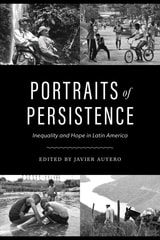
Portraits of Persistence
Inequality and Hope in Latin AmericaJavier Auyero
University of Texas Press, 2024
Profiles of triumph and hardship amid massive inequality in Latin America.
Each chapter of Portraits of Persistence, a project of the University of Texas Urban Ethnography Lab, offers an intimate portrait of one or two individual lives. The subjects are a diverse group of individuals from across the continent: grassroots activists and political brokers, private security entrepreneurs, female drug dealers, shantytown dwellers, and rural farmers, as well as migrants finding routes into and out of the region. Through these accounts, the writers explore issues that are common throughout today's world: precarious work situations, gender oppression, housing displacement, experiences navigating the bureaucracy for asylum seekers, state violence, environmental devastation, and access to good and affordable health care. Carefully situating these experiences within the sociohistorical context of their specific local regions or countries, editor Javier Auyero and his colleagues consider how people make sense of the paths their lives have taken, the triumphs and hardships they have experienced, and the aspirations they hold for the future. Ultimately, these twelve compelling profiles offer unique and personal windows into the region’s complex and multilayered reality.
Retention, Persistence, and Writing Programs
Todd Ruecker
Utah State University Press, 2017
From scholars working in a variety of institutional and geographic contexts and with a wide range of student populations, Retention, Persistence, and Writing Programs offers perspectives on how writing programs can support or hinder students’ transitions to college. The contributors present individual and program case studies, student surveys, a wealth of institutional retention data, and critical policy analysis.
Rates of student retention in higher education are a widely acknowledged problem: although approximately 66 percent of high school graduates begin college, of those who attend public four-year institutions, only about 80 percent return the following year, with 58 percent graduating within six years. At public two-year institutions, only 60 percent of students return, and fewer than a third graduate within three years. Less commonly known is the crucial effect of writing courses on these statistics.
First-year writing is a course that virtually all students have to take; thus, writing programs are well-positioned to contribute to larger institutional conversations regarding retention and persistence and should offer themselves as much-needed sites for advocacy, research, and curricular innovation. Retention, Persistence, and Writing Programs is a timely resource for writing program administrators as well as for new writing teachers, advisors, administrators, and state boards of education.
Contributors: Matthew Bridgewater, Cristine Busser, Beth Buyserie, Polina Chemishanova, Michael Day, Bruce Feinstein, Patricia Freitag Ericsson, Nathan Garrett, Joanne Baird Giordano, Tawanda Gipson, Sarah E. Harris, Mark Hartlaub, Holly Hassel, Jennifer Heinert, Ashley J. Holmes, Rita Malenczyk, Christopher P. Parker, Cassandra Phillips, Anna Plemons, Pegeen Reichert Powell, Marc Scott, Robin Snead, Sarah Elizabeth Snyder, Sara Webb-Sunderhaus, Susan Wolff Murphy
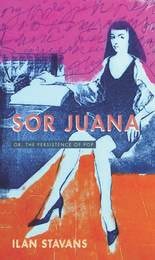
Sor Juana
Or, the Persistence of PopIlan Stavans
University of Arizona Press, 2018
Sor Juana: Or, the Persistence of Pop encapsulates the life, times, and legacy of Sor Juana. In this immersive work, essayist Ilan Stavans provides a biographical and meditative picture of the ways in which popular perceptions of her life and body of work both shape and reflect modern Latinx culture.

Superman
The Persistence of an American IconGordon, Ian
Rutgers University Press, 2017
Superman: Persistence of an American Icon examines the many iterations of the character in comic books, comic strips, radio series, movie serials, feature films, television shows, animation, toys, and collectibles over the past eight decades. Demonstrating how Superman’s iconic popularity cannot be attributed to any single creator or text, comics expert Ian Gordon embarks on a deeper consideration of cultural mythmaking as a collective and dynamic process. He also outlines the often contentious relationships between the various parties who have contributed to the Superman mythos, including corporate executives, comics writers, artists, nostalgic commentators, and collectors.
Armed with an encyclopedic knowledge of Superman’s appearances in comics and other media, Gordon also digs into comics archives to reveal the prominent role that fans have played in remembering, interpreting, and reimagining Superman’s iconography. Gordon considers how comics, film, and TV producers have taken advantage of fan engagement and nostalgia when selling Superman products. Investigating a character who is equally an icon of American culture, fan culture, and consumer culture, Superman thus offers a provocative analysis of mythmaking in the modern era.
The Impact of the Civil War and Reconstruction on Arkansas
Persistence in the Midst of RuinCarl H. Moneyhon
University of Arkansas Press, 2002
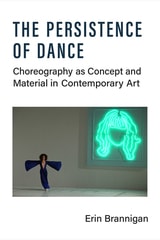
The Persistence of Dance
Choreography as Concept and Material in Contemporary ArtErin Brannigan
University of Michigan Press, 2023
The Persistence of Dance: Choreography as Concept and Material in Contemporary Art clarifies the continuities and differences between the second-wave dance avant-garde in the 1950s‒1970s and the third-wave starting in the 1990s. Through close readings of key artists such as Maria Hassabi, Sarah Michelson, Boris Charmatz, Meg Stuart, Philipp Gehmacher, Adam Linder, Agatha Gothe-Snape, Shelley Lasica and Latai Taumoepeau, The Persistence of Dance traces the relationship between the third-wave and gallery-based work. Looking at these artists highlights how the discussions and practices associated with “conceptual dance” resonate with the categories of conceptual and post-conceptual art as well as with the critical work on the function of visual art categories. Brannigan concludes that within the current post-disciplinary context, there is a persistence of dance and that a model of post-dance exists that encompasses dance as a contemporary art medium.
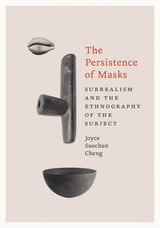
The Persistence of Masks
Surrealism and the Ethnography of the SubjectJoyce Suechun Cheng
University of Minnesota Press, 2025
An examination of surrealism’s unofficial ethnography of marginalized subjectivities
In interwar Paris, the encounter between surrealism and the nascent discipline of ethnology led to an intellectual project now known as “ethnographic surrealism.” In The Persistence of Masks, Joyce Suechun Cheng considers the ethnographic dimension of the surrealist movement in its formative years through a close look at the reviews Documents (1929–30) and Minotaure (1933–39) as well as the surrealist writer-turned-ethnographer Michel Leiris’s ethnography of possession. Analyzing surrealist aesthetic criticism, art, poetry, and field research in terms of a common interest in marginalized modes of subjectivity, Cheng argues that the surrealists used the figures of the mask, the veil, the hand, and the hat to radically reconceive the subject as nonhegemonic, nonanthropocentric, and feminine-identified.
Though ethnographic surrealism usually refers to the collaboration between professional ethnologists at the Institut de l’Ethnologie in Paris and Georges Bataille’s so-called dissident circle of surrealists, Cheng demonstrates that surrealism’s unofficial ethnography began long before the founding of the movement. Starting with André Breton’s wartime text “Subject” (1916), written when he was still a young psychiatric intern treating traumatized soldiers, she shows how the future surrealist poet shifted from a clinical to a para-ethnographic approach to subjectivity when adopting his patient’s first-person voice as a textual mask.
Revealing surrealism to be always implicitly ethnographic, Cheng uncovers deep affinities between archrivals Breton and Bataille, highlights psychiatry’s underacknowledged role in surrealism’s lay ethnography, and theorizes the surrealists’ feminine identification as a means of critiquing power. By broadening the scope of ethnographic surrealism, The Persistence of Masks offers new insights that challenge longstanding beliefs about this multifaceted movement in poetry, the arts, and culture.
The Persistence of Slavery
An Economic History of Child Trafficking in NigeriaRobin Phylisia Chapdelaine
University of Massachusetts Press, 2021
Despite efforts to abolish slavery throughout Africa in the nineteenth century, the coercive labor systems that constitute “modern slavery” have continued to the present day. To understand why, Robin Phylisia Chapdelaine explores child trafficking, pawning, and marriages in Nigeria's Bight of Biafra, and the ways in which British colonial authorities and Igbo, Ibibio, Efik, and Ijaw populations mobilized children's labor during the early twentieth century. Drawing on a wealth of primary sources that include oral interviews, British and Nigerian archival materials, newspaper holdings, and missionary and anthropological accounts, Chapdelaine argues that slavery's endurance can only be understood when we fully examine “the social economy of a child”—the broader commercial, domestic, and reproductive contexts in which children are economic vehicles.
The Persistence of Slavery provides an invaluable investigation into the origins of modern slavery and early efforts to combat it, locating this practice in the political, social, and economic changes that occurred as a result of British colonialism and its lingering effects, which perpetuate child trafficking in Nigeria today.
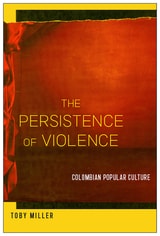
The Persistence of Violence
Colombian Popular CultureToby Miller
Rutgers University Press, 2020

Under the Spell of Orpheus
The Persistence of a Myth in Twentieth-Century ArtJudith E. Bernstock. Foreword by Peter Selz
Southern Illinois University Press, 1991
This comprehensive view of the Orpheus myth in modern art focuses on an extremely rich artistic symbol and cuts through all the clichés to explore truly significant problems of meaning. The author takes a new approach to the iconography of major modern artists by incorporating psychological and literary analysis, as well as biography.
The three parts of the book explore the ways in which artists have identified with different aspects of the often paradoxical Orpheus myth. The first deals with artists such as Paul Klee, Carl Milles, and Barbara Hepworth. In the second, Max Beckmann, Oskar Kokoschka, and Isamu Noguchi are discussed. Artists examined in the final part include Pablo Picasso, Jacques Lipchitz, Ethel Schwabacher, and Cy Twombly. The author documents her argument with more than sixty illustrations.
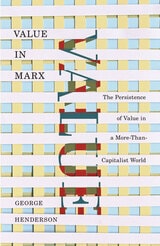
Value in Marx
The Persistence of Value in a More-Than-Capitalist WorldGeorge Henderson
University of Minnesota Press, 2013
Long prone to dogmatic disagreement, the question of value in Marx’s thought—what value is, the purpose it serves, its application to real-world capitalism—requires renewal if Marx’s work is to remain vibrant. In Value in Marx, George Henderson offers a lucid rereading of Marx that strips value of its turgid theoretical reduction and reframes it as an investigation into the tensions between social relations and forms as they are rather than as what they could otherwise become.
Drawing on Marx’s Capital and Grundrisse, Henderson shows how these volumes do not harbor a single theory of value that equates value to capital. Instead, these books experimentally compose and recompose value for a world that is more than capitalist. At stake is how Marx conceives of human freedom, of balanced social arrangements, and of control over the things people produce. Henderson finds that the limits on social becoming, including the tendency toward alienated existence, haunt Marx even as he looks beyond the critique of capital to an emancipated society to come.
Can these limits be confronted in a creative, even joyful, way? Can they become aspects of what we desire, rather than being silenced and denied? As long as we persist in interpreting value broadly, following it as an active and not a shut-down, predetermined feature of Marx’s texts, Henderson ultimately views Marx as responding positively to these challenges and employing value as a powerful tool of the political imaginary.

Violence against Queer People
Race, Class, Gender, and the Persistence of Anti-LGBT DiscriminationMeyer, Doug
Rutgers University Press, 2015
Selected as one of “The Best of the Best from the University Presses: Books You Should Know About” at the 2016 ALA Annual Conference
Violence against lesbians and gay men has increasingly captured media and scholarly attention. But these reports tend to focus on one segment of the LGBT community—white, middle class men—and largely ignore that part of the community that arguably suffers a larger share of the violence—racial minorities, the poor, and women. In Violence against Queer People, sociologist Doug Meyer offers the first investigation of anti-queer violence that focuses on the role played by race, class, and gender.
Drawing on interviews with forty-seven victims of violence, Meyer shows that LGBT people encounter significantly different forms of violence—and perceive that violence quite differently—based on their race, class, and gender. His research highlights the extent to which other forms of discrimination—including racism and sexism—shape LGBT people’s experience of abuse. He reports, for instance, that lesbian and transgender women often described violent incidents in which a sexual or a misogynistic component was introduced, and that LGBT people of color sometimes weren’t sure if anti-queer violence was based solely on their sexuality or whether racism or sexism had also played a role. Meyer observes that given the many differences in how anti-queer violence is experienced, the present media focus on white, middle-class victims greatly oversimplifies and distorts the nature of anti-queer violence. In fact, attempts to reduce anti-queer violence that ignore race, class, and gender run the risk of helping only the most privileged gay subjects.
Many feel that the struggle for gay rights has largely been accomplished and the tide of history has swung in favor of LGBT equality. Violence against Queer People, on the contrary, argues that the lives of many LGBT people—particularly the most vulnerable—have improved very little, if at all, over the past thirty years.

Viral Frictions
Global Health and the Persistence of HIV Stigma in KenyaElizabeth J. Pfeiffer
Rutgers University Press, 2022

Viscous Performances
The Persistence of Creative Resistances in Neoliberal ChileMaría José Contreras Lorenzini
Duke University Press, 2026
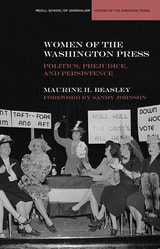
Women of the Washington Press
Politics, Prejudice, and PersistenceMaurine H. Beasley
Northwestern University Press, 2012
Women of the Washington Press argues that for nearly two centuries women journalists have persisted in their efforts to cover politics in the nation’s capital in spite of blatant prejudice and restrictive societal attitudes. They have been held back by the difficulties of combining two competing roles – those of women and journalists. As a group they have not agreed among themselves on feminist goals, while declaring that they aspire to be seen as professional journalists, not as advocates of a particular ideology. Still, they have brought a different perspective to the news, as they have fought hard to prove that they are capable of covering political issues just like male journalists. Over the years women have networked with each other and carved out areas of expertise – such as reporting of politically-oriented social events and coverage of first ladies – that men disdained, while they pressed to gain entrance to sex-segregated institutions like the National Press Club. Attempting to merge the personal and the political, they have raised issues like sexual harassment that men journalists left untouched. At a point today where they represent about half of accredited correspondents, women still face shifting barriers that make it difficult to combine the roles of both women and journalists in Washington, but they are continuing to broaden the definition of political journalism.
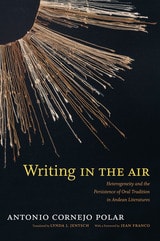
Writing in the Air
Heterogeneity and the Persistence of Oral Tradition in Andean LiteraturesAntonio Cornejo Polar
Duke University Press, 2013