Results by title
7 books match the query 'Peters, John Durham'

Action at a Distance
John Durham Peters
University of Minnesota Press, 2020
How are human actions shaped by the materiality of media?
Contemporary media leads us more than ever to an ‘acting at a distance,’ an acting entangled with the materiality of communication and the mediality of transmission. This book explores this crucial phenomenon thereby introducing urgent questions of human interaction, the binding and breaking of time and space, and the entanglement of the material and the immaterial.
Three vivid inquiries deal with histories and theories of mediality and materiality: John Durham Peters looks at episodes of simultaneity and synchronization. Christina Vagt discusses the agency of computer models against the backdrop of aesthetic theories by Henri Bergson and Hans Blumenberg, and Florian Sprenger discusses early electrical transmissions through copper wire and the temporality of instantaneity.
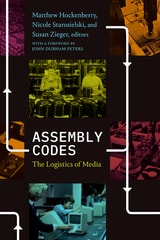
Assembly Codes
The Logistics of MediaMatthew Hockenberry, Nicole Starosielski, and Susan Zieger, editors
Duke University Press, 2021
Contributors
Ebony Coletu, Kay Dickinson, Stefano Harney, Matthew Hockenberry, Tung-Hui Hu, Shannon Mattern, Fred Moten, Michael Palm, Ned Rossiter, Nicole Starosielski, Liam Cole Young, Susan Zieger
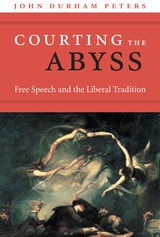
Courting the Abyss
Free Speech and the Liberal TraditionJohn Durham Peters
University of Chicago Press, 2005
A mesmerizing account of the role of public communication in the Anglo-American world, Courting the Abyss shows that liberty's earliest advocates recognized its fraternal relationship with wickedness and evil. While we understand freedom of expression to mean "anything goes," John Durham Peters asks why its advocates so often celebrate a sojourn in hell and the overcoming of suffering. He directs us to such well-known sources as the prose and poetry of John Milton and the political and philosophical theory of John Locke, Adam Smith, John Stuart Mill, and Oliver Wendell Holmes Jr., as well as lesser-known sources such as the theology of Paul of Tarsus. In various ways they all, he shows, envisioned an attitude of self-mastery or self-transcendence as a response to the inevitable dangers of free speech, a troubled legacy that continues to inform ruling norms about knowledge, ethical responsibility, and democracy today.
A world of gigabytes, undiminished religious passion, and relentless scientific discovery calls for a fresh account of liberty that recognizes its risk and its splendor. Instead of celebrating noxious doctrine as proof of society's robustness, Courting the Abyss invites us to rethink public communication today by looking more deeply into the unfathomable mystery of liberty and evil.
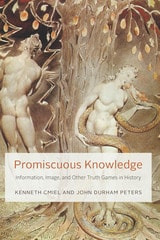
Promiscuous Knowledge
Information, Image, and Other Truth Games in HistoryKenneth Cmiel and John Durham Peters
University of Chicago Press, 2020
Speaking into the Air
A History of the Idea of CommunicationJohn Durham Peters
University of Chicago Press, 1999
"This is a most interesting and thought-provoking book. . . . Peters maintains that communication is ultimately unthinkable apart from the task of establishing a kingdom in which people can live together peacefully. Given our condition as mortals, communication remains not primarily a problem of technology, but of power, ethics and art." —Antony Anderson, New Scientist
"Guaranteed to alter your thinking about communication. . . . Original, erudite, and beautifully written, this book is a gem." —Kirkus Reviews
"Peters writes to reclaim the notion of authenticity in a media-saturated world. It's this ultimate concern that renders his book a brave, colorful exploration of the hydra-headed problems presented by a rapid-fire popular culture." —Publishers Weekly
What we have here is a failure-to-communicate book. Funny thing is, it communicates beautifully. . . . Speaking Into the Air delivers what superb serious books always do-hours of intellectual challenge as one absorbs the gradually unfolding vision of an erudite, creative author." —Carlin Romano, Philadelphia Inquirer
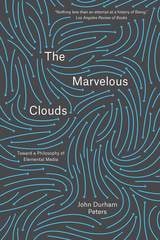
The Marvelous Clouds
Toward a Philosophy of Elemental MediaJohn Durham Peters
University of Chicago Press, 2015
When we speak of clouds these days, it is as likely that we mean data clouds or network clouds as cumulus or stratus. In their sharing of the term, both kinds of clouds reveal an essential truth: that the natural world and the technological world are not so distinct. In The Marvelous Clouds, John Durham Peters argues that though we often think of media as environments, the reverse is just as true—environments are media.
Peters defines media expansively as elements that compose the human world. Drawing from ideas implicit in media philosophy, Peters argues that media are more than carriers of messages: they are the very infrastructures combining nature and culture that allow human life to thrive. Through an encyclopedic array of examples from the oceans to the skies, The Marvelous Clouds reveals the long prehistory of so-called new media. Digital media, Peters argues, are an extension of early practices tied to the establishment of civilization such as mastering fire, building calendars, reading the stars, creating language, and establishing religions. New media do not take us into uncharted waters, but rather confront us with the deepest and oldest questions of society and ecology: how to manage the relations people have with themselves, others, and the natural world.
A wide-ranging meditation on the many means we have employed to cope with the struggles of existence—from navigation to farming, meteorology to Google—The Marvelous Clouds shows how media lie at the very heart of our interactions with the world around us. Peters’s book will not only change how we think about media but provide a new appreciation for the day-to-day foundations of life on earth that we so often take for granted.
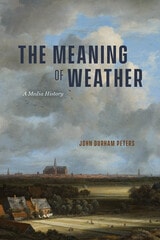
The Meaning of Weather
A Media HistoryJohn Durham Peters
University of Chicago Press, 0
A sweeping history of our relationship with weather in art, media, philosophy, religion, and science—and how the climate continually defies demystification.
We moderns tend to take the weather for granted. We know it through hourly timetables and radar maps and otherwise make it the subject of predictable and safe conversation. But weather is not safe or predictable and never has been. People have long used all their ingenuity to imagine and portray its shifty ways. As John Durham Peters argues, a closer look at the history of these efforts, from painting and poetry to cartography and close observation, has the potential to disclose something important about what it means to live in the world.
In The Meaning of Weather, John Durham Peters shows how the long history of understanding the weather has seen dreamers and data-crunchers alike craft remarkable visions of the world around us. From Babylonian astronomy to the Event Horizon Telescope, from illuminated manuscripts to television, and more, Peters explores the kaleidoscopic ways people have sought to understand, tame, or manage the weather—and how the climate resists being bridled. In this magisterial telling, Peters reimagines Western culture as a continuing struggle to know ourselves and each other through an ever-changing environment.