Results by title

4 books match the query 'Petroleum'
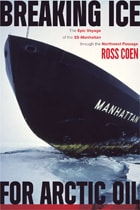
cover of Breaking Ice for Arctic Oil: The Epic Voyage of the SS Manhattan through the Northwest Passage

Breaking Ice for Arctic Oil

The Epic Voyage of the SS Manhattan through the Northwest Passage

Ross Coen

University of Alaska Press, 2012
In 1969, an icebreaking tanker, the SS Manhattan, was commissioned by Humble Oil to transit the Northwest Passage in order to test the logistical and economic feasibility of an all-marine transportation system for Alaska North Slope crude oil. Proposed as an alternative to the Trans-Alaska Pipeline, the Manhattan made two voyages to the North American Arctic and collected volumes of scientific data on ice conditions and the behavior of ships in ice. Although the Manhattan successfully navigated the Northwest Passage—closing a five-hundred-year chapter of Arctic exploration by becoming the first commercial vessel to do so—the expedition ultimately demonstrated the impracticality of moving crude oil using icebreaking ships.
Breaking Ice for Arctic Oil details this historic voyage, establishing its significant impact on the future of marine traffic and resource development in the Arctic and setting the stage for the current oil crisis.
[more]
cover of Ignition!: An Informal History of Liquid Rocket Propellants

Ignition!

An Informal History of Liquid Rocket Propellants

Clark, John D

Rutgers University Press, 1972

A classic work in the history of science, and described as “a good book on rocket stuff…that’s a really fun one” by SpaceX founder Elon Musk, readers will want to get their hands on this influential classic, available for the first time in decades.  

This newly reissued debut book in the Rutgers University Press Classics imprint is the story of the search for a rocket propellant which could be trusted to take man into space. This search was a hazardous enterprise carried out by rival labs who worked against the known laws of nature, with no guarantee of success or safety.

Acclaimed scientist and sci-fi author John Drury Clark writes with irreverent and eyewitness immediacy about the development of the explosive fuels strong enough to negate the relentless restraints of gravity. The resulting volume is as much a memoir as a work of history, sharing a behind-the-scenes view of an enterprise which eventually took men to the moon, missiles to the planets, and satellites to outer space.
 

[more]
cover of On Petrocultures: Globalization, Culture, and Energy

On Petrocultures

Globalization, Culture, and Energy

Imre Szeman

West Virginia University Press, 2019

On Petrocultures brings together key essays by Imre Szeman, a leading scholar in the field of energy humanities and a critical voice in debates about globalization and neoliberalism. Szeman’s most important and influential essays, in dialogue with exciting new pieces written for the book, investigate ever-evolving circuits of power in the contemporary world, as manifested in struggles over space and belonging, redefinitions of work and individual autonomy, and the deep links between energy use and climate change.

These essays explore life lived in the twenty-first century by examining critically the vocabulary through which capitalism makes sense of itself, focusing on concepts like the nation, globalization, neoliberalism, creativity, and entrepreneurship. At the heart of the volume is the concept of “petrocultures,” which demands that we understand a fundamental fact of modern life: we are shaped by and through fossil fuels. Szeman argues that we cannot take steps to address global warming without fundamentally changing the social, cultural, and political norms and expectations developed in conjunction with the energy riches of the past century. On Petrocultures maps the significant challenge of our dependence on fossil fuels and probes ways we might begin to leave petrocultures behind.
[more]
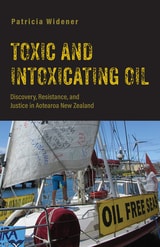
cover of Toxic and Intoxicating Oil: Discovery, Resistance, and Justice in Aotearoa New Zealand

Toxic and Intoxicating Oil

Discovery, Resistance, and Justice in Aotearoa New Zealand

Patricia Widener

Rutgers University Press, 2021

When oil and gas exploration was expanding across Aotearoa New Zealand, Patricia Widener was there interviewing affected residents and environmental and climate activists, and attending community meetings and anti-drilling rallies. Exploration was occurring on an unprecedented scale when oil disasters dwelled in recent memory, socioecological worries were high, campaigns for climate action were becoming global, and transitioning toward a low carbon society seemed possible. Yet unlike other communities who have experienced either an oil spill, or hydraulic fracturing, or offshore exploration, or climate fears, or disputes over unresolved Indigenous claims, New Zealanders were facing each one almost simultaneously. Collectively, these grievances created the foundation for an organized civil society to construct and then magnify a comprehensive critical oil narrative--in dialogue, practice, and aspiration. Community advocates and socioecological activists mobilized for their health and well-being, for their neighborhoods and beaches, for Planet Earth and Planet Ocean, and for terrestrial and aquatic species and ecosystems. They rallied against toxic, climate-altering pollution; the extraction of fossil fuels; a myriad of historic and contemporary inequities; and for local, just, and sustainable communities, ecologies, economies, and/or energy sources. In this allied ethnography, quotes are used extensively to convey the tenor of some of the country’s most passionate and committed people. By analyzing the intersections of a social movement and the political economy of oil, Widener reveals a nuanced story of oil resistance and promotion at a time when many anti-drilling activists believed themselves to be on the front lines of the industry’s inevitable decline.
[more]