Results by title
4 books match the query 'Pharmacists'
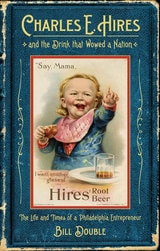
Charles E. Hires and the Drink that Wowed a Nation
The Life and Times of a Philadelphia EntrepreneurBill Double
Temple University Press, 2018
Introduced at the 1876 Centennial Exposition and powered by an historic advertising campaign, Hires Root Beer—launched 10 years before Coca-Cola—blazed the trail for development of the American soft drink industry. Its inventor, Charles Elmer Hires, has been described as “a tycoon with the soul of a chemist.” In addition to creating root beer, Hires, a devoted family man and a pillar of the Quaker community, became a leading importer of botanical commodities, an authority on the vanilla bean. Starting from scratch, he also built one of the world’s largest condensed milk companies.
Charles E. Hires and the Drink that Wowed a Nation chronicles the humble origin and meteoric business success of this extraordinary entrepreneur. Author Bill Double uses published interviews, correspondence, newspaper reports, magazine articles, financial data, and a small family archive to tell this story of native ingenuity. Here, the rough-hewn capitalism of the gilded age, the evolution of the neighborhood drugstore, the rise of advertising in creating mass markets, and the emerging temperance movement all come together in a biography that, well, fizzes with entrepreneurial spirit.
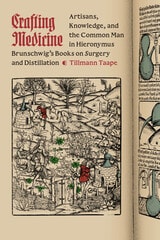
Crafting Medicine
Artisans, Knowledge, and the Common Man in Hieronymus Brunschwig's Books on Surgery and DistillationTillmann Taape
University of Chicago Press, 2025
Between 1497 and 1512, Hieronymus Brunschwig (ca. 1450–ca. 1530), an obscure craftsman from Strasbourg, wrote books on surgery and pharmacy that transformed medical expertise, how it was codified in print, and how it was communicated to new audiences. Brunschwig was an unlikely author. He apprenticed as a surgeon in the local guild and dispensed medicines from his own shop. But he was remarkably well-read in surgery, alchemy, and medical theory, even if he lacked a university education. His unique authorial voice spoke to the healing practices of craftsmen and common people in a down-to-earth German dialect.
Crafting Medicine, by Tillmann Taape, is the first in-depth study of Brunschwig and his works. In it, Taape argues that Brunschwig’s writings shaped a nascent tradition of vernacular medicine. Brunschwig’s books represent a key moment in the history of medical print, for they conveyed medical expertise to a new readership of nonacademic practitioners, who became a key audience for a flood of vernacular medical publications during the sixteenth century. Using Brunschwig’s books as a unique window into the past, Crafting Medicine beautifully reconstructs the world of science inhabited by Brunschwig, his fellow craftsmen, his translators, and his readers.
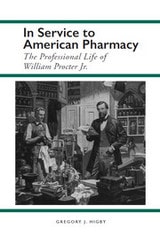
In Service to American Pharmacy
The Professional Life of William Procter Jr.Gregory J. Higby
University of Alabama Press, 1992
The story of the visionary pharmacist who helped build modern American pharmacy.
In Service to American Pharmacy: The Professional Life of William Procter Jr. by Gregory J. Higby is the definitive biography of William Procter Jr., widely recognized as the "Father of American Pharmacy." Through meticulous historical research, Higby chronicles Procter's extraordinary career and demonstrates how one individual's dedication helped transform pharmacy in the United States from a commercial trade into a respected healthcare profession during the nineteenth century.
The book follows Procter's contributions as a practicing pharmacist, pharmaceutical scientist, educator, editor, and organizational leader. It places his accomplishments within the broader evolution of American healthcare, tracing developments from the founding of the Philadelphia College of Pharmacy in 1821 through the emergence of professional standards, drug quality controls, pharmaceutical education, and meaningful pharmacy legislation. Higby shows how Procter's commitment to scientific rigor and public service helped establish many of the principles that continue to guide pharmacy practice today.
This book offers a valuable history of nineteenth-century medicine, science, and professionalization in America. Rich in historical context and scholarly insight, it illustrates the challenges and achievements involved in creating a modern profession dedicated to public health and pharmaceutical excellence. Essential for historians of medicine, pharmacy practitioners, and scholars of American science, this work highlights the enduring legacy of one of the most influential figures in healthcare history.
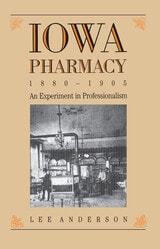
Iowa Pharmacy, 1880-1905
Experiment In ProfessionalismLee Anderson
University of Iowa Press, 1989
Popular culture remembers the settling of the Midwest as a golden era of unbounded opportunity, a time when every farm was a family farm and every farmer glowed with health. Pioneers in nineteenth-century Iowa, however, had to battle a formidable host of diseases during this golden era—malaria was endemic, smallpox and dysentery occurred in widespread epidemics, and typhoid, cholera, scarlet fever, and diphtheria had their seasons. Physicians in the growing Hawkeye State had little of the status and skill they command today, and herbalists, hydropaths, eclectics, Thomsonians, and homeopaths competed with purveyors of home remedies and patent medicines for their services.
The druggists of pioneer Iowa were artisan producers who compounded and prescribed botanical and chemical medicines, sold a variety of other merchandise from perfumes to paints, and dispensed the secret concoctions known as patent medicines, guaranteed to cure any condition, however alarming. In this compelling study, Lee Anderson tells the story of these early pharmacists and their hard-fought quest to legitimize their profession. While he confronts the politics of professionalism and the purpose of the pharmaceutical science and education, he also illuminates the mutual role of physicians and pharmacists in frontier health care.
With skill and humor, Anderson recreates an exciting time in midwestern history and provides insights into national issues of professionalism in medicine. His study will appeal to scholars in the history of medicine, pharmacy, and professionalism and to everyone interested in the history of the Midwest.