Results by title
3 books match the query 'Phenomenon'
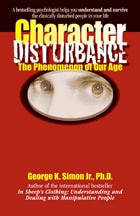
Character Disturbance
the phenomenon of our ageGeorge K. Simon
Parkhurst Brothers, Inc., 2011
Modern permissiveness and the new culture of entitlement allows disturbed people to reach adulthood without proper socialization. In a book meant both for the general public and for professionals, bestselling author and psychologist George Simon explains in plain English:
•How most disturbed characters think.•The habitual behaviors the disturbed use to avoid responsibility and to manipulate, deceive, and exploit others.
•Why victims in relationships with disturbed characters do not get help they need from traditional therapies.
•A straightforward guide to recognizing and understanding all relevant personality types, especially those most likely to undermine relationships.
•A new framework for making sense of the crazy world many find themselves in when there's a disturbed character in their lives.
•Concrete principles that promote responsibility and positive change when engaging disturbed characters.
•Tactics (for both lay persons and therapists) to lessen the chances for victimization and empower those who would otherwise be victims in their relationships with many types of disturbed characters.
[more]

The Phenomenon of Life
Toward a Philosophical BiologyHans Jonas
Northwestern University Press, 2001
A classic of phenomenology and existentialism, The Phenomenon of Life sets forth a systematic and comprehensive philosophy—an existential interpretation of biological facts laid out in support of his claim that the mind is prefigured throughout organic existence. Hans Jonas shows how life-forms present themselves on an ascending scale of perception and freedom of action, a scale reaching its apex in a human being's capacity for thought and morally responsible behavior.
[more]
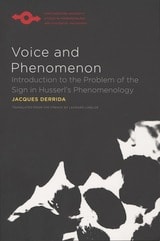
Voice and Phenomenon
Introduction to the Problem of the Sign in Husserl's PhenomenologyJacques Derrida, Translated from the French by Leonard Lawlor
Northwestern University Press, 2011
Published in 1967, when Derrida is 37 years old, Voice and Phenomenon appears at the same moment as Of Grammatology and Writing and Difference. All three books announce the new philosophical project called “deconstruction.” Although Derrida will later regret the fate of the term “deconstruction,” he will use it throughout his career to define his own thinking. While Writing and Difference collects essays written over a 10 year period on diverse figures and topics, and Of Grammatology aims its deconstruction at “the age of Rousseau,” Voice and Phenomenon shows deconstruction engaged with the most important philosophical movement of the last hundred years: phenomenology.
Only in relation to phenomenology is it possible to measure the importance of deconstruction. Only in relation to Husserl’s philosophy is it possible to understand the novelty of Derrida’s thinking. Voice and Phenomenon therefore may be the best introduction to Derrida’s thought in general. To adapt Derrida’s comment on Husserl’s Logical Investigations, it contains “the germinal structure” of Derrida’s entire thought. Lawlor’s fresh translation of Voice and Phenomenon brings new life to Derrida’s most seminal work.
Only in relation to phenomenology is it possible to measure the importance of deconstruction. Only in relation to Husserl’s philosophy is it possible to understand the novelty of Derrida’s thinking. Voice and Phenomenon therefore may be the best introduction to Derrida’s thought in general. To adapt Derrida’s comment on Husserl’s Logical Investigations, it contains “the germinal structure” of Derrida’s entire thought. Lawlor’s fresh translation of Voice and Phenomenon brings new life to Derrida’s most seminal work.
[more]