114 books match the query 'Philadelphia' and 7 start with a
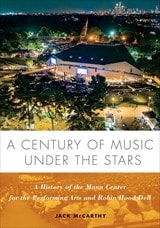
cover of A Century of Music Under the Stars: A History of the Mann Center for the Performing Arts and Robin Hood Dell

A Century of Music Under the Stars

A History of the Mann Center for the Performing Arts and Robin Hood Dell

McCarthy, Jack, and The Mann Center for the Performing Arts

Temple University Press, 2025

Everyone has a memorable story about attending a performance at the Mann Center for the Performing Arts or the Robin Hood Dell—“the Mann” and “the Dell” to their many patrons. Lavishly illustrated with more than 200 images, meticulously researched, and engagingly written by historian Jack McCarthy, A Century of Music Under the Stars reveals the fascinating inside story of Philadelphia’s premier outdoor concert venues on the eve of the Mann’s 50th Anniversary.

The Dell, which opened in 1930, and the Mann, which opened in 1976, were initially built as summer homes for The Philadelphia Orchestra. As McCarthy fondly recounts, the Mann Center evolved to host the world’s top artists across many musical genres. Contemporary audiences have gathered on the Great Lawn for concerts by performers including James Taylor, The Roots, Phish, Diana Ross, John Legend, and others. 

The venues, however, are more than just the music; they are about the beautiful natural setting, communal atmosphere, and spectacular view of the Philadelphia skyline. A Century of Music Under the Stars is a revealing and celebratory look back at beloved Philadelphia cultural icons. This informative and illuminating history will provide happy memories for generations of music lovers.
[more]
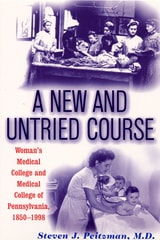
cover of A New and Untried Course: Women's Medical College and Medical College of Pennysylvania, 1850-1998

A New and Untried Course

Women's Medical College and Medical College of Pennysylvania, 1850-1998

Peitzman, Steve J

Rutgers University Press, 2000
In 1850, a group of reformist male Quaker physicians and allies founded the Female Medical College of Pennsylvania to offer formal medical training to women. By the 1890s, the renamed Woman's Medical College of Pennsylvania (WMC) had matured into a solid and progressive institution that would outlast other, younger women's medical schools that had arisen in the United States. Steven J. Peitzman describes how WMC survived periods of instability and crises as it became a remarkable experiment in single-sex professional education, and a rare early example of female-male collaboration in science and medicine. Its unique survival provided scarce opportunities for women physicians and scientists to teach and perform research, while maintaining the assurance of medical education free from gender discrimination, Yielding to complex forces, it became the coeducational Medical College of Pennsylvania in 1970 and found another new course to pursue
[more]
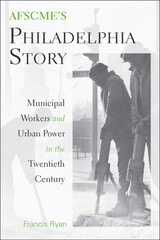
cover of AFSCME's Philadelphia Story: Municipal Workers and Urban Power in the Twentieth Century

AFSCME's Philadelphia Story

Municipal Workers and Urban Power in the Twentieth Century

Francis Ryan

Temple University Press, 2011

AFSCME's Philadelphia Story provides the most comprehensive account of the early years of the American Federation of State, County and Municipal Employees, which is one of the nation’s largest and most politically powerful unions in the AFL-CIO. Author Francis Ryan details the emergence of the Quaker City's interracial union, charting its beginnings in the political patronage system of one of the nation's most notorious political machines to the first decade of the twenty-first century. Ryan provides new insight into the working class origins of African American political power in the late twentieth century as well as a thorough overview of the role the municipal state played in the urban economy of one of the nation's largest cities.

Ryan describes the work processes and how they changed, and uses workers' testimonies to ground the detailed accounts of issues and negotiations. Beginning in the 1920s and ending in the 2000s, Ryan's study offers a long-term analysis of the growth of a single union in a major American city.
[more]
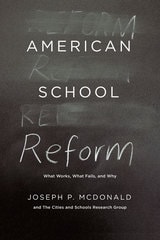
cover of American School Reform: What Works, What Fails, and Why

American School Reform

What Works, What Fails, and Why

Joseph P. McDonald and the Cities and Schools Research Group

University of Chicago Press, 2014

Dissecting twenty years of educational politics in our nation’s largest cities, American School Reform offers one of the clearest assessments of school reform as it has played out in our recent history. Joseph P. McDonald and his colleagues evaluate the half-billion-dollar Annenberg Challenge—launched in 1994—alongside other large-scale reform efforts that have taken place in New York, Chicago, Philadelphia, and the San Francisco Bay Area. They look deeply at what school reform really is, how it works, how it fails, and what differences it can make nonetheless.
             
McDonald and his colleagues lay out several interrelated ideas in what they call a theory of action space. Frequently education policy gets so ambitious that implementing it becomes a near impossibility. Action space, however, is what takes shape when talented educators, leaders, and reformers guide the social capital of civic leaders and the financial capital of governments, foundations, corporations, and other backers toward true results. Exploring these extraordinary collaborations through their lifespans and their influences on future efforts, the authors provide political hope—that reform efforts can work, and that our schools can be made better.   

[more]
cover of An Alternative Path: The Making and Remaking of Hahnemann Medical College and Hospital

An Alternative Path

The Making and Remaking of Hahnemann Medical College and Hospital

Naomi Rogers

Rutgers University Press, 1998
When Hahnemann Medical College was founded in Philadelphia in 1848, it was the only institution in the world to offer an M. D. degree in homeopathy, a therapeutic and intellectual alternative to orthodox medicine. This institutional history situates Hahnemann in the broader context of American social changes and chronicles its continual remaking in response to the rise of corporate medicine and constant changes in the Philadelphia community. In the nineteenth century, Hahnemann provided a distinctive and respected identity for its faculty, students, and supporters. In the early twentieth century, it accepted students denied admission elsewhere, especially Jewish and Italian students. It taught a flexible homeopathy that facilitated curricular changes remarkably similar to those at the best contemporary orthodox schools, including selective assimilation of the new experimental sciences, laboratory training, experience in the school's own teaching hospital, and a lengthened course of medical study. Hahnemann is no longer homeopathic, although it remained loyal to its alternative heritage long after the 1910 Flexner Report attempted to eliminate alternative medical education in America. Like many other American medical schools, Hahnemann has had its share of problems, financial and otherwise. The civil rights and radical student movements of the 1960s and 70s, however, pushed the College into a more politically conscious view of itself as a health care provider to the inner city and as a producer of health professionals. In 1993, the College merged with another Philadelphia medical school into a single health care and training institution called the Allegheny University of the HealthSciences. Although Hahnemann is now part of a new system of academic medicine, its institutional legacy endures, as it has in the past, by following alternative paths.
[more]
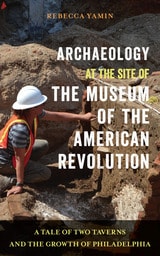
cover of Archaeology at the Site of the Museum of the American Revolution: A Tale of Two Taverns and the Growth of Philadelphia

Archaeology at the Site of the Museum of the American Revolution

A Tale of Two Taverns and the Growth of Philadelphia

Rebecca Yamin

Temple University Press, 2019

When the Museum of the American Revolution acquired the land at Third and Chestnut streets in Olde City, Philadelphia, it came with the condition that an archaeological investigation be conducted. The excavation that began in the summer of 2014 yielded treasures in the trash: unearthed privy pits provided remarkable finds from a mid-eighteenth-century tavern to relics from a button factory dating to the early twentieth century. These artifacts are described and analyzed by urban archaeologist Rebecca Yamin in Archaeology at the Site of the Museum of the American Revolution.

Yamin, lead archaeologist on the dig, catalogues items—including earthenware plates and jugs, wig curlers, clay pipes, and liquor bottles—to tell the stories of their owners and their roles in Philadelphia history. As she uncovers the history of the people as well as their houses, taverns, and buildings that were once on the site, she explains  that by looking at these remains, we see the story of the growth of Philadelphia from its colonial beginnings to the Second World War.

Archaeology at the Site of the Museum of the American Revolution is a perfect keepsake for armchair archaeologists, introductory students, and history buffs.
[more]
cover of an other: a black feminist consideration of animal life

an other

a black feminist consideration of animal life

Sharon Patricia Holland

Duke University Press, 2023

In an other, Sharon Patricia Holland offers a new theorization of the human animal/divide by shifting focus from distinction toward relation in ways that acknowledge that humans are also animals. Holland centers ethical commitments over ontological concerns to spotlight those moments when Black people ethically relate with animals. Drawing on writers and thinkers ranging from Hortense Spillers, Sara Ahmed, Toni Morrison, and C. E. Morgan to Jane Bennett, Jacques Derrida, and Donna Haraway, Holland decenters the human in Black feminist thought to interrogate blackness, insurgence, flesh, and femaleness. She examines MOVE’s incarnation as an animal liberation group; uses sovereignty in Morrison’s A Mercy to understand blackness, indigeneity, and the animal; analyzes Charles Burnett’s films as commentaries on the place of animals in Black life; and shows how equestrian novels address Black and animal life in ways that rehearse the practices of the slavocracy. By focusing on doing rather than being, Holland demonstrates that Black life is not solely likened to animal life; it is relational and world-forming with animal lives.
[more]