Results by title

3 books match the query 'Philippine literature (Spanish)'
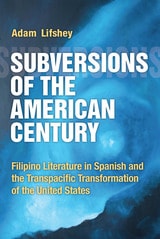
cover of Subversions of the American Century: Filipino Literature in Spanish and the Transpacific Transformation of the United States

Subversions of the American Century

Filipino Literature in Spanish and the Transpacific Transformation of the United States

Adam Lifshey

University of Michigan Press, 2016
Subversions of the American Century: Filipino Literature in Spanish and the Transpacific Transformation of the United States argues that the moment the United States became an overseas colonial power in 1898, American national identity was redefined across a global matrix. The Philippines, which the United States seized at that point from Spain and local revolutionaries, is therefore the birthplace of a new kind of America, one with a planetary reach that was, most profoundly, accompanied by resistance to that reach by local peoples.

Post-1898 Filipino literature in Spanish testifies crucially to this foregrounding fact of American global power, for it is the language of that tradition that speaks directly to the reality of one empire having wrested land from another. Yet this literature is invisible in American Studies programs, Asian Studies programs, Spanish and English departments, and everywhere else. Subversions of the American Century will change that. After Subversions, students and scholars in various American Studies disciplines as well as Asian, Spanish, and Comparative Literature fields will find it necessary to revisit and revamp the basic parameters by which they approach their subjects.

[more]
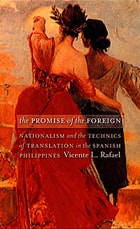
cover of The Promise of the Foreign: Nationalism and the Technics of Translation in the Spanish Philippines

The Promise of the Foreign

Nationalism and the Technics of Translation in the Spanish Philippines

Vicente L. Rafael

Duke University Press, 2005

In The Promise of the Foreign, Vicente L. Rafael argues that translation was key to the emergence of Filipino nationalism in the nineteenth century. Acts of translation entailed technics from which issued the promise of nationhood. Such a promise consisted of revising the heterogeneous and violent origins of the nation by mediating one’s encounter with things foreign while preserving their strangeness. Rafael examines the workings of the foreign in the Filipinos’ fascination with Castilian, the language of the Spanish colonizers. In Castilian, Filipino nationalists saw the possibility of arriving at a lingua franca with which to overcome linguistic, regional, and class differences. Yet they were also keenly aware of the social limits and political hazards of this linguistic fantasy.

Through close readings of nationalist newspapers and novels, the vernacular theater, and accounts of the 1896 anticolonial revolution, Rafael traces the deep ambivalence with which elite nationalists and lower-class Filipinos alike regarded Castilian. The widespread belief in the potency of Castilian meant that colonial subjects came in contact with a recurring foreignness within their own language and society. Rafael shows how they sought to tap into this uncanny power, seeing in it both the promise of nationhood and a menace to its realization. Tracing the genesis of this promise and the ramifications of its betrayal, Rafael sheds light on the paradox of nationhood arising from the possibilities and risks of translation. By repeatedly opening borders to the arrival of something other and new, translation compels the nation to host foreign presences to which it invariably finds itself held hostage. While this condition is perhaps common to other nations, Rafael shows how its unfolding in the Philippine colony would come to be claimed by Filipinos, as would the names of the dead and their ghostly emanations.
[more]
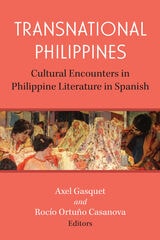
cover of Transnational Philippines: Cultural Encounters in Philippine Literature in Spanish

Transnational Philippines

Cultural Encounters in Philippine Literature in Spanish

Axel Gasquet and Rocío Ortuño Casanova, Editors

University of Michigan Press, 2024

Transnational Philippines: Cultural Encounters in Philippine Literature in Spanish approaches literature that has been forgotten or neglected in studies on other literatures in Spanish due, in part, to the fact that today Spanish is no longer spoken in the Philippines or in Asia. However, isolation has not always been the case, and by omitting Philippine literature in Spanish from the picture of world literatures and Spanish-language literatures, the landscape of these disciplines is incomplete. Transnational Philippines studies how this literary production stemmed from its relationship with other cultures, literature, and arts. It attempts to break this literature’s isolation and show how it is part of the broad literary system of literature written in Spanish. 

Yet Transnational Philippines also questions the constraints of traditional literary genres in order to make room for Philippine texts and other colonial and postcolonial texts, so that those texts can be taken into consideration in literary studies. Its chapters elaborate on the problems surrounding the cultural and identity relations of the Philippines with other regions and the literary nature of Philippine texts. By addressing the need for a postnational approach to Spanish-language Philippine literature, the book challenges the Spain/Latin America dichotomy existing in Spanish language literary studies and leans toward a global conception of the Hispanophone.
[more]