Results by title
10 books match the query 'Philosophical'
Accident
A Philosophical and Literary HistoryRoss Hamilton
University of Chicago Press, 2008
An accidental glance at a newspaper notice causes Rousseau to collapse under the force of a vision. A car accidentally hits Giacometti, and he experiences an epiphany. Darwin introduces accident to the basic process of life, and Freud looks to accident as the expression of unconscious desire. Accident, Ross Hamilton claims, is the force that makes us modern. Tracing the story of accident from Aristotle to Buster Keaton and beyond, Hamilton’s daring book revives the tradition of the grand history of ideas.
Accident tells an original history of Western thought from the perspective of Aristotle’s remarkably durable categories of accident and substance. Throughout antiquity and the Middle Ages, Aristotle’s distinction underwrote an insistence on order and subordination of the inessential. In a groundbreaking innovation, Hamilton argues that after the Reformation, the concept of accident began to change places with that of substance: accident became a life-transforming event and effectively a person’s essence. For moderns, it is the accidental, seemingly trivial moments of consciousness that, like Wordsworth’s “spots of time,” create constellations of meaning in our lives. Touching on a broad array of images and texts—Augustine, Dante, the frescoes of Raphael, Descartes, Jane Austen, the work of the surrealists, and twentieth-century cinema—Hamilton provides a new way to map the mutations of personal identity and subjectivity.
Biological Individuality
Integrating Scientific, Philosophical, and Historical PerspectivesEdited by Scott Lidgard and Lynn K. Nyhart
University of Chicago Press, 2017
Bringing together biologists, historians, and philosophers, this book provides a multifaceted exploration of biological individuality that identifies leading and less familiar perceptions of individuality both past and present, what they are good for, and in what contexts. Biological practice and theory recognize individuals at myriad levels of organization, from genes to organisms to symbiotic systems. We depend on these notions of individuality to address theoretical questions about multilevel natural selection and Darwinian fitness; to illuminate empirical questions about development, function, and ecology; to ground philosophical questions about the nature of organisms and causation; and to probe historical and cultural circumstances that resonate with parallel questions about the nature of society. Charting an interdisciplinary research agenda that broadens the frameworks in which biological individuality is discussed, this book makes clear that in the realm of the individual, there is not and should not be a direct path from biological paradigms based on model organisms through to philosophical generalization and historical reification.
Cost-Benefit Analysis
Economic, Philosophical, and Legal PerspectivesEdited by Matthew D. Adler and Eric A. Posner
University of Chicago Press, 2001
This new scholarly debate includes not only economists, but also contributors from philosophy, cognitive psychology, legal studies, and public policy who can further illuminate the justification and moral implications of this method and specify alternative measures.
These articles originally appeared in the Journal of Legal Studies.
Contributors:
- Matthew D. Adler - Gary S. Becker
- John Broome - Robert H. Frank
- Robert W. Hahn - Lewis A. Kornhauser
- Martha C. Nussbaum - Eric A. Posner
- Richard A. Posner - Henry S. Richardson
- Amartya Sen - Cass R. Sunstein
- W. Kip Viscusi
Maimonides' "Guide of the Perplexed"
A Philosophical GuideAlfred L. Ivry
University of Chicago Press, 2016
Drawing on a lifetime of study, Alfred L. Ivry has written the definitive guide to the Guide—one that makes it comprehensible and exciting to even those relatively unacquainted with Maimonides’ thought, while also offering an original and provocative interpretation that will command the interest of scholars. Ivry offers a chapter-by-chapter exposition of the widely accepted Shlomo Pines translation of the text along with a clear paraphrase that clarifies the key terms and concepts. Corresponding analyses take readers more deeply into the text, exploring the philosophical issues it raises, many dealing with metaphysics in both its ontological and epistemic aspects.
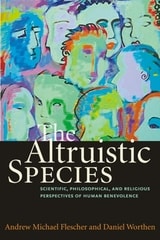
The Altruistic Species
Scientific, Philosophical, and Religious Perspectives of Human BenevolenceAndrew Michael Flescher
Templeton Press, 2008
What motivates altruism? How essential is the phenomenon of altruism to the human experience? Is altruism readily accessible to the ordinary person? In The Altruistic Species, Andrew Michael Flescher and Daniel L. Worthen explore these questions through the lenses of four disciplinary perspectives—biology, psychology, philosophy, and religion. In their investigation, they make an extended argument for the existence of altruism against competing theories that construe all ostensible cases of benevolence as self-interest in disguise. The authors consider theories of egoism; the role of genetics and evolutionary biology; the psychological that induce altruistic behavior; philosophical theories of altruism in normative ethics such as Kantian, utilitarian, and Aristotelian models of moral action; and accounts of love of the neighbor in Christianity and Buddhism. Additionally, they offer a new, comprehensive definition of altruism that includes the insights of each of these perspectives.
The Altruistic Species reinvigorates the debate over the prevalence of selfless motivation in human behavior—whether it is a rare or ubiquitous phenomenon—something considered exceptional or a capacity that members of any community could potentially develop. This noteworthy interdisciplinary examination of altruism balances science, virtue theory, and theology. It is ideal for ethics, human behavior, and evolutionary biology courses as an educational resource for other multidisciplinary studies and interested lay readers.
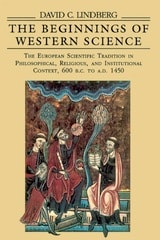
The Beginnings of Western Science
The European Scientific Tradition in Philosophical, Religious, and Institutional Context, 600 B.C. to A.D. 1450David C. Lindberg
University of Chicago Press, 1992
Lindberg surveys all the most important themes in the history of ancient and medieval science, including developments in cosmology, astronomy, mechanics, optics, alchemy, natural history, and medicine. He synthesizes a wealth of information in superbly organized, clearly written chapters designed to serve students, scholars, and nonspecialists alike. In addition, Lindberg offers an illuminating account of the transmission of Greek science to medieval Islam and subsequently to medieval Europe. And throughout the book he pays close attention to the cultural and institutional contexts within which scientific knowledge was created and disseminated and to the ways in which the content and practice of science were influenced by interaction with philosophy and religion. Carefully selected maps, drawings, and photographs complement the text.
Lindberg's story rests on a large body of important scholarship produced by historians of science, philosophy, and religion over the past few decades. However, Lindberg does not hesitate to offer new interpretations and to hazard fresh judgments aimed at resolving long-standing historical disputes. Addressed to the general educated reader as well as to students, his book will also appeal to any scholar whose interests touch on the history of the scientific enterprise.
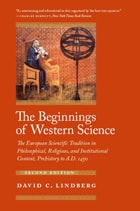
The Beginnings of Western Science
The European Scientific Tradition in Philosophical, Religious, and Institutional Context, Prehistory to A.D. 1450, Second EditionDavid C. Lindberg
University of Chicago Press, 2008
The Beginnings of Western Science is a landmark, the best book to ever to present a unified account of both ancient and medieval science in a single volume. Chronicling the development of scientific ideas, practices, and institutions from pre-Socratic Greek philosophy to late-Medieval scholasticism, David C. Lindberg surveys all the most important themes in the history of science, including developments in cosmology, astronomy, mechanics, optics, alchemy, natural history, and medicine. In addition, he offers an illuminating account of the transmission of Greek science to medieval Islam and subsequently to medieval Europe.
The Mind That Is Catholic
Philosophical and Political EssaysJames V. Schall
Catholic University of America Press, 2008
The Nature of Scientific Evidence
Statistical, Philosophical, and Empirical ConsiderationsEdited by Mark L. Taper and Subhash R. Lele
University of Chicago Press, 2004
Though the book uses ecology as an exemplary science, the interdisciplinary evaluation of the use of statistics in empirical research will be of interest to any reader engaged in the quantification and evaluation of data.
The Sacred Cosmos
Theological, Philosophical, and Scientific Conversations in the Twelfth Century School of ChartresPeter Ellard
University of Scranton Press, 2007
The School of Chartres was a bold intellectual movement of the twelfth century that introduced the World Soul and the Chartrian cosmology to Christendom. In his controversial book, The Sacred Cosmos, theologian Peter Ellard analyzes the most radical aspects of Chartrian thought and traces their relation to classical and late-antique philosophers such as Boethius and Plato. In addition, Ellard investigates the Cathedral of Chartres as an important proof and example of Chartrian theology in this essential volume for anyone interested in the intersection of spirituality and philosophy.