Results by title

3 books match the query 'Philosophical Reflections'
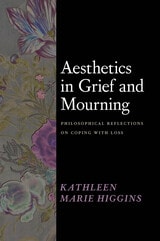
cover of Aesthetics in Grief and Mourning: Philosophical Reflections on Coping with Loss

Aesthetics in Grief and Mourning

Philosophical Reflections on Coping with Loss

Kathleen Marie Higgins

University of Chicago Press, 2024

A philosophical exploration of aesthetic experience during bereavement.

In Aesthetics of Grief and Mourning, philosopher Kathleen Marie Higgins reflects on the ways that aesthetics aids people experiencing loss. Some practices related to bereavement, such as funerals, are scripted, but many others are recursive, improvisational, mundane—telling stories, listening to music, and reflecting on art or literature. Higgins shows how these grounding, aesthetic practices can ease the disorienting effects of loss, shedding new light on the importance of aesthetics for personal and communal flourishing.
[more]
cover of Echoes From The Holocaust: Philosophical Reflections on a Dark Time

Echoes From The Holocaust

Philosophical Reflections on a Dark Time

edited by Alan Rosenberg and Gerald E. Myers

Temple University Press, 1990

The murder of six million Jewish men, women, and children during World War II was an act of such barbarity as to constitute one of the central events of our time; yet a list of the major concerns of professional philosophers since 1945 would exclude the Holocaust. This collection of twenty-three essays, most of which were written expressly for this volume, is the first book to focus comprehensively on the profound issues and philosophical significance of the Holocaust.

The essays, written for general as well as professional readers, convey an extraordinary range of factual information and philosophical reflection in seeking to identify the haunting meanings of the Holocaust. Among the questions addressed are: How should philosophy approach the Holocaust? What part did the philosophical climate play in allowing Hitlerism its temporary triumph? What is the philosophical climate today and what are its probable cultural effects? Can philosophy help our culture to become a bulwark against future agents of evil? The multiple dimensions of the Holocaust—historical, sociological, psychological, religious, moral, and literary—are collected here for concentrated philosophical interpretations.
[more]
cover of In Reasonable Hope: Philosophical Reflections on Ultimate Meaning

In Reasonable Hope

Philosophical Reflections on Ultimate Meaning

Patrick Masterson

Catholic University of America Press, 2021

In Reasonable Hope considers three foundational responses to this quest for some understanding of the existence, meaning, and value of everything. Other approaches can be considered as combinations or variations of these. Firstly, there is the approach which claims that it is our humanity, exercising its unique intelligent subjectivity, that is the source and measure of all possible meaning and value. Nothing can be thought of as existing, meaningful or of value apart from a thinking human subject. This is a broadly Humanist approach to ultimate meaning. Man is the measure of all things. Secondly, there is the approach of Scientism. This claims that an ultimate understanding of the world and ourselves must be sought, less anthropocentrically, in terms of the findings of basic empirical sciences such as physics and chemistry. We live in a world ever-increasingly dominated by the autonomous system of science and technology. Such Scientism implies an explicitly reductionist and materialist conception of the meaning and value of everything. Thirdly, there is the approach of Theism which maintains that, in the final analysis, the meaning and value of everything, insofar as this can be known, is to be explained in terms of a transcendent infinitely perfect personal being we call God. The first two approaches are carefully considered. However, it is the third to which most attention is devoted. Consideration is given to the traditional impersonal metaphysical approach to questions about the existence and nature of God. The alternative approaches of linguistic philosophy and phenomenology, which reject such metaphysical speculation are also discussed. These various approaches are judged to be complementary rather than strict alternatives. In the latter half of the book is devoted to a more personal and self-involving discussion of the relevance of an affirmation of the existence of God. It explores the implications of a rational commitment to live one's life in accordance with the requirements of values which transcend explanation in purely physical terms, such as truth, goodness, beauty, and especially love. It provides a personal and existential development of the rational hope that such values are ultimately more objectively real and dependable than the eventual universal material chaos predicted by empirical science. It argues that the existence of God as the infinite expression and source of these values is the necessary and sufficient condition of this rational hope in their enduring significance. Finally, there is an account of how the Christian Revelation illuminates and transforms our rational hope in the enduring significance of love of God and neighbor.
[more]