Results by title
55 books match the query 'Philosophy, Ancient' and 6 start with a
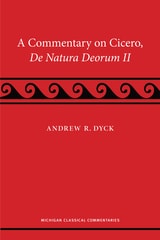
A Commentary on Cicero, De Natura Deorum II
Andrew R. Dyck
University of Michigan Press, 2025
Distinguished Latinist Andrew R. Dyck presents the first English commentary on Cicero’s De Natura Deorum II in over fifty years. This text is the only connected exposition of Stoic theology to survive from the ancient world. It includes an argument for the existence of the gods from the construction of the cosmos taken up by later thinkers, as well as an exposition of the world-order and divine providence according to Stoic doctrine. After a period in which Cicero’s philosophical works were treated mainly as sources for reconstructing the thought of earlier philosophers, they are now coming to be appreciated as intelligent and skillful works in their own right. This book will assist students and others studying Cicero’s De Natura Deorum II by providing its historical context, improved Latin text, and a detailed commentary with references to the latest literature on the subject.
[more]
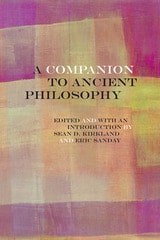
A Companion to Ancient Philosophy
Edited and with an introduction by Sean D. Kirkland and Eric Sanday
Northwestern University Press, 2018
A Companion to Ancient Philosophy is a collection of essays on a broad range of themes and figures spanning the entire period extending from the Pre-Socratics to Plato, Aristotle, and the Hellenistic thinkers.
Rather than offering synoptic and summary treatments of preestablished positions and themes, these essays engage with the ancient texts directly, focusing attention on concepts that emerge as urgent in the readings themselves and then clarifying those concepts interpretively. Indeed, this is a companion volume that takes a very serious and considered approach to its designated task—accompanying readers as they move through the most crucial passages of the infinitely rich and compelling texts of the ancients. Each essay provides a tutorial in close reading and careful interpretation.
Because it offers foundational treatments of the most important works of ancient philosophy and because it, precisely by doing so, arrives at numerous original interpretive insights and suggests new directions for research in ancient philosophy, this volume should be of great value both to students just starting off reading the ancients and to established scholars still fascinated by philosophy's deepest abiding questions.
[more]
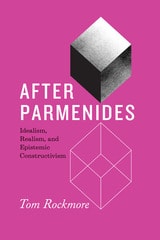
After Parmenides
Idealism, Realism, and Epistemic ConstructivismTom Rockmore
University of Chicago Press, 2021
Engages with one of the oldest philosophical problems—the relationship between thought and being—and offers a fresh perspective with which to approach the long history of this puzzle.
In After Parmenides, Tom Rockmore takes us all the way back to the beginning of Western philosophy, when Parmenides asserted that thought and being are the same. This idea created a division between what the mind constructs as knowable entities and the idea that there is also a mind-independent real, which we can know or fail to know. Rockmore argues that we need to give up on the idea of knowing the real as it is, and instead focus on the objects of cognition that our mind constructs. Though we cannot know mind-independent objects as they “really” are, we can and do know objects as they appear to us.
After Parmenides charts the continual engagement with these ideas of the real and the knowable throughout philosophical history from Plato and Aristotle to Descartes, Kant, Fichte, Hegel, Schopenhauer, Marx, and others. This ambitious book shows how new connections can be made in the history of philosophy when it is reread through a new lens.
[more]
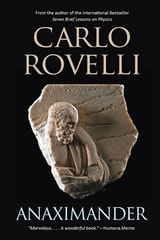
Anaximander
Carlo Rovelli
Westholme Publishing, 2011
THIS EBOOK IS NO LONGER AVAILABLE.
[more]
Antisthenes of Athens
Texts, Translations, and CommentarySusan H. Prince
University of Michigan Press, 2015
Antisthenes of Athens (c. 445-365 BCE) was a famous ancient disciple of Socrates, senior to Plato by fifteen years and inspirational to Xenophon. He is relevant to two of the greatest turning points in ancient intellectual history, from pre-Socraticism to Socraticism, and from classical Athens to the Hellenistic period. A better understanding of Antisthenes leads to a better understanding of the intellectual culture of Athens that shaped Plato and laid the foundations for Hellenistic philosophy and literature as well. Antisthenes wrote prolifically, but little of this text remains today. Susan Prince has collected all the surviving passages that pertain most closely to Antisthenes’ ancient reputation and literary production, translates them into English for the first time, and sets out the parameters for their interpretation, with close attention to the role Antisthenes likely played in the literary agenda of each ancient author who cited him.
This is the first translation of Antisthenes’ remains into English. Chapters present the ancient source, the original Greek passage, and necessary critical apparatus. The author then adds the modern English translation and notes on the context of the preservation, the significance of the testimonium, and on the Greek. Several new readings are proposed.
Antisthenes of Athens will be of interest to anyone seeking to understand Antisthenes and his intellectual context, as well as his contributions to ancient literary criticism, views on discourse, and ethics.
[more]
Aristotle's "Art of Rhetoric"
Aristotle
University of Chicago Press, 2019
For more than two thousand years. Aristotle’s “Art of Rhetoric” has shaped thought on the theory and practice of rhetoric, the art of persuasive speech. In three sections, Aristotle discusses what rhetoric is, as well as the three kinds of rhetoric (deliberative, judicial, and epideictic), the three rhetorical modes of persuasion, and the diction, style, and necessary parts of a successful speech. Throughout, Aristotle defends rhetoric as an art and a crucial tool for deliberative politics while also recognizing its capacity to be misused by unscrupulous politicians to mislead or illegitimately persuade others.
Here Robert C. Bartlett offers a literal, yet easily readable, new translation of Aristotle’s “Art of Rhetoric,” one that takes into account important alternatives in the manuscript and is fully annotated to explain historical, literary, and other allusions. Bartlett’s translation is also accompanied by an outline of the argument of each book; copious indexes, including subjects, proper names, and literary citations; a glossary of key terms; and a substantial interpretive essay.
Here Robert C. Bartlett offers a literal, yet easily readable, new translation of Aristotle’s “Art of Rhetoric,” one that takes into account important alternatives in the manuscript and is fully annotated to explain historical, literary, and other allusions. Bartlett’s translation is also accompanied by an outline of the argument of each book; copious indexes, including subjects, proper names, and literary citations; a glossary of key terms; and a substantial interpretive essay.
[more]