Results by title
3 books match the query 'Philosophy, Yoruba'
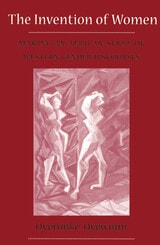
Invention Of Women
Making An African Sense Of Western Gender DiscoursesOyeronke Oyewumi
University of Minnesota Press, 1997
Oyewumi traces the misapplication of Western, body-oriented concepts of gender through the history of gender discourses in Yoruba studies. Her analysis shows the paradoxical nature of two fundamental assumptions of feminist theory: that gender is socially constructed and that the subordination of women is universal. The Invention of Women demonstrates, to the contrary, that gender was not constructed in old Yoruba society, and that social organization was determined by relative age.
A meticulous historical and epistemological account of an African culture on its own terms, this book makes a persuasive argument for a cultural, context-dependent interpretation of social reality. It calls for a reconception of gender discourse and the categories on which such study relies. More than that, the book lays bare the hidden assumptions in the ways these different cultures think. A truly comparative sociology of an African culture and the Western tradition, it will change the way African studies and gender studies proceed.
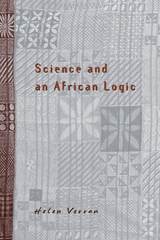
Science and an African Logic
Helen Verran
University of Chicago Press, 2001
In this captivating book, Helen Verran addresses precisely that question by looking at how science, mathematics, and logic come to life in Yoruba primary schools. Drawing on her experience as a teacher in Nigeria, Verran describes how she went from the radical conclusion that logic and math are culturally relative, to determining what Westerners find so disconcerting about Yoruba logic, to a new understanding of all generalizing logic. She reveals that in contrast to the one-to-many model found in Western number systems, Yoruba thinking operates by figuring things as wholes and their parts. Quantity is not absolute but always relational. Certainty is derived not from abstract logic, but from cultural practices and associations.
A powerful story of how one woman's investigation in this everday situation led to extraordinary conclusions about the nature of numbers, generalization, and certainty, this book will be a signal contribution to philosophy, anthropology of science, and education.
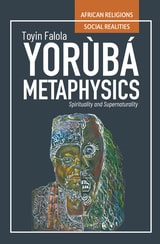
Yorùbá Metaphysics
Spirituality and SupernaturalityToyin Falola
Ohio University Press, 2025
Yorùbá Metaphysics challenges Western dominance in the field of epistemology and sheds light on the sophisticated realm of indigenous African knowledge systems and metaphysical thought. Toyin Falola comprehensively explores the complex interplay between the physical and spiritual worlds as understood by the Yorùbá people, offering a fresh perspective on metaphysics, spirituality, and the societal roles these elements play in African communities. The book contributes to the fields of philosophy, religious studies, and African studies by revealing how indigenous epistemologies can inform broader discussions of metaphysics, ethics, and societal development that are outside the Western frame of thought. Each of the book’s fifteen chapters focuses on a distinct aspect of Yorùbá life and cosmology. Topics encompass the everyday consequences of spiritual beliefs on social interactions and community living as well as the philosophical foundations that inform these practices. Noteworthy discussions include the function of language in conveying metaphysical knowledge, the societal impact of esoteric beliefs, and the application of these traditional understandings to contemporary life challenges. This work not only elucidates the nuances of Yorùbá metaphysical thought but also promotes the integration of this knowledge into broader academic and practical settings to advance societal development and sustainability. As global discourse increasingly seeks to acknowledge and incorporate diverse viewpoints, this book provides essential insights into the workings of an African metaphysical philosophy and its relevance to both regional and international concerns. Falola urges the academic community to reconsider the value and role of indigenous knowledge systems in present-day education and policy formation. This work is vital for scholars, policymakers, and practitioners interested in cultural studies, philosophy, religious studies, and African studies. It is not merely a scholarly work; it is an appeal for a reassessment of the methods by which indigenous knowledge is viewed and applied on an international scale.