Results by title
22 books match the query 'Philosophy in literature'
'Pataphysics
The Poetics of an Imaginary ScienceChristian Bok
Northwestern University Press, 2002
A long overdue critical look at a significant strain of the twentieth-century avant-garde, 'Pataphysics: The Poetics of Imaginary Science raises important historical, cultural, and theoretical issues germane to the production and reception of poetry, the ways we think about, write, and read it, and the sorts of claims it makes upon our understanding.
A Philosophical Novelist
George Santayana and the Last PuritanH. T. Kirby-Smith
Southern Illinois University Press, 1997
H. T. Kirby-Smith uses Santayana’s 1936 novel, The Last Puritan, as both an occasion and a means for bringing into focus the complex relations between Santayana’s life, his personality, and his philosophy. Opening with an account of Santayana’s various literary styles and arguing for the significance of Santayana’s writing of philosophy as literature, Kirby-Smith notes that Santayana saw the rational life as a continual adjustment and accommodation of contradictory claims. And he saw a literary style as an accommodation of the author to the reader.
Chapters 2 through 5 provide the philosophical background for a consideration of The Last Puritan, summarizing exactly how Santayana assimilated other philosophies into his own.
Chapters 6 and 7 incorporate Santayana’s three-volume autobiography, his letters and memoirs, and biographical studies by others into a psychological portrait of the author. All of this is in preparation for chapters 8 and 9, which focus on The Last Puritan. Kirby-Smith closes with a chapter that serves as a legal brief in defense of the author against the harsh, sometimes malicious attacks of his critics.
American Literature and the Destruction of Knowledge
Innovative Writing in the Age of EpistemologyRonald E. Martin
Duke University Press, 1991
The works of Melville, Emerson, Whitman, and Dickinson, followed by Crane, Frost, Pound, Stein, Hemingway, Dos Passos, Aiken, Stevens, and Williams, are examined as part of a cultural current that casts doubt on the possibility of knowledge itself. The destruction of concepts, of literary and linguistic forms, was for these writers a precondition for liberating the imagination to gain more access to the self and the real world. As part of the exploration of this cultural context, literary and philosophical realisms are examined together, allowing a comparison of their somewhat different objectives, as well as their common epistemological predicament.
Being Here Is Glorious
On Rilke, Poetry, and PhilosophyJames D. Reid
Northwestern University Press, 2015
With a new translation of the Duino Elegies
“Who, if I cried out, would hear me among the angels’/orders?” Rainer Maria Rilke’s Duino Elegies opens with one of the most powerful poetic expressions of the search for meaning in the modern world. Published in 1923, the Elegies would influence important philosophers on the Continent, including Heidegger. But with a few exceptions, Rilke’s poetry has not had an impact on philosophy in the Anglo-American world. In Being Here Is Glorious, James D. Reid offers a fresh translation of the Elegies, which hews to the form of the original and provides his own meditation on the place of poetry in philosophy. Reid makes a convincing case that poetry and philosophy can address the problem of finding things significant and worth affirming in light of various reasons to doubt the value of the world in which we find ourselves cast.
Dreaming of Justice, Waking to Wisdom
Rousseau's Philosophic LifeLaurence D. Cooper
University of Chicago Press, 2023
Dreaming of Justice, Waking to Wisdom reveals what could be thought of as the capstone of Rousseau’s thought, even if that capstone has been nearly invisible to readers. Despite criticizing philosophy for its corrosive effects on both natural goodness and civic virtue, Rousseau, argues Laurence D. Cooper, held the philosophic life as an ideal. Cooper expertly unpacks Rousseau’s vivid depiction of the philosophic life and the case for that life as the most natural, the freest, or, in short, the best or most choice-worthy of lives. Cooper focuses especially on a single feature, arguably the defining feature of the philosophic life: the overcoming of the ordinary moral consciousness in favor of the cognitivist view of morality. Cooper shows that Rousseau, with his particular understanding and embrace of the philosophic life, proves to be a kind of latter-day Socratic. Thorough and thought-provoking, Dreaming of Justice, Waking to Wisdom provides vital insight into Rousseau.

Early Stevens
The Nietzschean IntertextB. J. Leggett
Duke University Press, 1992
Concentrating on poems published between 1915 and 1935—but moving occasionally into later poems, as well as letters and essays—B. J. Leggett draws together texts of Stevens and Nietzsche to produce new and surprising readings of the poet's early work. This intertextual critique reveals previously undisclosed ideologies operating at the margins of Stevens's work, enabling Leggett to read aspects of the poetry that have until now been unreadable. Leggett's analysis demonstrates that the Nietzschean presence in Stevens brings with it certain assumptions that need to be made explicit if the form of the poetry is to be understood.
Though many critics have discussed the concept of intertextuality, few have attempted a truly intertextual reading of a particular poet. Early Stevens not only develops an exemplary model of such a reading; it also provides crucial insights into Stevens's notions of femininity, virility, and poetry and elucidates the notions of art, untruth, fiction, and interpretation in both Stevens and Nietzsche.

Fictions of Consciousness
Mill, Newman, and the Reading of Victorian ProseJonathan Loesberg
Rutgers University Press, 1986
Flannery O'Connor and Blaise Pascal
Recovering the Incarnation for the Modern MindAnn Hartle
Catholic University of America Press, 2025
Groundless Noir
Ontology and Latin American Crime FictionErik Larson
Bucknell University Press, 2026
This philosophical study of Latin American noir fiction poses the question, What if precarity and uncertainty aren’t just themes of the genre but ways of being in the world? Emerging from a region immersed in violence, trauma, and political instability, the novela negra reveals not just disillusionment but a desire to adapt to, even dwell within, chaos. In the hands of writers like Ricardo Piglia, Roberto Bolaño, and Patricia Melo, savvy detectives and antiheroes navigate a world in which meaning constantly shifts and certainty is elusive. Blending literary analysis with philosophical inquiry, Larson draws on Heideggerian ontology to demonstrate how the noir novel becomes a mode of existence—grounded in its very groundlessness. Rather than offering resolution, these novels embody a paradoxical desire: to engage crisis while also adapting to it. In doing so, they become both ideological and pedagogical—existential fiction for an uncertain world.
Published by Bucknell University Press. Distributed worldwide by Rutgers University Press.

I Think I Am
Philip K. DickLaurence A. Rickels
University of Minnesota Press, 2010
In Quest of the Ordinary
Lines of Skepticism and RomanticismStanley Cavell
University of Chicago Press, 1988

Lunar Voices
Of Tragedy, Poetry, Fiction, and ThoughtDavid Farrell Krell
University of Chicago Press, 1995
Krell pursues important philosophical motifs such as time, rhythm, and desire, through texts by Nietzsche, Trakl, Empedocles, Kafka, and Garcia Marquez. He surveys instances in which poets or novelists explicitly address philosophical questions, and philosophers confront literary texts—Heidegger's and Derrida's appropriations of Georg Trakl's poetry, Blanchot's obsession with Kafka's tortuous love affairs, and Garcia Marquez's use of Nietzsche's idea of the Eternal Return—all linked by the tragic hero Empedocles.
In his search to understand the insatiable desire for completeness that patterns so much art and philosophy, Krell investigates the identification of the lunar voice with woman in various roles—lover, friend, sister, shadow, and narrative voice.
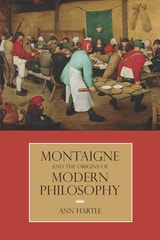
Montaigne and the Origins of Modern Philosophy
Ann Hartle
Northwestern University Press, 2013
Montaigne’s Essays are rightfully studied as giving birth to the literary form of that name. Ann Hartle’s Montaigne and the Origins of Modern Philosophy argues that the essay is actually the perfect expression of Montaigne as what he called "a new figure: an unpremeditated and accidental philosopher." Unpremeditated philosophy is philosophy made sociable—brought down from the heavens to the street, where it might be engaged in by a wider audience. In the same philosophical act, Montaigne both transforms philosophy and invents "society," a distinctly modern form of association. Through this transformation, a new, modern character emerges: the individual, who is neither master nor slave and who possesses the new virtues of integrity and generosity. In Montaigne’s radically new philosophical project, Hartle finds intimations of both modern epistemology and modern political philosophy.
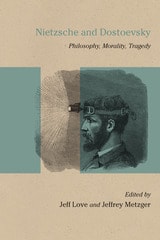
Nietzsche and Dostoevsky
Philosophy, Morality, TragedyEdited by Jeff Love and Jeffrey Metzger
Northwestern University Press, 2016
On Moral Personhood
Philosophy, Literature, Criticism, and Self-UnderstandingRichard Eldridge
University of Chicago Press, 1989
Eldridge presents an extensive new interpretation of Kantian ethics that is deeply informed by Kant's aesthetics. He defends a revised version of Kantian universalism and a Kantian conception of the content of morality. Eldridge then turns to literature armed not with any a priori theory but with an interpretive stance inspired by Hegel's phenomenology of self-understanding, more or less naturalized, and by Wittgenstein's work on self-understanding as ongoing narrative-interpretive activity, a stance that yields Kantian results about the universal demands our nature places on itself.
Eldridge goes on to present readings of novels by Conrad and Austen and poetry by Wordsworth and Coleridge. In each text protagonists are seen to be struggling with moral conflicts and for self-understanding as moral persons. The route toward partial resolution of their conflicts is seen to involve multiple and ongoing activities of reading and interpreting. The result of this kind of interpretation is that such literature—literature that portrays protagonists as themselves readers and interpreters of human capacities for morality—is a primary source for the development of morally significant self-understanding. We see in the careers of these protagonists that there can be genuine and fruitful moral deliberation and valuable action, while also seeing how situated and partial any understanding and achievement of value must remain.
On Moral Personhood at once delineates the moral nature of persons; shows various conditions of the ongoing, contextualized, partial acknowledgment of that nature and of the exercise of the capacities that define it; and enacts an important way of reading literature in relation to moral problems. Eldridge's work will be important reading for moral philosophers (especially those concerned with Kant, Hegel, and issues dividing moral particularists from moral universalists), literary theorists (especially those concerned with the value of literature and its relation to philosophy and to moral problems), and readers and critics of Conrad, Wordsworth, Coleridge, and Austen.
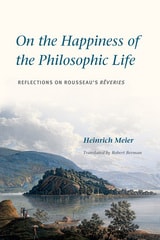
On the Happiness of the Philosophic Life
Reflections on Rousseau's "Rêveries" in Two BooksHeinrich Meier
University of Chicago Press, 2016
On the Happiness of the Philosophic Life presents Heinrich Meier’s confrontation with Rousseau’s Rêveries, the philosopher’s most beautiful and daring work, as well as his last and least understood. Bringing to bear more than thirty years of study of Rousseau, Meier unfolds his stunningly original interpretation in two parts.
The first part of On the Happiness of the Philosophic Life approaches the Rêveries not as another autobiographical text in the tradition of the Confessions and the Dialogues, but as a reflection on the philosophic life and the distinctive happiness it provides. The second turns to a detailed analysis of a work referred to in the Rêveries, the “Profession of Faith of the Savoyard Vicar,” which triggered Rousseau’s political persecution when it was originally published as part of Émile. In his examination of this most controversial of Rousseau’s writings, which aims to lay the foundations for a successful nonphilosophic life, Meier brings to light the differences between natural religion as expressed by the Vicar and Rousseau’s natural theology. Together, the two reciprocally illuminating parts of this study provide an indispensable guide to Rousseau and to the understanding of the nature of the philosophic life.
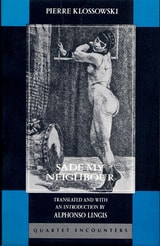
Sade My Neighbor
Pierre Klossowski
Northwestern University Press, 1991
Klossowski was one of the first philosophers in postwar Europe to ask whether Sade's reason, although aberrant and perverted to evil passions, could be taken seriously. Klossowski's seminal work inspired virtually all subsequent study of Sadean thought, including that of de Beauvoir, Deleuze, Derrida, Bataille, Blanchot, Paulhan, and Lacan.

The Natural History of H. G. Wells
John Robert Reed
Ohio University Press, 1982
This new study offers a general reassessment of H. G. Wells as a writer and thinker. It concentrates upon the close relationship between Wells’ developing philosophy and his literary techniques. The early chapters examine Wells’ treatment of such subjects as confinement and escape, sex, the nature of human identity, the relationship of individual to race, human progress, and the importance of education. At the same time, the describe the emotional topography that Wells created as a mean of vivifying his ideas, a topography constructed from image complexes largely based upon the analogy between individual and racial evolution.
The major contribution of the book comes in its later chapters, which deal with Wells’ metaphysical assumptions and his approach to his craft. His views on free will and strength of will were intimately related to his methods of literary composition. The important later chapters detail this relationship, while describing some of Wells’ characteristic literary devices, such as the intentional violations of certain novelistic conventions or the sly borrowing from and alluding to contemporary works of literature in what amounted to a covert polemic.
On the whole, this study argues for a coherent and consistent, though developing, philosophy operating throughout Wells’ career and manifested in experimental literary works which, while not always successful, were consistently inventive and intelligently crafted in the service of Wells’ principle aim, the education of the human species to a command of its own destiny.
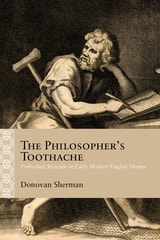
The Philosopher's Toothache
Embodied Stoicism in Early Modern English DramaDonovan Sherman
Northwestern University Press, 2022
Informed by work in both classical philosophy and performance studies, Donovan Sherman argues that Stoicism infused the complex theatrical culture of early modern England. Plays written and performed during this period gave life to Stoic exercises that instructed audiences to cultivate their virtue, self-awareness, and creativity. By foregrounding Stoicism’s embodied nature, Sherman recovers a vital dimension too often lost in reductive portrayals of the Stoics by early modern writers and contemporary scholars alike. The Philosopher’s Toothache features readings of dramatic works by William Shakespeare, Cyril Tourneur, and John Marston alongside considerations of early modern adaptations of classical Stoics (Seneca, Epictetus, and Marcus Aurelius) and Neo-Stoics such as Justus Lipsius. These plays model Stoic virtues like unpredictability, indifference, vulnerability, and dependence—attributes often framed as negative but that can also rekindle a sense of responsible public action.

The Pluralistic Philosophy of Stephen Crane
Patrick K. Dooley
University of Illinois Press, 1993
formally trained in the discipline of philosophical inquiry. Dooley shows how
Crane's philosophical pluralism, which represents his response to the acute moral
uncertainties resulting from the decline of late nineteenth-century religious
authority, allies him with the contextualism of such contemporary philosophers
as William James, C. S. Peirce, and Josiah Royce."
-- James B. Colvert, author of Stephen Crane
The Senses of Walden
An Expanded EditionStanley Cavell
University of Chicago Press, 1992
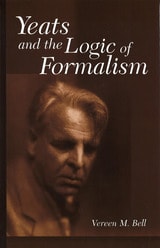
Yeats and the Logic of Formalism
Vereen M. Bell
University of Missouri Press, 2006