Results by title

3 books match the query 'Philosophy in motion pictures'
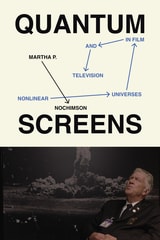
cover of Quantum Screens: Nonlinear Universes in Film and Television

Quantum Screens

Nonlinear Universes in Film and Television

Martha P. Nochimson

University of Texas Press, 2026

An exploration of how nonlinear storytelling opens a post-Newtonian reality and changes both the hero’s journey and how we understand history in film and television.

Begin at the beginning and keep going until the end. That’s the cardinal rule of conventional storytelling. But ever since the modernists of the early twentieth century, popular narratives have occasionally eschewed this linear approach to temporality. It’s as though our stories, formerly unfolding in the stable, predictable universe of Newtonian physics, can now take place in multidimensional time where anything and anyone can be as incalculable as Schrödinger’s cat.

Quantum Screens is a journey through the past and present of nonlinear time in film and television. Moving beyond the early experiments of Luis Buñuel and the first nonlinear commercial films, such as 2001: A Space Odyssey, Martha Nochimson shows how risk-taking auteurs David Lynch, Damon Lindelof, and Terrence Malik have opened new horizons and a new concept of beauty in storytelling through their revelatory creations. Quantum Screens takes us deep into the audience’s experience of nonlinearity, exploring the emotional dislocations such storytelling creates, using television programs such as Twin Peaks, Westworld, and Watchmen, and films including The Tree of Life, BlacKkKlansman, and Arrival. Indeed, viewers are at the heart of a changing aesthetics of nonlinearity, Nochimson argues. Amid innovations like on-demand viewing, unlimited replay, and binge-watching, the experience of real time is more malleable than ever, and creators are responding by structuring their stories in compelling new ways.
[more]
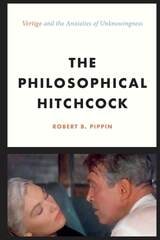
cover of The Philosophical Hitchcock: “Vertigo” and the Anxieties of Unknowingness

The Philosophical Hitchcock

“Vertigo” and the Anxieties of Unknowingness

Robert B. Pippin

University of Chicago Press, 2017

On the surface, The Philosophical Hitchcock: Vertigo and the Anxieties of Unknowingness, is a close reading of Alfred Hitchcock’s 1958 masterpiece Vertigo. This, however, is a book by Robert B. Pippin, one of our most penetrating and creative philosophers, and so it is also much more. Even as he provides detailed readings of each scene in the film, and its story of obsession and fantasy, Pippin reflects more broadly on the modern world depicted in Hitchcock’s films. Hitchcock’s characters, Pippin shows us, repeatedly face problems and dangers rooted in our general failure to understand others—or even ourselves—very well, or to make effective use of what little we do understand. Vertigo, with its impersonations, deceptions, and fantasies, embodies a general, common struggle for mutual understanding in the late modern social world of ever more complex dependencies. By treating this problem through a filmed fictional narrative, rather than discursively, Pippin argues, Hitchcock is able to help us see the systematic and deep mutual misunderstanding and self-deceit that we are subject to when we try to establish the knowledge necessary for love, trust, and commitment, and what it might be to live in such a state of unknowingness.
 
A bold, brilliant exploration of one of the most admired works of cinema, The Philosophical Hitchcock will lead philosophers and cinephiles alike to a new appreciation of Vertigo and its meanings.
 
[more]
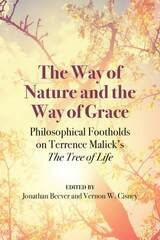
cover of The Way of Nature and the Way of Grace: Philosophical Footholds on Terrence Malick's "The Tree of Life"

The Way of Nature and the Way of Grace

Philosophical Footholds on Terrence Malick's "The Tree of Life"

Jonathan Beever and Vernon W. Cisney

Northwestern University Press, 2016

Amid all the controversy, criticism, and celebration of Terrence Malick's award-winning film The Tree of Life, what do we really understand of it? The Way of Nature and the Way of Grace thoughtfully engages the philosophical riches of life, culture, time, and the sacred through Malick's film. This innovative collection traverses the relationships among ontological, moral, scientific, and spiritual perspectives on the world, demonstrating how phenomenological work can be done in and through the cinematic medium, and attempting to bridge the gap between narrow "theoretical" works on film and their broader cultural and philosophical significance. Exploring Malick's film as a philosophical engagement, this readable and insightful collection presents an excellent resource for film specialists, philosophers of film, and film lovers alike.
[more]