Results by title
7 books match the query 'Philosophy of nature in literature'
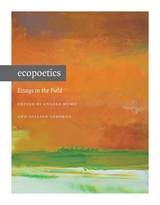
Ecopoetics
Essays in the FieldAngela Hume and Gillian Osborne
University of Iowa Press, 2018
Ecopoetics: Essays in the Field makes a formidable intervention into the emerging field of ecopoetics. The volume’s essays model new and provocative methods for reading twentieth and twenty-first century ecological poetry and poetics, drawing on the insights of ecocriticism, contemporary philosophy, gender and sexuality studies, black studies, Native studies, critical race theory, and disability studies, among others.
Contributors offer readings of a diverse range of poets, few of whom have previously been read as nature writers—from midcentury Beat poet Michael McClure, Objectivist poet George Oppen, and African American poets Melvin Tolson and Robert Hayden; to contemporary writers such as Diné poet Sherwin Bitsui, hybrid/ collage poets Claudia Rankine and Evelyn Reilly, emerging QPOC poet Xandria Phillips, and members of the Olimpias disability culture artists’ collective. While addressing preconceptions about the categories of nature writing and ecopoetics, contributors explore, challenge, and reimagine concepts that have been central to environmental discourse, from apocalypse and embodiment to toxicity and sustainability.
This collection of essays makes the compelling argument that ecopoetics should be read as “coextensive with post-1945 poetry and poetics,” rather than as a subgenre or movement within it. It is essential reading for any student or scholar working on contemporary literature or in the environmental humanities today.
Contributors: Joshua Bennett, Rob Halpern, Matt Hooley, Angela Hume, Lynn Keller, Petra Kuppers, Michelle Niemann, Gillian Osborne, Samia Rahimtoola, Joan Retallack, Joshua Schuster, Jonathan Skinner.
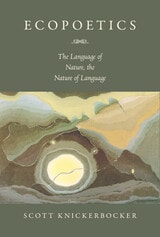
Ecopoetics
The Language of Nature, the Nature of LanguageScott Knickerbocker
University of Massachusetts Press, 2012
Ecopoetics probes the complex relationship between artifice and the natural world in the work of modern American poets—in particular Wallace Stevens, Elizabeth Bishop, Richard Wilbur, and Sylvia Plath. These poets relate to nature as a deep wellspring of meaning, although they all avoid using language the way most nature writers do, merely to reflect or refer directly to the world. Each of these poets, in his or her own distinct way, employs instead what Knickerbocker terms sensuous poesis, the process of rematerializing language through sound effects and other formal devices as a sophisticated response to nonhuman nature.
Rather than attempt to erase the artifice of their own poems, to make them seem more natural and thus supposedly closer to nature, the poets in this book unapologetically embrace artifice—not for its own sake but in order to perform and enact the natural world. Indeed, for them, artifice is natural. In examining their work, Knickerbocker charts a new direction for ecocriticism.
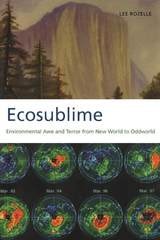
Ecosublime
Environmental Awe and Terror from New World to OddworldLee Rozelle
University of Alabama Press, 2006
Explores 19th-century, modern, postmodern, and millennial texts as they portray the changing ecological face of America
Lee Rozelle probes the metaphor of environmental catastrophe in American literature of the last 150 years. In each instance, Rozelle finds evidence that the ecosublime--nature experienced as an instance of wonder and fear--profoundly reflects spiritual and political responses to the natural world, America’s increasingly anti-ecological trajectory, and the ascendance of a post-natural landscape.
In the 19th century, Rozelle argues, Isabella Bird and Edgar Allan Poe represented the western wilderness as culturally constructed and idealized landscapes. Gardens, forests, and frontiers are conceptual frameworks that either misrepresent or uphold ecological space. Modernists like Nathanael West and William Carlos Williams, on the other hand, portray urban space as either wastelands or mythical urban gardens. A chapter on Charles W. Chesnutt and Rebecca Harding Davis analyzes a new breed of literary eco-advocate, educating and shocking mainstream readers through depictions of ecological disaster. A later chapter probes the writings of Edward Abbey and the Unabomber Manifesto to delve into the sublime dimensions of environmental activism, monkey-wrenching, and eco-terrorism.
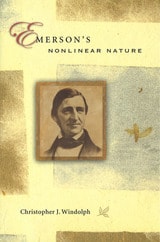
Emerson's Nonlinear Nature
Christopher J. Windolph
University of Missouri Press, 2007
In this provocative study, Christopher Windolph analyzes Emersonian naturalism from the standpoint of nonlinearity, offering new ways of reading and thinking about Emerson’s stance toward naturalism and the influence of science on his thought. Drawing on ideas in perspective theory, architecture, and nonlinear dynamics to argue that Emerson’s natural philosophy follows from his analysis of the development of organic forms, Windolph breaks new ground in Emerson studies by exploring how considerations of shape and the act of seeing underpin all of Emerson’s theories about nature.
Bringing to his study a focused attention to the history of Western science and philosophy, Windolph reexamines Emerson’s understanding of how the act of seeing occurs and of the eye’s ability to see through appearances to organizing principles, showing how Emerson’s naturalism extends beyond the narrow confines of traditional linear science. Through extensive readings of Emerson’s journals, essays, and lectures, Windolph shows that Emerson was an empirical idealist who integrated a scientific approach to nature with an exploration of nonlinear principles, revealing him to be more prescient in his writings about certain recent developments in scientific thought than has been realized.
This work makes a major contribution to the ongoing study of Emerson and science, expanding Emerson’s role as a major American philosopher while rebutting those who see him primarily as a rhetorician or poetic propagandist. Emerson’s Nonlinear Nature opens new ways of thinking about Emerson’s work in its nineteenth-century contexts, reassesses his reception in twentieth-century criticism, and makes a strong case for his continuing relevance in the century ahead.
Greening The Lyre
Environmental Poetics And EthicsDavid W. Gilcrest
University of Nevada Press, 2002
This work covers important and neglected ground—environmental language theory. Gilcrest poses two overarching questions: To what extent does contemporary nature poetry represent a recapitulation of familiar poetics? And, to what extent does contemporary nature poetry engage a poetics that stakes out new territory? He addresses these questions with important thinkers, especially Kenneth Burke, and considers such poets as Frost, Kunitz, Heaney, Ammons, Cardenal, and Rich.
The Meaning of Rivers
Flow and Reflection in American LiteratureT. S. McMillin
University of Iowa Press, 2011
Unnatural Ecopoetics
Unlikely Spaces in Contemporary PoetrySarah Nolan
University of Nevada Press, 2017
By approaching environments in a new way, Nolan closes this gap and recognizes how contemporary poets employ self-reflexive commentary and formal experimentation in order to create new natural/cultural environments on the page. She proposes a radical new direction for ecopoetics and deploys it in relation to four major American poets. Working from literal to textual spaces through the contemporary poetry of A.R. Ammons’s Garbage, Lyn Hejinian’s My Life, Susan Howe’s The Midnight, and Kenneth Goldsmith’s Seven American Deaths and Disasters, the book presents applications of unnatural ecopoetics in poetic environments, ones that do not engage with traditional ideas of nature and would otherwise remain outside the scope of ecocritical and ecopoetic studies.
Nolan proposes a new practical approach for reading poetic language. Ecocriticism is a very fluid and evolving discipline, and Nolan’s pioneering new book pushes the boundaries of second-wave ecopoetics—the fundamental issue being what is nature/natural, and how does poetic language, particularly self-conscious contemporary poetic agency, contribute to and complicate that question.