Results by title
5 books match the query 'Phoenix (Ariz.)'
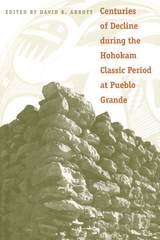
Centuries of Decline during the Hohokam Classic Period at Pueblo Grande
Edited by David R. Abbott
University of Arizona Press, 2003
In the prehispanic Southwest, Pueblo Grande was the site of the largest platform mound in the Phoenix basin and the most politically prominent village in the region. It has long been held to represent the apex of Hohokam culture that designates the Classic period.
New data from major excavations in Phoenix, however, suggest that little was "classic" about the Classic period at Pueblo Grande. These findings challenge views of Hohokam society that prevailed for most of the twentieth century, suggesting that for Pueblo Grande it was a time of decline rather than prosperity, a time marked by overpopulation, environmental degradation, resource shortage, poor health, and social disintegration. During this period, the Hohokam in the lower Salt River Valley began a precipitous slide toward the eventual abandonment of a homeland that they had occupied for more than one thousand years.
This volume is a long-awaited summary of one of the most important data-recovery projects in Southwest archaeology, synthesizing thousands of pages of data and text published in seven volumes of contract reports. The authors—all leading authorities in Hohokam archaeology who played primary roles in this revolution of understanding—here craft a compelling argument for the eventual collapse of Hohokam society in the late fourteenth century as seen from one of the largest and seemingly most influential irrigation communities along the lower Salt River.
Drawing on extremely large and well-preserved collections, the book reveals startling evidence of a society in decline as reflected in catchment analysis, archaeofaunal assemblage composition, skeletal studies, burial assemblages, artifact exchange, and ceramic production. The volume also includes a valuable new summary of the archival reconstruction of the architectural sequence for the Pueblo Grande platform mound.
With its wealth of data, interpretation, and synthesis, Centuries of Decline represents a milestone in our understanding of Hohokam culture. It is a key reference for Southwest archaeologists who seek to understand the Hohokam collapse and a benchmark for anyone interested in the prehistory of Arizona.
[more]
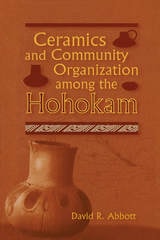
Ceramics and Community Organization among the Hohokam
David R. Abbott
University of Arizona Press, 2000
Among desert farmers of the prehistoric Southwest, irrigation played a crucial role in the development of social complexity. This innovative study examines the changing relationship between irrigation and community organization among the Hohokam and shows through ceramic data how that dynamic relationship influenced sociopolitical development.
David Abbott contends that reconstructions of Hohokam social patterns based solely on settlement pattern data provide limited insight into prehistoric social relationships. By analyzing ceramic exchange patterns, he provides complementary information that challenges existing models of sociopolitical organization among the Hohokam of central Arizona.
Through ceramic analyses from Classic period sites such as Pueblo Grande, Abbott shows that ceramic production sources and exchange networks can be determined from the composition, surface treatment attributes, and size and shape of clay containers. The distribution networks revealed by these analyses provide evidence for community boundaries and the web of social ties within them.
Abbott's meticulous research documents formerly unrecognized horizontal cohesiveness in Hohokam organizational structure and suggests how irrigation was woven into the fabric of their social evolution. By demonstrating the contribution that ceramic research can make toward resolving issues about community organization, this work expands the breadth and depth of pottery studies in the American Southwest.
[more]
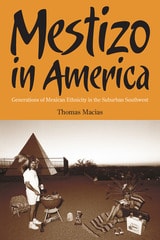
Mestizo in America
Generations of Mexican Ethnicity in the Suburban SouthwestThomas Macias
University of Arizona Press, 2006
How much does ethnicity matter to Mexican Americans today, when many marry outside their culture and some can’t even stomach menudo? This book addresses that question through a unique blend of quantitative data and firsthand interviews with third-plus-generation Mexican Americans. Latinos are being woven into the fabric of American life, to be sure, but in a way quite distinct from ethnic groups that have come from other parts of the world. By focusing on individuals’ feelings regarding acculturation, work experience, and ethnic identity—and incorporating Mexican-Anglo intermarriage statistics—Thomas Macias compares the successes and hardships of Mexican immigrants with those of previous European arrivals. He describes how continual immigration, the growth of the Latino population, and the Chicano Movement have been important factors in shaping the experience of Mexican Americans, and he argues that Mexican American identity is often not merely an “ethnic option” but a necessary response to stereotyping and interactions with Anglo society.Talking with fifty third-plus generation Mexican Americans from Phoenix and San Jose—representative of the seven million nationally with at least one immigrant grandparent—he shows how people utilize such cultural resources as religion, spoken Spanish, and cross-national encounters to reinforce Mexican ethnicity in their daily lives. He then demonstrates that, although social integration for Mexican Americans shares many elements with that of European Americans, forces related to ethnic concentration, social inequality, and identity politics combine to make ethnicity for Mexican Americans more fixed across generations. Enhancing research already available on first- and second-generation Mexican Americans, Macias’s study also complements research done on other third-plus-generation ethnic groups and provides the empirical data needed to understand the commonalities and differences between them. His work plumbs the changing meaning of mestizaje in the Americas over five centuries and has much to teach us about the long-term assimilation and prospects of Mexican-origin people in the United States.
[more]
Minorities in Phoenix
A Profile of Mexican American, Chinese American, and African American Communities, 1860-1992Bradford Luckingham
University of Arizona Press, 1994
Phoenix is the largest city in the Southwest and one of the largest urban centers in the country, yet less has been published about its minority populations than those of other major metropolitan areas. Bradford Luckingham has now written a straightforward narrative history of Mexican Americans, Chinese Americans, and African Americans in Phoenix from the 1860s to the present, tracing their struggles against segregation and discrimination and emphasizing the active roles they have played in shaping their own destinies.
Settled in the mid-nineteenth century by Anglo and Mexican pioneers, Phoenix emerged as an Anglo-dominated society that presented formidable obstacles to minorities seeking access to jobs, education, housing, and public services. It was not until World War II and the subsequent economic boom and civil rights era that opportunities began to open up. Drawing on a variety of sources, from newspaper files to statistical data to oral accounts, Luckingham profiles the general history of each community, revealing the problems it has faced and the progress it has made. His overview of the public life of these three ethnic groups shows not only how they survived, but how they contributed to the evolution of one of America's fastest-growing cities.
Settled in the mid-nineteenth century by Anglo and Mexican pioneers, Phoenix emerged as an Anglo-dominated society that presented formidable obstacles to minorities seeking access to jobs, education, housing, and public services. It was not until World War II and the subsequent economic boom and civil rights era that opportunities began to open up. Drawing on a variety of sources, from newspaper files to statistical data to oral accounts, Luckingham profiles the general history of each community, revealing the problems it has faced and the progress it has made. His overview of the public life of these three ethnic groups shows not only how they survived, but how they contributed to the evolution of one of America's fastest-growing cities.
[more]
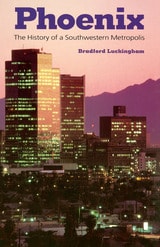
Phoenix
The History of a Southwestern MetropolisBradford Luckingham
University of Arizona Press, 1989
More than half of all Arizonans live in Phoenix, the center of one of the most urbanized states in the nation. This history of the Sunbelt metropolis traces its growth from its founding in 1867 to its present status as one of the ten largest cities in the United States. Drawing on a wide variety of archival materials, oral accounts, promotional literature, and urban historical studies, Bradford Luckingham presents an urban biography of a thriving city that for more than a century has been an oasis of civilization in the desert Southwest. First homesteaded by pioneers bent on seeing a new agricultural empire rise phoenix-like from ancient Hohokam Indian irrigation ditches and farming settlements, Phoenix became an agricultural oasis in the desert during the late 1800s. With the coming of the railroads and the transfer of the territorial capital to Phoenix, local boosters were already proclaiming it the new commercial center of Arizona. As the city also came to be recognized as a health and tourist mecca, thanks to its favorable climate, the concept of "the good life" became the centerpiece of the city's promotional efforts. Luckingham follows these trends through rapid expansion, the Depression, and the postwar boom years, and shows how economic growth and quality of life have come into conflict in recent times.
[more]