Results by title
22 books match the query 'Phonetics & Phonology'

African American English Speakers and Their Participation in Local Sound Changes
A Comparative Study, Volume 84Erik R. Thomas
Duke University Press, 0
An Acoustic Analysis of Vowel Variation in New World English, Volume 76
Erik R. Thomas, ed.
Duke University Press, 0
While the work opens with an introduction on the methods and aims of the study, the following chapter immediately moves to a detailed discussion of distinctive vowel sounds called phonemes, characterizing each variant of sound listed within the cited reference literature. The remaining chapters provide explanatory descriptions of the variants of each dialect, reviewing past research specific to that dialect. While the United States English, Canadian English, and Caribbean varieties are featured in various chapters throughout the work, individual chapters are devoted to African-American, Mexican-American, and Native American English, emphasizing not only ethnic variation but delving into the historical development of each dialect.
This monograph is an essential reference on vowel variation for all sociolinguists, phoneticians, phonologists, creolists, and historical linguists.
Elements of Acoustic Phonetics
Peter Ladefoged
University of Chicago Press, 1995
Like its predecessor, this edition of Elements of Acoustic Phonetics will serve as an invaluable textbook and reference for students and practitioners of linguistics and speech science, and for anyone who wants to understand the physics of speech.

Elements, Government and Licensing
Developments in PhonologyEdited by Florian Breit, Yuko Yoshida, and Connor Youngberg
University College London, 2023
Elements, Government and Licensing covers three principal domains of phonological representation: melody and segmental structure; tone, prosody, and prosodic structure; and phonological relations, empty categories, and vowel-zero alternations. Theoretical topics covered include the formalization of Element Theory, the hotly debated topic of structural recursion in phonology, and the empirical status of government.
In addition, a wealth of new analyses and empirical evidence sheds new light on empty categories in phonology, the analysis of certain consonantal sequences, phonological and non-phonological alternation, the elemental composition of segments, and many more. Taking up long-standing empirical and theoretical issues informed by the Government Phonology and Element Theory, this book provides theoretical advances while also bringing to light new empirical evidence and analysis challenging previous generalizations.
The insights offered here will be equally exciting for phonologists working on related issues inside and outside the Principles and Parameters program, such as researchers working in Optimality Theory or classical rule-based phonology.
Empirical Models of Phonological Networks and Their Growth in English
Eva Maria Luef
Karolinum Press, 2025
Network science has become increasingly popular in the cognitive sciences, including linguistics. Phonological Networks and Their Growth in Second Languages is the first to explore lexical networks in learners of English as a second language with a focus on the relationships between phonological word forms in the mental lexicon. It highlights the contributions that network science can make to the study of lexical organization of second languages.
Within the theoretical framework of evolving networks, lexical learning is seen as a process of network growth. The book models the lexicon as a growing phonological network that increases in size as language users advance through second language proficiency stages. As such, the analysis of specific growth algorithms (such as preferential attachment) accounts for observed mechanisms of lexical acquisition. Empirical models of evolving lexical networks can help shed light on the structural changes occurring as the second language lexicon expands.
Language Files
Materials for an Introduction to Language and Linguistics, 13th EditionThe Ohio State University Department of Linguistics
The Ohio State University Press, 2022
The thirteenth edition has been revised, clarified, and updated throughout to ensure that it remains the most comprehensive and accessible introductory linguistics textbook on the market. The revised chapter on morphology includes a more thorough discussion of allomorphy and adds sections on templatic morphology, suprasegmental morphology, and morphological metathesis to give students a more complete picture of all morphological phenomena. The chapter on language and computers has been updated with new sections on deep learning, artificial neural networks, and on other areas of computational linguistics, providing readers with a better sense of current research and applications in this rapidly developing field. Other additions include new sections on syntactic non-constituents and non-generative rule systems in the syntax chapter and a complete rewrite to the creole languages file in the language contact chapter. We have also adopted the use of the singular they when referring to a generic person whose gender is unknown or irrelevant. Exercises and lists of other readings have been updated throughout.
Metrical Stress Theory
Principles and Case StudiesBruce Hayes
University of Chicago Press, 1994
Hayes incorporates the iambic/trochaic opposition into a general theory of word stress assignment, intended to account for all languages in which stress is assigned on phonological as opposed to morphological principles. His theory addresses particularly problematic areas in metrical work, such as ternary stress and unusual weight distinctions, and he proposes new theoretical accounts of them. Attempting to take more seriously the claim of generative grammar to be an account of linguistic universals, Hayes proposes analyses for the stress patterns of over 150 languages.
Hayes compares his own innovative views with alternatives from the literature, allowing students to gain an overview of the field. Metrical Stress Theory should interest all who seek to understand the role of stress in language.
Perspectives in Phonology
Edited by Jennifer S. Cole and Charles Kisseberth
CSLI, 1997
Phonetic Symbol Guide
Geoffrey K. Pullum and William A. Ladusaw
University of Chicago Press, 1996
This fully revised second edition incorporates the major revisions to the International Phonetic Alphabet made in 1989 and 1993. Also covered are the American tradition of transcription stemming from the anthropological school of Franz Boas; the Bloch/Smith/Trager style of transcription; the symbols used by dialectologists of the English language; usages of specialists such as Slavicists, Indologists, Sinologists, and Africanists; and the transcription proposals found in all major textbooks of phonetics.
With sixty-one new entries, an expanded glossary of phonetic terms, added symbol charts, and a full index, this book will be an indispensable reference guide for students and professionals in linguistics, phonetics, anthropology, philology, modern language study, and speech science.
Phonetics
A Critical Analysis of Phonetic Theory and a Technique for the Practical Description of SoundsKenneth L. Pike
University of Michigan Press, 1943

Phonology as Human Behavior
Theoretical Implications and Clinical ApplicationsYishai Tobin
Duke University Press, 1997
Tobin describes the methodological connection between phonological theory and phonetics by way of a comprehensive and insightful survey of phonology’s controversial role in twentieth-century linguistics. He reviews the work of Saussure, Jakobson, Troubetzkoy, Martinet, Zipf, and Diver, among others, and discusses issues in distributional phonology through analyses of English, Italian, Latin, Hebrew, and Yiddish. Using his theory to explain various functional and pathological speech disorders, Tobin examines a wide range of deviant speech processes in aphasia, the speech of the hearing-impaired, and other syndromes of organic origin. Phonology as Human Behavior provides a unique set of principles connecting the phylogeny, ontogeny, and pathology of sound systems in human language.
Phonology in the Twentieth Century
Theories of Rules and Theories of RepresentationsStephen R. Anderson
University of Chicago Press, 1985

Piros and Prehistory
A Study in TanoanDavid Leedom Shaul
University of Utah Press, 2024
Shaul’s arguments use linguistic analyses coupled with historic and prehistoric records of migration and cultural interaction. Following the establishment of Piro as a Tanoan language, much of the linguistic analysis involves determining the aspects of Piro that were inherited from the earlier Proto-Tanoan versus those that were incorporated later as a result of borrowing from other languages through cultural interaction. This book lays out the linguistic argument that the similarities between Piro and Tiwan languages result from borrowing, not common ancestry, and it provides a record of contact between groups and linguistic evolution based on these movements.
Preliminaries to Linguistic Phonetics
Peter Ladefoged
University of Chicago Press, 1971
Prosodic Phrase in Spoken Czech
Jan Volín, Pavel Šturm, Radek Skarnitzl, and Tomáš Boril
Karolinum Press, 2025
The prosodic phrase is a crucial element in the sound structure of the Czech language, though oft overlooked. The properties of prosodic phrases, such as stress, intonation, and tonal pattern, show typical characteristics of prose. Prosodic Phrase in Spoken Czech provides a source for this missing information in an approachable format for all manner of readers. The core of the study draws on authentic speech material—storytelling, news reading, and poetry recitation—where prosodic phrases are analyzed in terms of their phonetic structure, acoustic characteristics, and associated syntactic features. Supported by the presentation of original perception experiments, this monograph delves into the perceptual significance of prosodic phrasing. Beyond offering intriguing insights into this core aspect of prosodic structure, it serves as a valuable resource for designing future experiments in natural language processing.
Shaping Phonology
Edited by Diane Brentari and Jackson L. Lee
University of Chicago Press, 2018
Divided into two parts, Shaping Phonology first explores the elaboration of abstract domains (or units of analysis) that fall under the purview of phonology. These chapters reveal the increasing multidimensionality of phonological representation through such analytical approaches as autosegmental phonology and feature geometry. The second part looks at how the advent of machine learning and computational technologies has allowed for the analysis of larger and larger phonological data sets, prompting a shift from using key examples to demonstrate that a particular generalization is universal to striving for statistical generalizations across large corpora of relevant data. Now fundamental components of the phonologist’s tool kit, these two shifts have inspired a rethinking of just what it means to do linguistics.

Studies in General Linguistics and Language Structure
N.S. Trubetzkoy
Duke University Press, 2001
Translated by Marvin Taylor and Anatoly Liberman
N. S. Trubetzkoy (1890–1939) is generally celebrated today as the creator of the science of phonology. While his monumental Grundzüge der Phonologie was published posthumously and contains a summary of Trubetzkoy’s late views on the linguistic function of speech sounds, there has, until now, been no practical way to trace the development of his thought or to clarify the conclusions appearing in that later work. With the publication of Studies in General Linguistics and Language Structure, not only will linguists have that opportunity, but a collection of Trubetzkoy’s work will appear in English for the first time.
Translated from the French, German, and Russian originals, these articles and letters present Trubetzkoy’s work in general and on Indo-European linguistics. The correspondence reprinted here, also for the first time in English, is between Trubetzkoy and Roman Jakobson. The resulting collection offers a view of the evolution of Trubetzkoy’s ideas on phonology, the logic in laws of linguistic geography and relative chronology, and the breadth of his involvement with Caucasian phonology and the Finno-Ugric languages.
A valuable resource, this volume will make Trubetzkoy’s work available to a larger audience as it sheds light on problems that remain at the center of contemporary linguistics.
The Geometry of Visual Phonology
Linda Ann N. Uyechi
CSLI, 1996

The Indo-European Dialects
Antoine Meillet
University of Alabama Press, 1967
The Indo‑European Dialects is a foundational work of historical linguistics that investigates how the Indo‑European language family diversified into its major regional branches. Originally delivered as lectures and first published in the early twentieth century, the book remains essential reading for understanding how phonological, morphological, and lexical evidence reveals ancient patterns of language contact, migration, and cultural development. Including Indo‑European, Indo‑Iranian, Greek, Italic (including Latin), Celtic, Germanic, Baltic, Slavic, Armenian, Albanian, Anatolian, and Tocharian, Meillet’s comparative approach situates dialect differences within a broader historical framework, making this volume a lasting contribution to Indo‑European studies and to the methods of linguistic reconstruction more generally.
The author, Antoine Meillet, was one of the most influential linguists of the twentieth century and a central figure in the development of Indo‑European comparative grammar. This edition is expertly translated by Samuel N. Rosenberg, whose careful scholarship preserves Meillet’s analytical precision while making the work accessible to modern English‑language readers. The volume is further enhanced by scholarly notes, bibliographical references, and indexes that increase its usefulness for research and teaching.
This book will be of interest to linguists, philologists, classicists, and historians of language, as well as graduate and advanced undergraduate students studying historical linguistics. It will also appeal to readers interested in how language evidence informs the study of prehistoric societies and cultural connections across Europe and Asia.
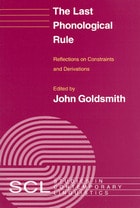
The Last Phonological Rule
Reflections on Constraints and DerivationsEdited by John A. Goldsmith
University of Chicago Press, 1993
In this provocative book, leading linguists and computer scientists consider the challenges that computational innovations pose to current rule-based phonological theories and speculate about the advantages of phonological models based on artificial neural networks and other computer designs. The authors offer new conceptions of phonological theory for the 1990s, the most radical of which proposes that phonological processes cannot be characterized by rules at all, but arise from the dynamics of a system of phonological representations in a high-dimensional vector space of the sort that a neural network embodies. This new view of phonology is becoming increasingly attractive to linguists and others in the cognitive sciences because it answers some difficult questions about learning while drawing on recent results in philosophy, psychology, artificial intelligence, and neuroscience.
The contributors are John A. Goldsmith, Larry M. Hyman, George Lakoff, K. P. Mohanan, David S. Touretzky, and Deirdre W. Wheeler.
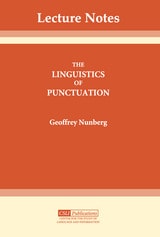
The Linguistics of Punctuation
Geoffrey Nunberg
CSLI, 1990

What Makes Sound Patterns Expressive?
The Poetic Mode of Speech PerceptionReuven Tsur
Duke University Press, 1992
Research in recent decades has established two distinct types of aural perception: a nonspeech mode, in which the acoustic signals are received in the manner of musical sounds or natural noises; and a speech mode, in which acoustic signals are excluded from awareness and only an abstract phonetic category is perceived. Here, Tsur proposes a third type of speech perception, a poetic mode in which some part of the acoustic signal becomes accessible, however faintly, to consciousness.
Using Roman Jakobson’s model of childhood acquisition of the phonological system, Tsur shows how the nonreferential babbling sounds made by infants form a basis for aesthetic valuation of language. He tests the intersubjective and intercultural validity of various spatial and tactile metaphors for certain sounds. Illustrating his insights with reference to particular literary texts, Tsur considers the relative merits of cognitive and psychoanalytic approaches to the emotional symbolism of speech sounds.